
In this story
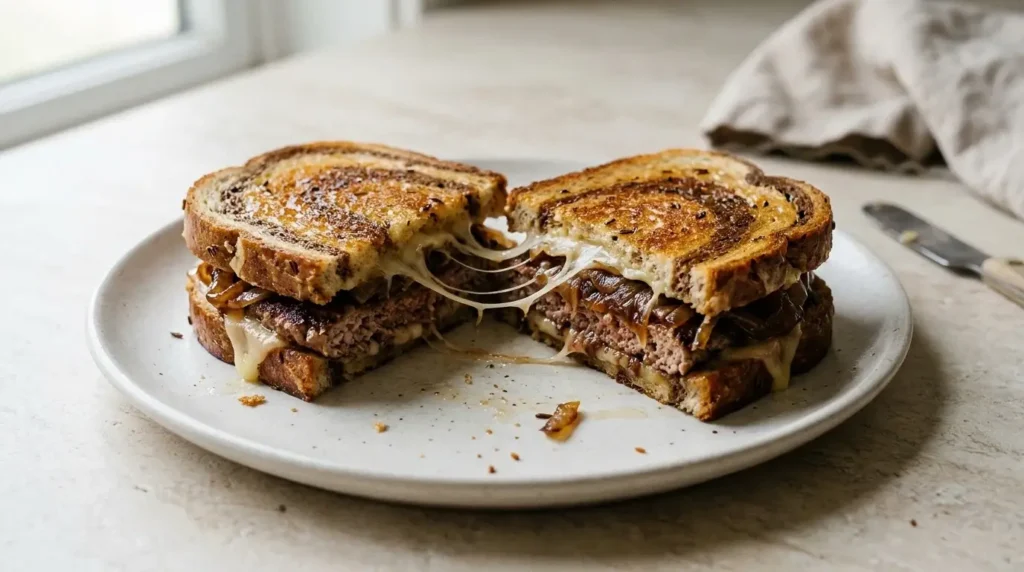
The patty melt is a griddled sandwich of ground beef, melted cheese and onions cooked down until sweet, pressed between two slices of buttered bread instead of a bun. The Daily Meal describes it as a hot sandwich of beef, cheese and caramelized onions on sliced bread, and that description holds across nearly every source consulted. Its history is far less settled, and the credit usually given to a Los Angeles restaurateur named Tiny Naylor comes with a date range of almost three decades.
The sandwich sits between two better-known categories. It is built like a cheeseburger and finished like a grilled cheese, which is why food writers keep arguing over which family it belongs to.
Video: How to Make Classic Diner-Style Patty Melts, America’s Test Kitchen
Tiny Naylor and the Los Angeles claim
The name that appears most often is Tiny Naylor, a Los Angeles restaurateur. Saveur reports that fast-food lore gives him credit for the patty melt sometime in the 1940s or 1950s, and that his son Biff places the rye-bread version after Tiny moved to Los Angeles following World War II. The Daily Meal is more specific about the menu: patty melt historians usually point to his diner, Tiny Naylor’s, which sold the sandwich in the 1950s.
That is where the agreement ends. The same Daily Meal article says Naylor may have come up with it earlier, during the Great Depression. The Nibble goes further, passing along a line from Eater Los Angeles that the sandwich was created “possibly in 1932” by William “Tiny” Naylor, and adding that other sources place it in the 1940s while others range from 1930 to 1959. The Eater LA piece itself could not be fetched for this article, so the 1932 date rests on The Nibble’s account of it.
A menu date versus an invention date
The sources are less far apart than the range suggests. The 1950s date attaches to the menu at Tiny Naylor’s, a documented place where the sandwich was sold. The earlier dates attach to the question of who first put the pieces together, and none of the fetched sources supplies a dated record for 1932 or for the 1940s. Tasting Table takes the simple route and states that the sandwich was invented in the 1950s, while InsideHook says only that Naylor put a sandwich of sliced bread, ground beef, cheese and grilled onions on his drive-in menu in that decade. It also notes that sliced bread was first produced in Missouri in 1928, which sets the earliest plausible starting point for any sandwich of this kind.
Other restaurants named
Naylor is not the only name in circulation. Writing about his own recipe, pastry chef David Lebovitz relays a reader’s comment from his Facebook page that “Norms in Southern California invented the Patty Melt.” He does not verify it, and no other fetched source repeats the claim, so it stands as an unconfirmed assertion about a Southern California restaurant.
The same page carries a different kind of evidence. A commenter, Ellen Schultz, recalls meeting the patty melt in Los Angeles in the 1980s, when every cafe and diner served one, and then not finding it on New York diner menus after moving back east. That is a personal memory rather than a record, but it fits the picture of a sandwich that spread through Southern California first.
No source consulted for this article names a New York, Midwestern or European inventor.
Patty melt versus a cheeseburger
The simplest difference is the bread. A cheeseburger arrives on a bun, while a patty melt uses sliced bread, usually rye, toasted or griddled in butter. Tasting Table adds that the beef is often formed into a square or oblong shape to match the slices, and that the patty melt stays simple where a burger can carry a long list of toppings.
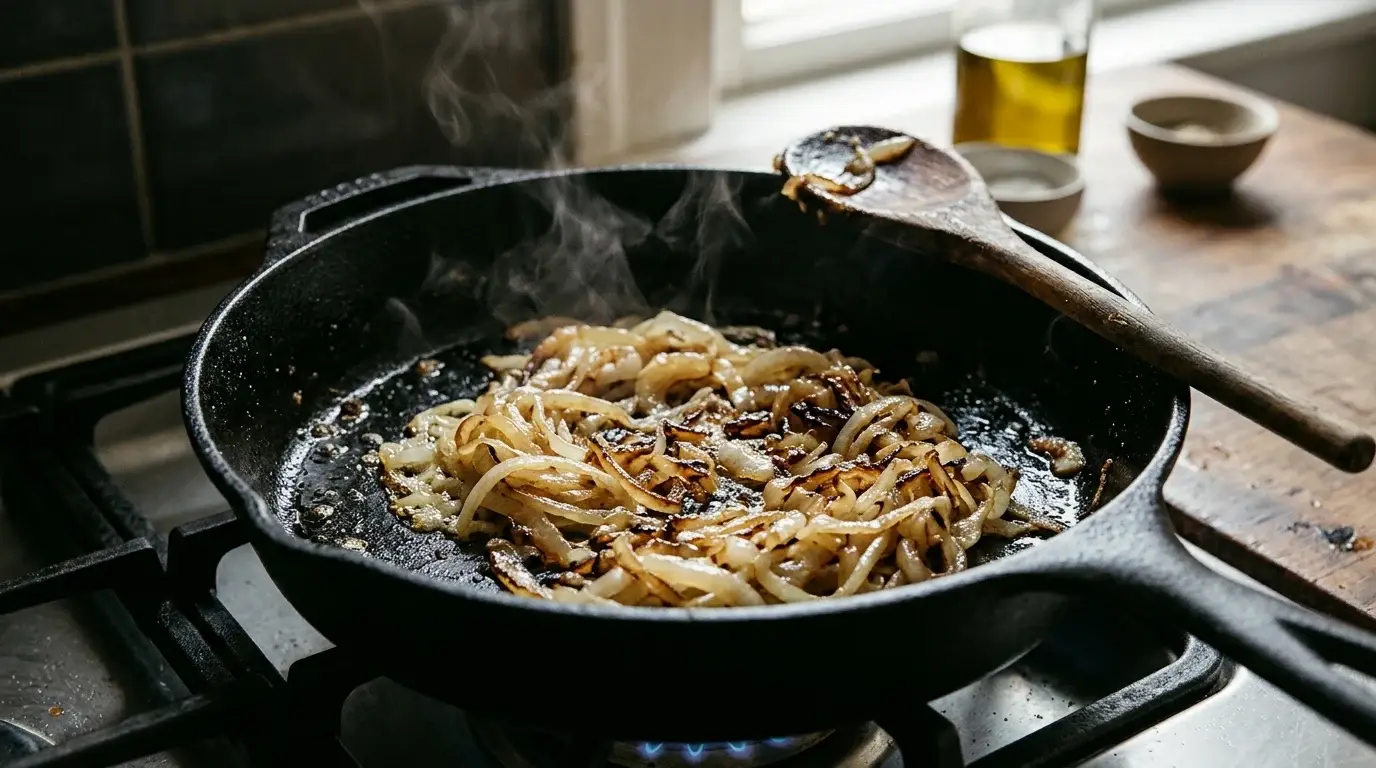
Onions are the second marker. A patty melt expects them cooked slowly until soft and brown, a point made by Cooksense and The Daily Meal alike, and Saveur adds that purists skip condiments entirely.
The third difference is how the sandwich is cooked. The Daily Meal defines a burger as a freshly cooked patty between buns. A patty melt is assembled and then cooked again in butter on a griddle or skillet, which, in Saveur’s account, lets cheese on both sides of the patty bind it to the onions.
Patty melt versus a grilled cheese
Strip out the beef and what remains is close to a grilled cheese: buttered bread, melted cheese, a hot pan. The Daily Meal calls the patty melt a middle ground between a cheeseburger and a grilled cheese, since a grilled cheese holds only melted cheese. InsideHook compresses the idea into a phrase, calling it “a grilled cheese with a burger inside.”
Classification remains open. Some writers treat the patty melt as a cheeseburger variant served on sliced bread, and others as a grilled cheese variant carrying a patty and fried onions. Tasting Table notes that it looks so much like a grilled cheese that whether it counts as a sandwich at all is left to the reader.
The usual build
Most sources agree on the parts and quarrel only over the details.
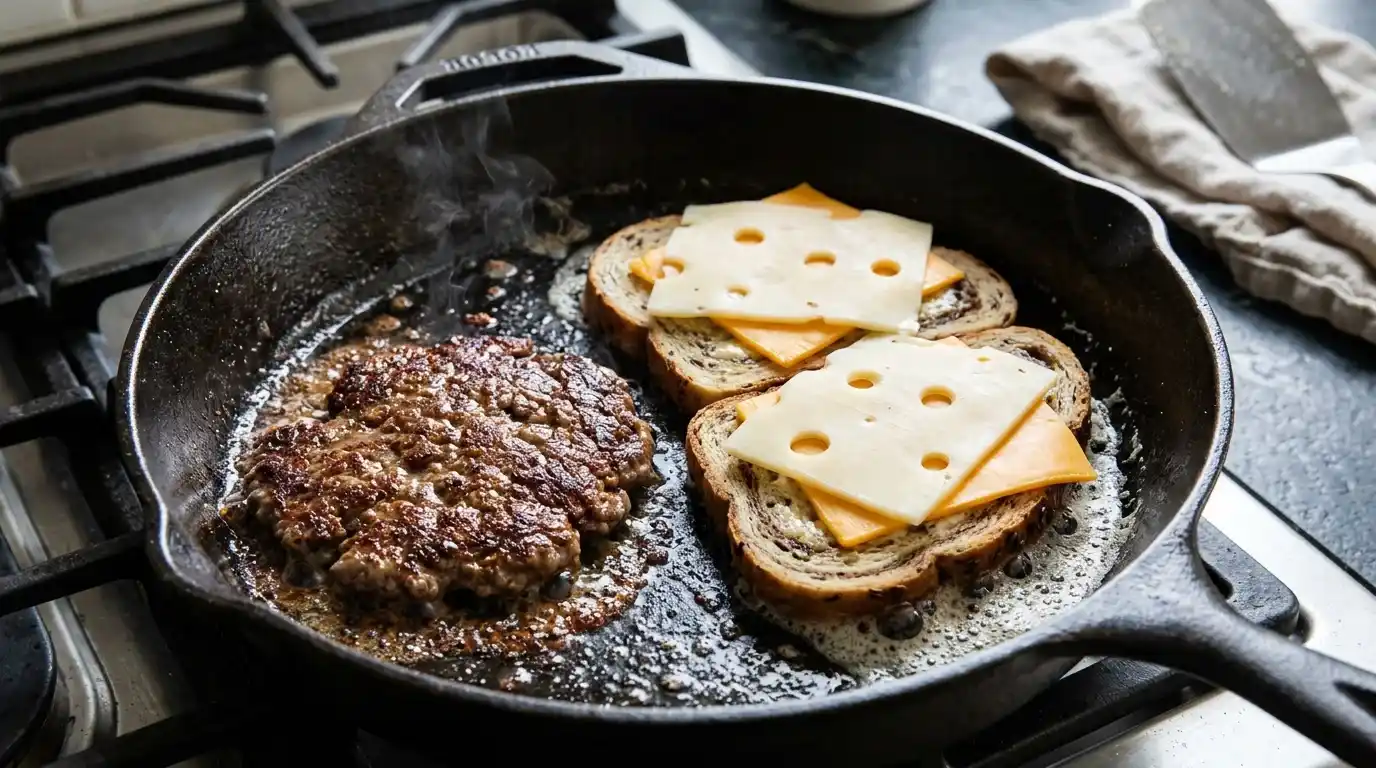
- Bread: griddled rye. The Daily Meal says purists insist on rye but that sourdough and other breads still count, and The Nibble lists sourdough, Texas toast and brioche as occasional substitutes.
- Cheese: Swiss for purists, according to The Daily Meal. Tasting Table gives American as the classic choice instead, with cheddar, Swiss and provolone as alternatives. Saveur recommends thin, meltable cheddar, Swiss or American.
- Onions: thinly sliced and cooked until soft and deep gold.
- Beef: a thin patty shaped to the bread.
The split over cheese is the clearest example of a disagreement that cannot be settled by looking up a date. The sources that name a classic version simply name different ones. The America’s Test Kitchen recipe below uses both at once.
Cooking it: three tested methods
America’s Test Kitchen
The diner-style patty melts recipe serves four from one pound of 80 percent lean ground beef, with eight slices of seeded rye, eight slices of deli Swiss and four slices of deli American. The rye is lightly toasted first, which keeps it sturdy enough to crisp rather than turn soggy. Each portion of beef is pressed into a very thin oval, no more than a quarter inch thick and slightly larger than the bread.
The patties are seared in a 12-inch cast-iron skillet over medium-high heat for 60 to 90 seconds per side, then set on toasts already layered with Swiss and American. Onions go into the same skillet with water and are covered for 8 to 10 minutes, then uncovered for 5 to 7 minutes, then cooked another 5 to 7 minutes with a mixture of ketchup, cider vinegar, brown sugar and Worcestershire sauce until browned. The assembled sandwiches cook covered in butter over medium heat, 3 to 5 minutes on the first side and about 3 minutes on the second, and rest in a 200 degree oven while the rest are finished.
Saveur
Saveur’s method puts the time into the onions instead, caramelizing sliced yellow onions in cast iron for 20 to 25 minutes. The patties are thin, about a quarter inch, seasoned on both sides and seared over high heat for roughly 2 to 4 minutes total, slightly undercooked because they finish inside the sandwich. Thin deli-style rye is buttered edge to edge on both sides, cheese goes on both sides of the patty, and the sandwich spends 3 to 4 minutes per side in cast iron over medium heat.
David Lebovitz
Lebovitz keeps the onions to about 15 minutes in butter and fries about 350 grams of seasoned beef as two oval patties, stopping a little short of the usual doneness. The sandwiches are pressed firmly as they griddle, and the pan is covered if the cheese is slow to melt.
The three methods share a pattern: cook the patty and the onions separately, keep the patty slightly underdone, and finish everything together in butter.
Variations
Not every cook accepts rye. InsideHook describes chef Craig Koketsu’s version, which uses sourdough Pullman instead of rye, toasted on both sides, with American cheese and onions warmed in barbecue sauce. It is stacked with three layers of bread in the manner of a club sandwich. Lebovitz’s commenters mention sauerkraut in place of fried onions, one from the Fairfax district of West Hollywood and another from Reno, who also uses pepper Jack.
Pete Wells of The New York Times, as summarized on Wikipedia, calls the patty melt almost unknown outside the United States, partly because it asks for a lot of flattop space to cook the onions, patty and bread at once. The original article could not be fetched, so that point is a pointer only.
Sources:
- The Daily Meal, “What’s The Difference Between A Burger And A Patty Melt?”: https://www.thedailymeal.com/1439496/burger-patty-melt-difference-explained
- Saveur, “Deconstructing the Perfect Patty Melt”: https://www.saveur.com/deconstructing-perfect-patty-melt/
- The Nibble, “It’s National Patty Melt Day: What’s A Patty Melt?”: https://blog.thenibble.com/2022/02/07/its-national-patty-melt-day-whats-a-patty-melt/
- Tasting Table, “Is There A Difference Between A Patty Melt And A Burger?”: https://www.tastingtable.com/1229833/is-there-a-difference-between-a-patty-melt-and-a-burger/
- InsideHook, patty melt article: https://www.insidehook.com/?p=455384
- David Lebovitz, patty melt recipe: https://www.davidlebovitz.com/patty-melt-burger-hamburger-recipe/
- America’s Test Kitchen, Diner-Style Patty Melts: https://www.americastestkitchen.com/recipes/14928-diner-style-patty-melts?extcode=NSAKI26FB
- Cooksense, “patty melt”: https://cooksense.org/patty-melt
- Wikipedia, “Patty melt” (pointer only): https://en.wikipedia.org/wiki/Patty_melt