In this story
Provolone is a pasta filata cheese, made by heating curd and stretching it into a smooth, pliable mass before it is shaped, brined and hung to age. Its name is the augmentative of provola, a smaller, pear-shaped stretched-curd cheese: Cheese Atlas explains that provolone means a large-sized provola. Two quite different products now share the name. One is Provolone Valpadana, a protected Italian cheese with a written specification, and the other is the American-made provolone sold sliced in delis, governed by a federal standard of identity.
Video: Lidia on How Provolone Cheese is Made! | Lidia Bastianich
The pasta filata method
Pasta filata translates as “spun paste.” Writing in TBR News Media, wine and food columnist Bob Lipinski describes the process as heating the curd in hot whey, then kneading or spinning it into long threads until it forms a soft ball that can be molded. The federal definition is close to that. The Code of Federal Regulations calls provolone a pasta filata or stretched curd-type cheese and lists the steps: dairy ingredients are warmed and cultured, coagulated and cut, and the curd is drained, kneaded and stretched in hot water, molded, firmed in cold water, salted in brine, dried and cured further.
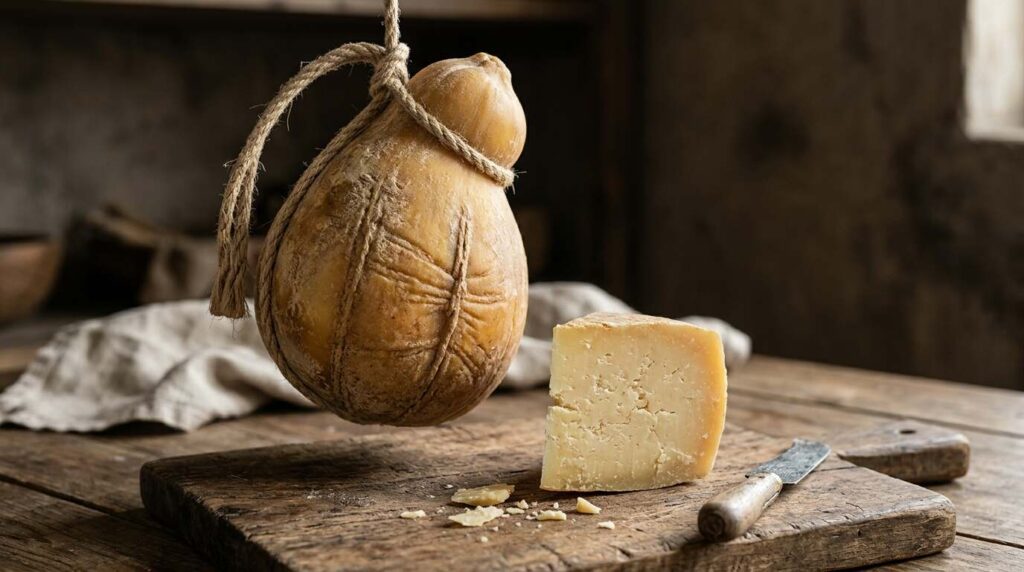
Mozzarella shares the first half of that sequence. Wisconsin Cheese notes that both belong to the pasta filata family but that they use different starter cultures, and the difference in what happens next is larger. Mozzarella is typically eaten fresh, while provolone is salted and aged for anywhere from two weeks to several months, often hung in a rope-tied teardrop shape. That hanging gave the cheese its look. A column from the Door County Pulse says provolone originally was bound in a bag and hung from the ceiling of aging rooms, and the shapes still sold today include sausage, bottle and large-pear forms with a knob on top for the string, according to Wisconsin Cheese’s provolone page.
From the south of Italy to the Po Valley
Sources agree that provolone began in the south and that the version now protected by name was developed in the north, though they tell the middle of the story with different details. A Google Arts & Culture account of Provolone Valpadana says the cheese emerged by combining southern spun-curd traditions with Po Valley dairy practice. The southern provale cheeses date to the Middle Ages, in that telling, but were small, aged and smoked, limited by scarce local milk. Italian unification in 1861 then let southern entrepreneurs settle in the Po Valley.
Two cheesemaking brothers appear in the northern chapter. The Provolone Valpadana document published on the ONAF site, says the word provolone first appears in 1871, when the Margiotta brothers, southern cheesemakers, moved north and began making stretched-curd cheeses. The Google Arts & Culture account adds that in 1870 the brothers ran a factory in the Brescia plains that made very large provole, and that the word first appeared in print in 1871 in an agricultural vocabulary. The year the brothers started is therefore given as 1870 by one source and 1871 by the other, while the printed-word date is the same in both.
Cheese Atlas offers a different, monastic origin, crediting Cistercian monks working between the Lambro and Adda rivers who reclaimed surface waters for farming, which allowed dairy cattle and cheesemaking to develop. The Arts & Culture account also places the cheese’s creation between those rivers after the monks’ work, so the two accounts overlap on the land and differ on the cheesemakers.
Brand history adds a commercial thread. Auricchio’s company history dates the first production of its provolone to 1877 in San Giuseppe Vesuviano, in Campania, and says the cheese reached the United States in the early 1900s through Italian stores in Little Italy. The Arts & Culture account says Gennaro Auricchio moved to Cremona in the early 1900s and became the largest producer there. The company’s own page, by contrast, places the growth of Po Valley production and the modern plant near Cremona in the late 1970s.
What the Valpadana specification requires
The protected cheese is defined tightly. According to the ONAF document, Provolone Valpadana is made from whole cow’s milk, raw, pasteurized or thermized, that must not be used after 60 hours from milking. The production zone covers the full provinces of Cremona, Brescia, Verona, Vicenza, Rovigo, Padua and Piacenza, plus listed municipalities in Bergamo, Mantua, Lodi and Trento. The Arts & Culture account reports that the European Union granted protected designation of origin status on 21 June 1996, and that the word Valpadana was added to the name in 1993.
Rennet separates the two styles. Per the ONAF specification, the sweet style, dolce, uses calf rennet, which may include lamb or kid rennet, while the piquant style, piccante, uses kid or lamb rennet, alone or together. Cheese Atlas describes the piccante difference only as goat rennet added to the milk, a simpler statement than the specification’s wording.
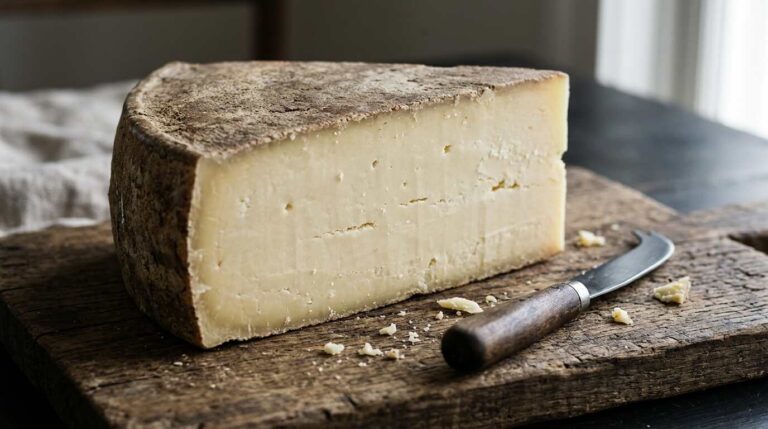
Aging depends on weight in the specification: at least 10 days up to 6 kilograms, at least 30 days above 6, at least 90 above 15, and at least 8 months above 30. The same document sets labels by age. Dolce is not aged beyond roughly two to three months, piccante is aged more than three months, and the long-aged piccante stagionato, more than eight months, is branded P.V.S. with a hot iron. Cheese Atlas says the stagionato can mature past 12 months. Weights range from about half a kilogram to over 100, and the rind is described as thin, glossy and golden, not edible, sometimes coated in paraffin.
American-made provolone
Imported provolone comes mainly from southern Italy, Lipinski writes, and the domestic version is mostly made in Wisconsin. Wisconsin Cheese calls the state one of the leading producers of both mozzarella and provolone and says Italian immigrants brought cheesemaking knowledge there more than a century ago. Lipinski adds that Auricchio’s Errico Auricchio moved the family to Wisconsin in 1979, drawn by its milk supply.
The American product is regulated by a federal standard of identity, 21 CFR 133.181, not by a regional specification. As summarized from the Cornell Legal Information Institute copy of the regulation, provolone must contain at least 45 percent milkfat on a solids basis and no more than 45 percent moisture. Dairy ingredients may be milk, nonfat milk or cream, and clotting enzymes may be rennet or other enzymes of animal, plant or microbial origin. Unpasteurized dairy ingredients require curing at no less than 35 degrees Fahrenheit for at least 60 days. Smoking is optional, and the label must say “Smoked” or “Not smoked” beside the name. The standard permits a shape name such as “salami provolone.”
None of that resembles the Italian rules. The federal text contains no production-area limit, no 60-hour milk window and no named style such as dolce or piccante, as far as the summary reproduces. The Door County Pulse column adds that Wisconsin cheesemakers make both smoked and unsmoked versions, and that the traditional slight smokiness came from the wood fires in Italian curing rooms. Lipinski lists a smoked style, affumicato, that is smoked for one week and then aged two months. The eCFR copy of the regulation could not be fetched for this post, so the Cornell copy is cited and the current official text should be checked before it is relied on.
Dolce and piccante
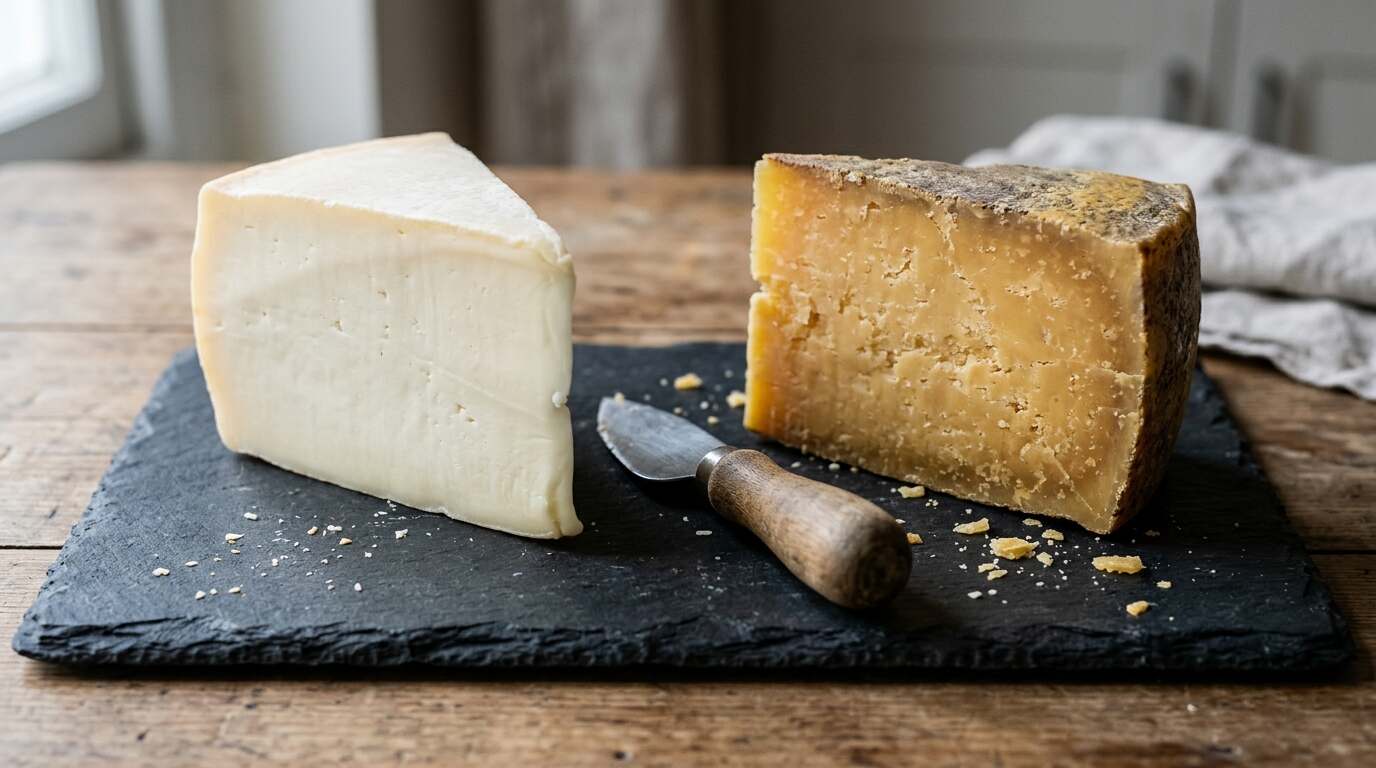
The sweet and sharp styles differ mainly in age, and sources set the boundaries differently. Wisconsin Cheese puts dolce at two to three months and piccante at four months or longer, and describes the cheese overall as clean, buttery and slightly smoky. Lipinski calls dolce mild and delicate and piccante sharp and slightly salty. In the Arts & Culture description, sweet Valpadana has a delicate flavor, a soft texture and small holes, and the piquant style has a stronger flavor and a slightly flaky texture.
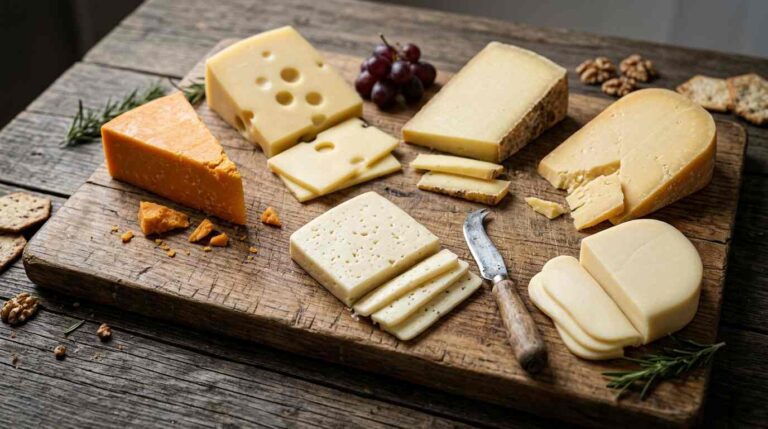
Uses split along the same line. Cheese Atlas recommends dolce for cooking and names it for melting in a grilled cheese or eating fresh in a Philly hoagie. Piccante suits a cheese board, and the long-aged stagionato is crumbly, earthy and sharper, suitable to eat alone or to grate over pasta. Lipinski likewise says hard, aged provolone is good for grating. The same Cheese Atlas page suggests fontina as a substitute with a texture close to piccante, and mozzarella as a milder one.
How provolone melts
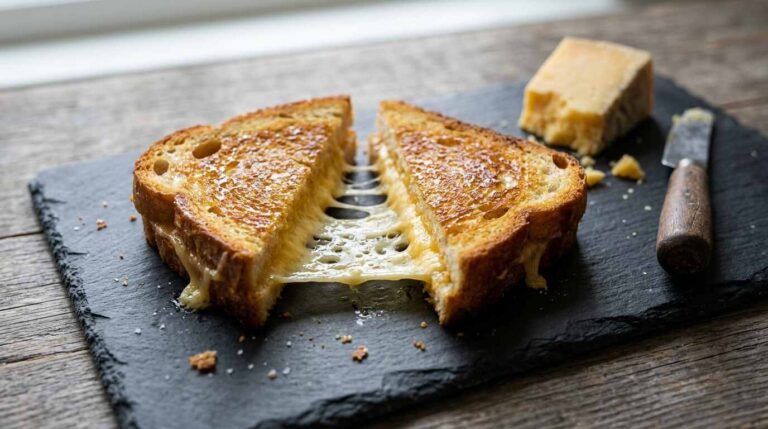
Wisconsin Cheese gives the most direct description. Provolone melts smoothly and cohesively but without mozzarella’s stretch, the article says, holds its shape longer under heat and browns well. Mozzarella supplies stretch and a gooey texture. Cheese Professor calls provolone another top-notch Italian melting cheese.
Age matters, according to the same Cheese Professor article. Werlin, a source quoted in the article, says “For the most part, you want higher moisture cheeses for that ultimate melt quality,” and the article adds that aged cheeses are drier and generally melt less well than young ones. Applied to provolone, that reasoning points toward a young cheese, which matches Cheese Atlas’s advice to cook with dolce. The sources do not test the point on provolone directly, so it stays an inference from general melting principles.
Wisconsin Cheese also describes a common pairing. Provolone and mozzarella are often combined on pizzas and hot sandwiches, with mozzarella supplying the melt and provolone adding depth. How well provolone suits a grilled cheese sandwich, compared with other cheeses, is covered in the post on the best cheese for grilled cheese.
Cheesesteaks and Italian subs
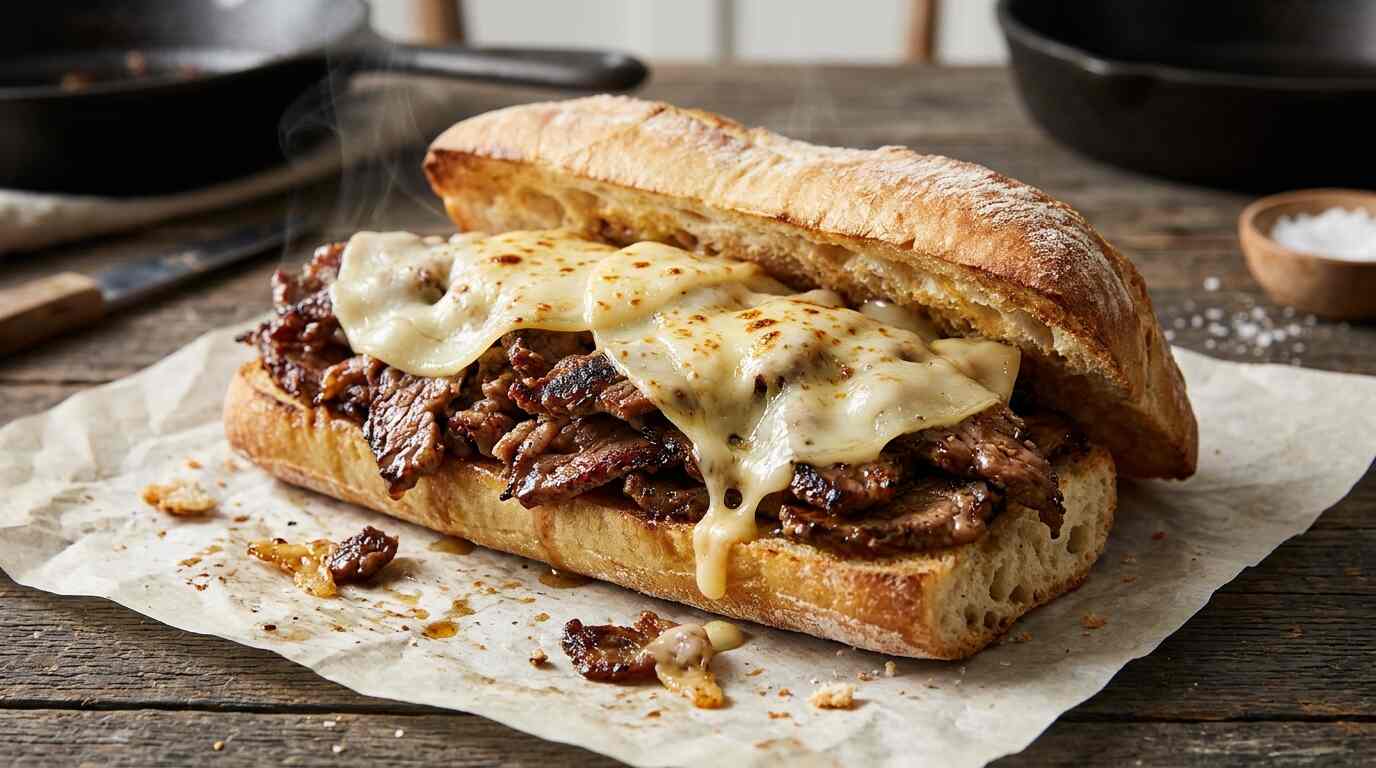
Wisconsin Cheese lists provolone’s typical sandwich uses as Philly cheesesteaks and Italian subs, along with burgers and paninis. On a cheesesteak it competes with American cheese and Cheez Whiz. Visit Philadelphia’s primer treats Whiz as the usual choice and says American and mild or sharp provolone are common substitutions.
The Philadelphia Inquirer’s 2008 survey of steak shops gives the provolone argument from the people selling it. Joey Vento of Geno’s said the shop always recommended provolone: “That’s the real cheese,” though he acknowledged that most customers ordered Whiz. Pat’s owner Frank Olivieri Jr. said the original debate had been between American and sharp provolone. Critic Craig LaBan, in the same article, wrote that provolone is for aficionados. At an Atlantic City sub shop, the article reports, provolone was far and away the top seller and Whiz was not offered. Where the cheese first went onto the sandwich, and who put it there, is a disputed story covered in the post on the Philly cheesesteak.
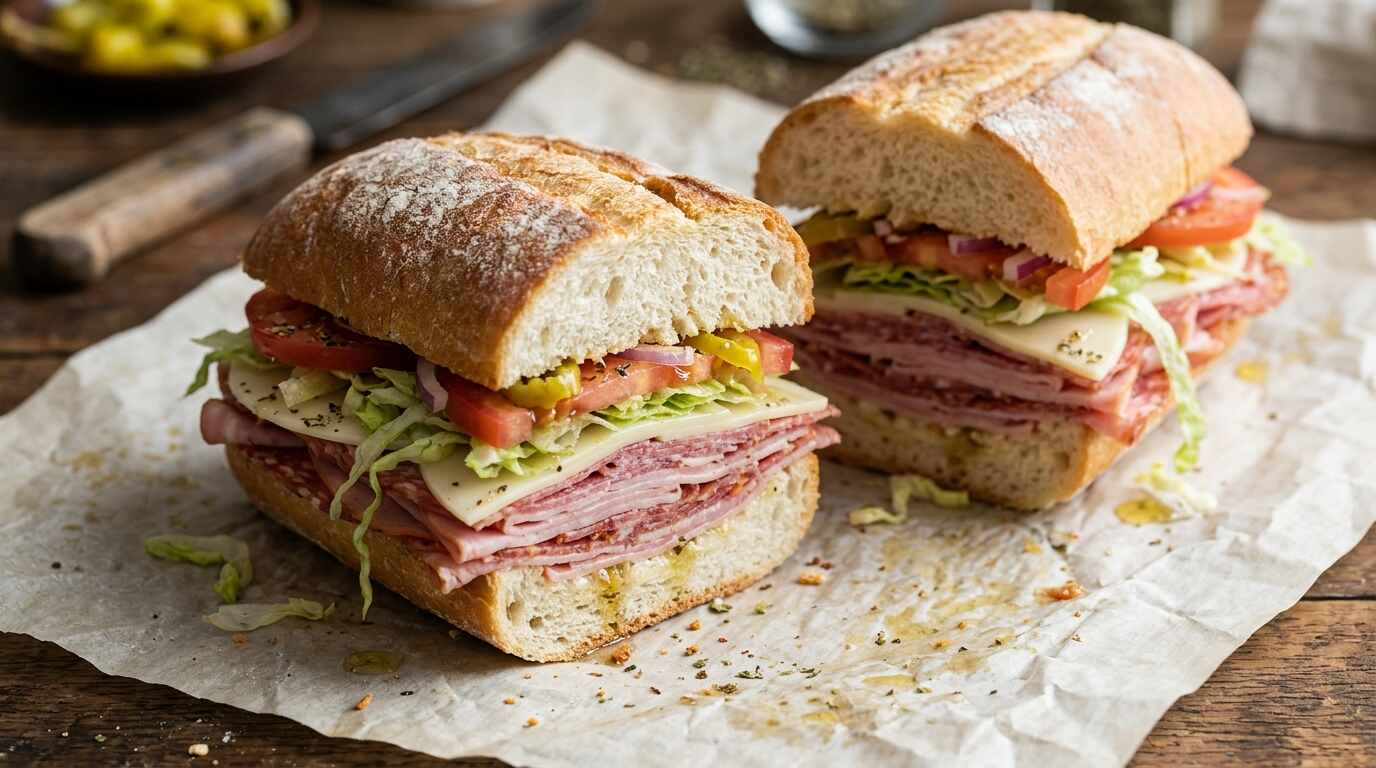
The Italian sub or hoagie is provolone’s other fixture. Cheese Atlas calls provolone the most common choice for a Philly hoagie, though some versions use American or Swiss. Its own recipe layers four slices of provolone dolce with Genoa salami, boiled ham and capicola, plus lettuce, tomato, red onion and peperoncini, with olive oil on the bread. The sandwich’s names, which vary by city, are the subject of the post on hoagies, subs, heroes and grinders.
Sources:
- Cheese Atlas, “Provolone Valpadana”: https://thecheeseatlas.com/cheese-profiles/provolone-valpadana/
- Cheese Atlas, “Perfect Philly Provolone Hoagie”: https://thecheeseatlas.com/recipes/perfect-philly-provolone-hoagie/
- Google Arts & Culture, “Provolone Valpadana”: https://artsandculture.google.com/story/VgVxg7hIxQEA8A
- ONAF, “Provolone Valpadana” (production specification summary, in Italian): https://www.onaf.it/uploads/public/19983_provolone-valpadana.pdf
- Auricchio, company history (in Italian): https://www.auricchio.it/wp-content/uploads/2022/11/Auricchio_StoriaW.pdf
- Cornell Legal Information Institute, 21 CFR 133.181, Provolone cheese: https://www.law.cornell.edu/cfr/text/21/133.181
- Wisconsin Cheese, “Provolone vs. Mozzarella: The Story Behind Their Differences”: https://wisconsincheese.com/the-cheese-life/article/251/provolone-vs-mozzarella-the-story-behind-their-differences
- Wisconsin Cheese, “Provolone”: https://www.wisconsincheese.com/about-cheese/provolone
- TBR News Media, Bob Lipinski, “The Wine Connoisseur: Provolone cheese – Italy’s gift to the world”: https://tbrnewsmedia.com/?p=151224
- Door County Pulse, “The Cheese Insider”: https://doorcountypulse.com/the-cheese-insider-18/
- Cheese Professor, “The 10 Best Melting Cheeses”: https://www.cheeseprofessor.com/blog/the-10-best-melting-cheeses
- The Philadelphia Inquirer, “Whiz on a cheesesteak: Hit or myth?”: https://www.inquirer.com/philly/food/20080523_Whiz_on_a_cheesesteak__Hit_or_myth_.html
- Visit Philadelphia, “Cheesesteak 101”: https://www.visitphilly.com/media-center/press-releases/cheesesteak-101-a-primer-on-the-who-what-where-whiz-of-philly-cheesesteaks/
- Lidia Bastianich (YouTube), “Lidia on How Provolone Cheese is Made!”: https://www.youtube.com/watch?v=hWrP3MxmmDQ