In this story
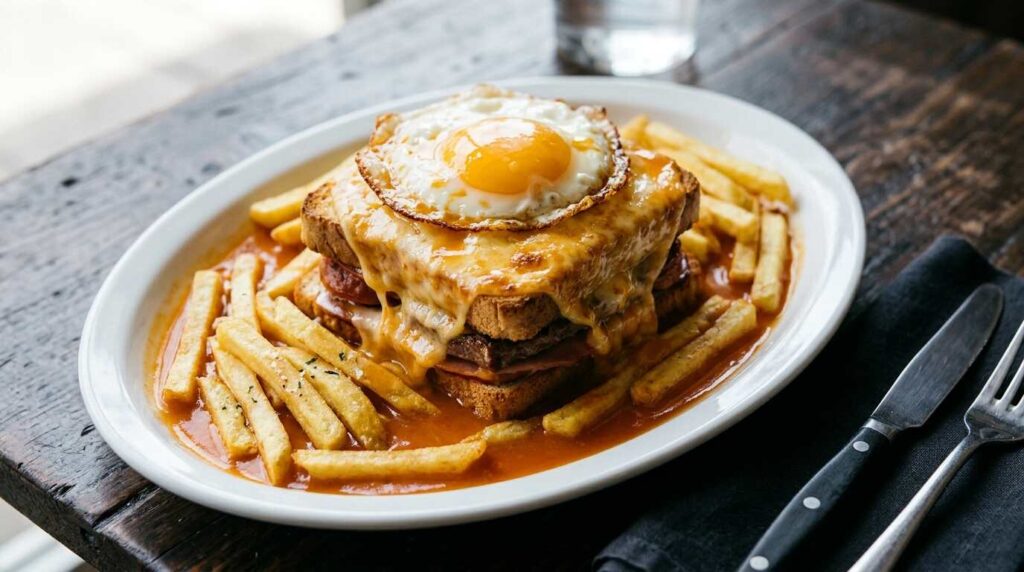
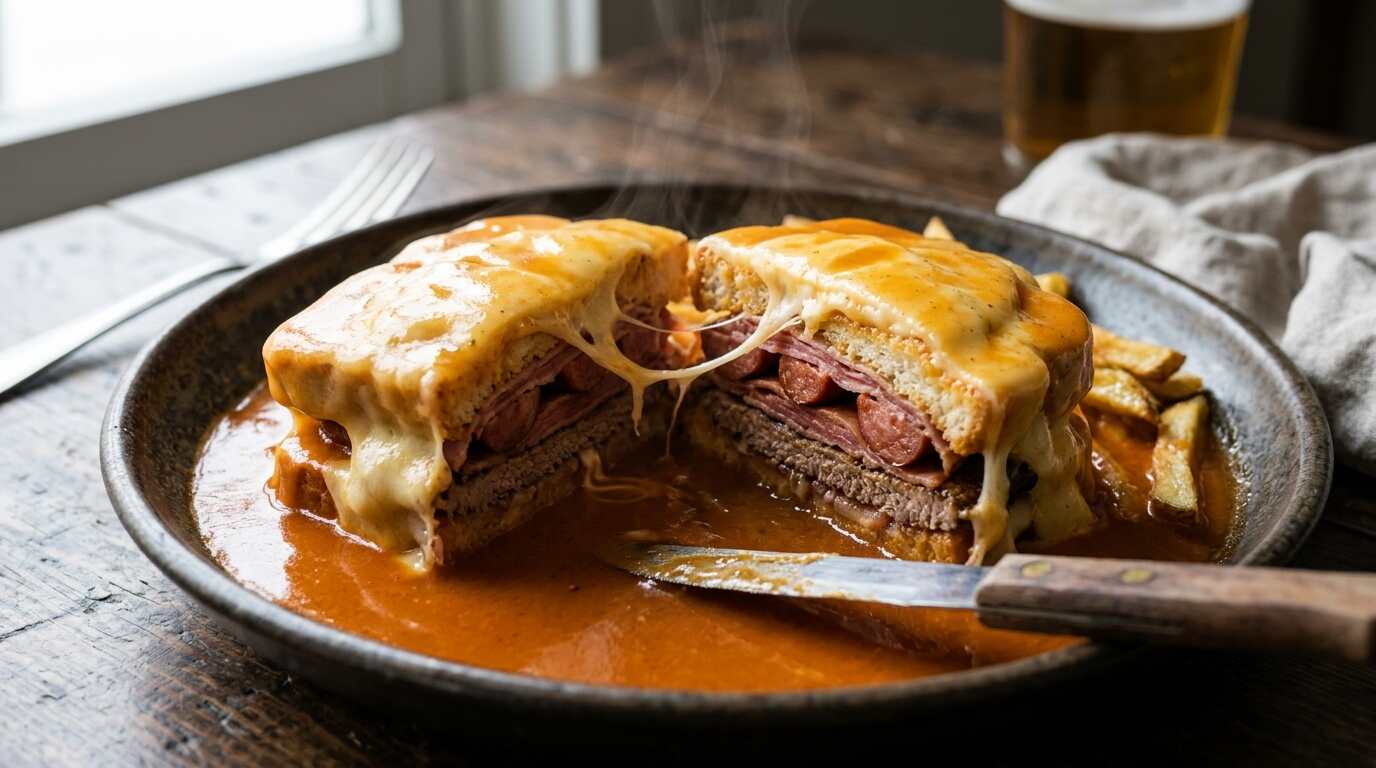
The francesinha is a knife-and-fork sandwich from Porto, Portugal: bread, ham, sausage and steak under a blanket of melted cheese, drowned in a spiced tomato-and-beer sauce. Most accounts trace it to a single restaurant, A Regaleira on Rua do Bonjardim, and to a single man, Daniel da Silva, who had spent time abroad. Portugal.com dates the first one to 1953 and says he was “allegedly inspired by the French dish Croque Monsieur.” The details around that story (the year, the country he returned from, whether he owned the restaurant) change from one source to the next.
Video: Portugal’s Most Iconic Sandwich Is Smothered In Cheese And Sauce | Legendary Eats, Insider Food
Daniel da Silva and A Regaleira
A Regaleira has its own record. Portugal’s government heritage site for historic shops, Comércio com História, says the restaurant was founded in 1934 at Rua do Bonjardim 85-87. António Augusto Gomes Gonçalves Passos bought it in the following years, and his grandsons Francisco and Tiago run it now.
The same page gives the creator’s full name as Daniel David da Silva, also called Daniel Silva. In the 1950s, Passos met him in a French hotel, where he worked as a barman, and invited him to come work at the restaurant. A few years later he became a partner. He made the first francesinha behind the counter, according to the page, and the restaurant says it still serves the sandwich from the original recipe.
That recipe was smaller than the sandwich known today. Comércio com História describes a small roll of soft wheat bread called biju, filled with roast beef and smoked meat, with a secret hot sauce. Portugal.com agrees that the early version was “much simpler than the one seen today.”
The restaurant has not stayed put. Building works closed it in 2019, and it reopened in July 2021 at number 83 on the same street. A newspaper report in Sábado notes that it came back after more than two years of uncertainty and still serves the sandwich as Daniel David da Silva made it in 1952. Most of that article sits behind a paywall, so nothing beyond the visible lines is relied on here.
The year, the country and the owner
Sábado says 1952. Portugal.com, Chowhound and Tasting Table say 1953. The Portuguese daily Observador, in a 2018 piece on how the sandwich got its name, places the invention at Regaleira around 1952. Postal.pt, a Portuguese news site, writes “around 1953”. Neither year is documented in anything fetched for this post.
The country is equally loose. Observador says Silva had lived in Belgium and worked in restaurants there. Comércio com História puts him in a French hotel. Paste Magazine calls him a Belgian and French emigrant. Londonist says the story is “the most consensual” one and involves a returned emigrant from France and Belgium.
His role at the restaurant is reported two ways. The government heritage page has him arriving as an employee and becoming a partner. Observador says Daniel David de Silva owned the Regaleira, near Rua Sá da Bandeira, and that his croque-monsieur-style idea at first did not catch on locally. Even his surname varies: “da Silva” in Londonist and Paste, “Silva” in Portugal.com and Chowhound, “de Silva” in Observador.
The Observador account rests on one witness. A regular named Júlio Couto, who was 83 when he spoke to the paper, remembered being among the friends who first tasted it. The article does not back the date or the anecdote with a second source, and it reports no rival claim to the invention.
How the sandwich got its name
Francesinha means “little French girl” or “little French woman.” Two explanations circulate, and they conflict.
In the Observador telling, Couto asked Silva what the new dish would be called. Silva had no answer, so Couto suggested it himself: “Porque não chamar-lhe francesinha?” (“Why not call it francesinha?”). Couto tied the name to French women, whom he associated with the dish’s spicy, appealing character. The article presents that as his personal recollection.
Postal.pt gives a legend that credits Silva himself, quoting him as saying “A mulher mais picante que conheço é a francesa!”, roughly “the spiciest woman known to him is the French one.” Paste Magazine adds two more versions: that locals could not pronounce “croque monsieur,” and that Silva named it for a French girlfriend he considered “strong and spicy like no other woman in the world.”
Paste also reports that some people believe the sandwich arrived with French troops during the Napoleonic wars. No other fetched source mentions the idea, and none offers evidence for it.
The croque monsieur claim
Nearly every account links the francesinha to the French croque monsieur, but the strength of the claim varies. Portugal.com hedges with “allegedly.” Comércio com História states that Silva was inspired by the croque monsieur without qualification. Saveur calls the origins “murky” while still tying the sandwich to the French original, and Portugal.com gives no documentation for the Silva story at all.
A second, broader version of the claim removes the single inventor. Kevin Gould’s Guardian piece, syndicated by inkl, says that under Salazar’s dictatorship many Portuguese emigrated in the 1950s and 60s, and that they brought back the croque monsieur, which was reworked into a much larger sandwich. Taste Porto makes the same point about emigrants without naming anyone.
What the francesinha kept from the French sandwich is the hot, cheese-covered ham sandwich. What it added is meat, sauce and size. Chowhound describes the croque monsieur as a hot ham-and-cheese sandwich with béchamel and calls the francesinha much heavier. Londonist calls the Portuguese version “a middle finger — a middle finger dripping in bechamel, mind — in the face of French cuisine.” The French sandwich has its own disputed history, laid out in the croque monsieur post.
Another sauce-covered, knife-and-fork sandwich with a documented creator is the Hot Brown, an open-faced turkey, bacon and Mornay sauce dish that the Brown Hotel in Louisville credits to chef Fred Schmidt in the 1920s. The sandwich and its contested details are covered in the Hot Brown post. The two have no documented connection.
An egg changes the comparison. Paste notes that a fried egg on top makes the francesinha technically a croque madame, and The Takeout’s recipe writer calls it “a Portuguese croque madame.”
What goes between the bread
No single list of fillings holds across Porto. Tasting Table names beef steak, fiambre (cooked ham) and linguiça sausage, sometimes with bacon, between toasted bread and cheese, and says a runny-yolk fried egg sits on top. Chowhound lists ham, sliced sausages and steak under melted cheese. Paste adds mortadella to the layers.
Taste Porto’s step-by-step recipe builds the sandwich in an oven-safe dish: toasted bread, ham and baloney, linguiça and a fresh sausage side by side, rump steak, a second slice of bread, then cheese on top, broiled until it melts. The cheese in that recipe is Flamengo, a semi-soft cow’s milk cheese, with provolone suggested as a substitute. Postal.pt’s traditional version calls for four small beef steaks, ham, two fresh linguiças and two fresh sausages across four slices of sandwich bread, with eight slices of cheese.
The bread in the earliest accounts differs from the bread in recipes. Observador notes that the original used pão bijou rather than sliced sandwich bread, and roast meat rather than steak. Saveur says the bread varies between toasted sandwich bread and thick country loaf.
The sandwich is eaten with cutlery and usually arrives with fries. The Guardian piece reported a price of around €6.50, with two-for-one deals at many bars and cafes during happy hour, and summed up the sandwich with the line “Health food it’s not.”
The sauce
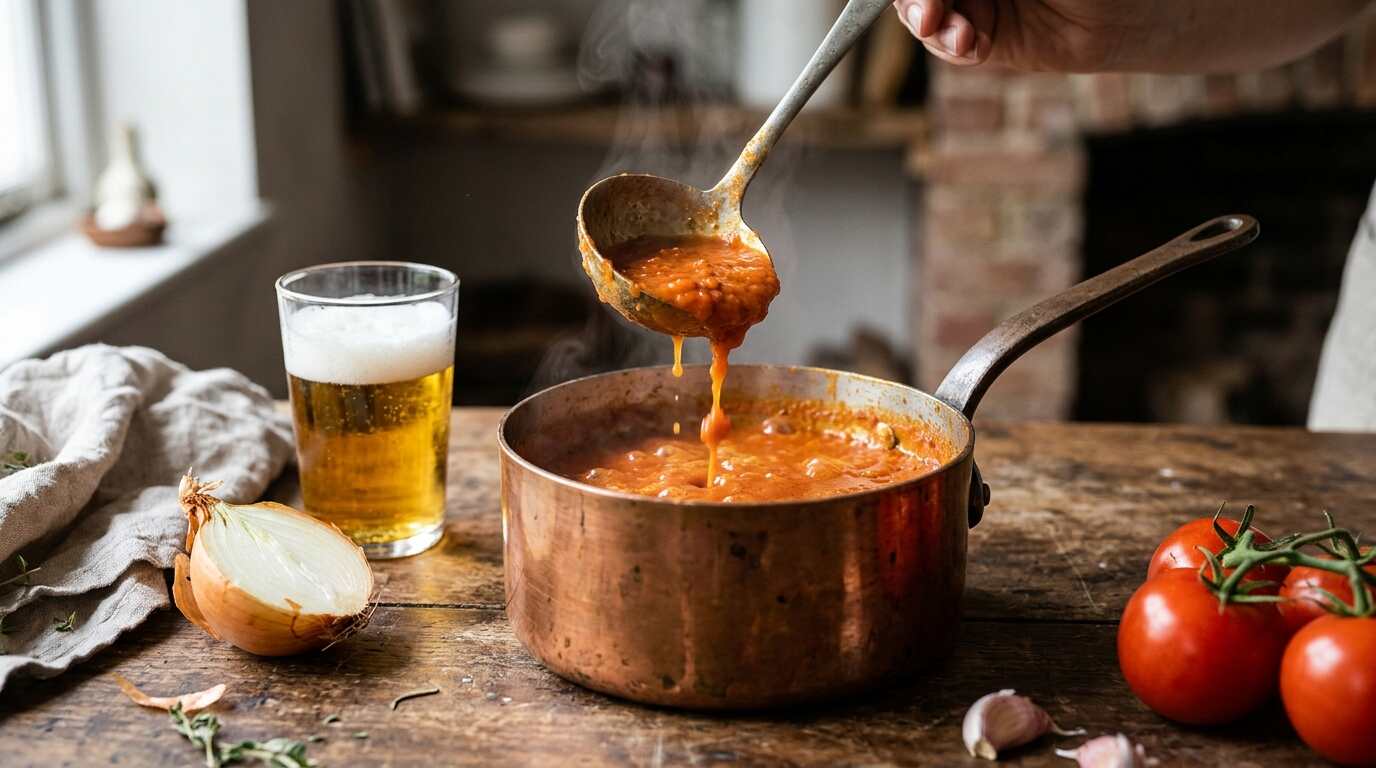
The sauce is where the recipes split. Paste Magazine calls the recipes closely guarded and says they vary by restaurant. Chowhound describes tomato paste, wine or beer, and often chili peppers, with some restaurants using meat stock or Port. Portugal.com says the beer-and-tomato sauce was not part of the original and was added in later decades, which fits Observador’s description of the first one as an orange sauce with no recipe given.
Specific recipes show how far apart they are. Tasting Table’s sauce starts with lard, olive oil, garlic, bay leaf, onion and canned tomatoes, then adds beef stock, Port, light beer, Worcestershire sauce and piri-piri. Postal.pt’s uses 4 deciliters of beer, half a deciliter each of brandy and Port, tomato, Worcestershire sauce, mustard, piri-piri, paprika and cornflour to thicken. Taste Porto’s blends sauteed onion with white wine, ketchup, tomato paste, oxtail soup mix, whiskey and tawny Port, then adds two 250-milliliter pilsners and a milk-and-flour mixture.
The serving method is the one constant. Taste Porto calls for at least two ladles over the sandwich and the rest in a gravy boat on the side, and Tasting Table notes that the hot sauce poured over the top is what finishes melting the cheese.
Spread, variants and a famous visitor
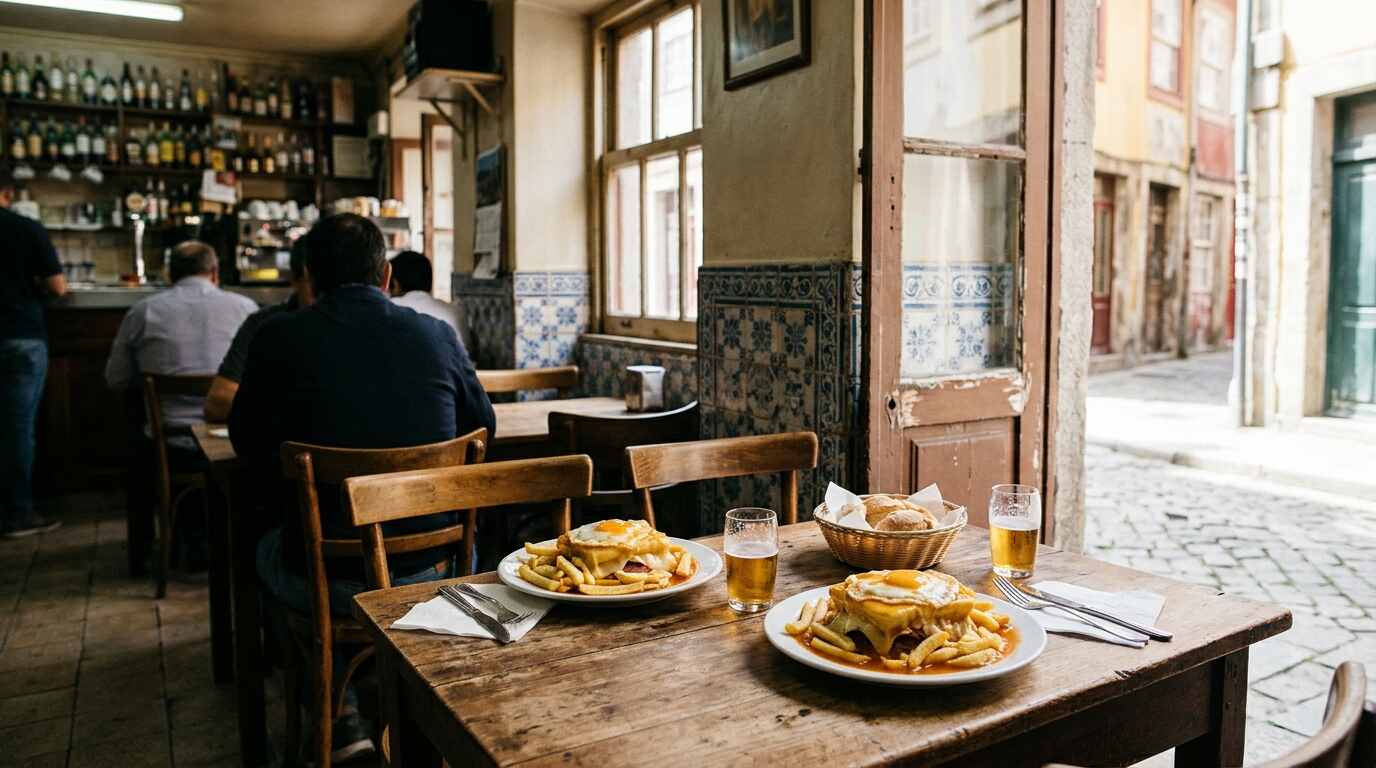
By Paste’s estimate, about 1,500 restaurants in Porto list a francesinha. Observador reports that staff who left Regaleira made their own versions, citing Café Mocabe in Vila Nova de Gaia as one example, and that Couto thought there was no single original recipe because everyone makes it their own way. Paste names Café Santiago as the most commonly recommended place and records Anthony Bourdain’s recommendation of O Afonso, where the chef called the dish “the immortal combination.”
The Takeout adds that Bourdain visited O Afonso for Parts Unknown and that the restaurant keeps a mural of him and a framed quote from the episode. His reaction, as quoted there, was “Good Lord, look at that thing.”
Paste adds a social note: the sandwich was long treated as a snack for young men, and women who ate it in the 1950s and 60s were said to earn a bad reputation. Tasting Table says it appears at restaurants, bars and cafes across Portugal, that Porto remains its best-known center, and that meatless versions use prawn, tuna or tofu.
Wikipedia, used here only because no other fetched source covers regional variants, lists a Póvoa de Varzim version from the early 1960s that uses different bread and sauce and can be eaten by hand, and a breadless variation called pica-pau. The same page says “the only common ingredient is beer” in the sauce, though it cites no source for that line that was checked.
Sources:
- Portugal.com, “The Story Behind Porto’s Francesinha”: https://www.portugal.com/food-drink/the-story-behind-portos-francesinha
- Comércio com História (Portuguese government), “Restaurante A Regaleira”: https://www.comerciocomhistoria.gov.pt/en/?p=46148
- Observador, “Porque não chamar-lhe francesinha? A história de como foi batizada a famosa iguaria portuense” (2018): https://observador.pt/2018/06/10/porque-nao-chamar-lhe-francesinha-a-historia-de-como-foi-batizada-a-famosa-iguaria-portuense/
- Sábado, “A Regaleira: aqui nasceram as francesinhas”: https://www.sabado.pt/gps/detalhe/a-regaleira-aqui-nasceram-as-francesinhas
- Postal.pt, “Francesinha: a história e a receita do melhor petisco do Porto”: https://postal.pt/nacional/francesinha-a-historia-e-a-receita-do-melhor-petisco-do-porto/
- Paste Magazine, “The Francesinha, Porto’s Iconic Sandwich”: https://www.pastemagazine.com/food/dishes/what-is-francesinha-porto-portugal/
- Tasting Table, “Francesinha: Portugal’s Overstuffed Sandwich”: https://tastingtable.com/1212809/francesinha-portugals-overstuffed-sandwich
- Chowhound, “The French Origins Of One Of Portugal’s Most Decadent Sandwiches”: https://chowhound.com/1580833/francesinha-sandwich-origins
- Londonist, “One Man’s Hunt For Portugal’s Maddest Sandwich”: https://londonist.com/london/food/one-man-s-hunt-for-portugal-s-maddest-sandwich
- Kevin Gould, “Porto’s francesinha sandwich is a gut buster” (The Guardian, 2016; syndicated by inkl): https://www.inkl.com/news/porto-s-francesinha-sandwich-is-a-gut-buster
- Saveur, “Mega Monsieur: Porto’s Francesinha Sandwich”: https://www.saveur.com/article/Travels/Porto-Francesinha-Sandwich
- Taste Porto, “Francesinha: The Story Behind This Iconic Portuguese Meal”: https://tasteporto.com/francesinha-the-story-behind-this-iconic-portuguese-meal/
- Taste Porto, “How to make Francesinha”: https://tasteporto.com/passport_post/how-to-make-francesinha
- The Takeout, “How To Make Francesinha, The Portuguese Sandwich Blessed By Anthony Bourdain”: https://www.thetakeout.com:443/francesinha-sandwich-recipe-portugal-1839323079
- The Brown Hotel, “The Hot Brown”: https://www.brownhotel.com/hot-brown
- Wikipedia, “Francesinha” (pointer only): https://en.wikipedia.org/wiki/Francesinha
- Insider Food (YouTube), “Portugal’s Most Iconic Sandwich Is Smothered In Cheese And Sauce | Legendary Eats”: https://www.youtube.com/watch?v=UYWaf8pgrms