
In this story
Pimento cheese is counted among the signature foods of the American South, yet the earliest version of the spread was a Northern product made from cream cheese and canned Spanish peppers. Food historian Robert Moss, as reported by Good Grit, places its beginnings in New York State in the late nineteenth century, and the mixture reached homes first as a packaged, factory-made item. The cheddar-and-mayonnaise spread now associated with Georgia and the Carolinas came later, and sources do not agree on exactly when or by whom it was changed.
Video: The Curious Tale of Pimento Cheese | CHEF IN THE KITCHEN
Cream cheese and Spanish peppers in New York
The ingredients came together in the 1870s, according to the Museum of the New South. New York dairy farmers were making an American version of Neufchâtel, a soft French cheese that later turned into the cream cheese spread on bagels, and pimentos were arriving from Spain as a luxury import. Pairing the two produced the first pimento cheese. The Takeout reaches the same conclusion, noting that the word pimiento means red sweet pepper in Spanish and that the English form “pimento” stuck.
Sources disagree about where in New York. Moss, in the Good Grit account, names Orange County. The Cheese Professor, summarizing Moss’s writing for Serious Eats, points to New York City and calls the spread “a product of industrial food manufacturing and mass marketing.” That page adds that home economists at the turn of the century found cream cheese and canned pimentos made a fast, appealing sandwich filling. Neither account supplies a company name or a date for the first jar.
The oldest printed recipe that sources cite is from 1908. America’s Test Kitchen reports that Good Housekeeping published a recipe that year combining cream cheese and minced pimentos with mustard and chives, and calls it an early version rather than the modern dish. Tasting Table, citing Tupelo Honey, dates the same recipe to a 1908 issue and says national popularity followed the magazine’s coverage.
Visit Macon, a tourism site with its own stake in the story, credits a 1910 book, Fancy Cheese in America, with a pepper cream cheese recipe from Johan D. Frederickson of Little Falls, New York. The page calls it one of the first printed mentions, a claim that belongs to the blog and was not checked against the book itself.
How Georgia came to grow the peppers
Imported pimientos were expensive, and the cost pushed American farmers to grow them. The Atlanta Journal-Constitution, drawing on food writer Anne Byrn, dates one early arrival to 1891, when Henry McHatton of Macon brought canned Spanish pimientos home from Cuba, possibly the pepper’s first appearance in Georgia. In 1916 the Riegel family of Experiment, Georgia, grew Spanish seed and developed a thick-fleshed variety suited to canning, called Perfection Pimento. Mark Riegel’s roaster made large-scale canning possible, and the family sold its patents to Pomona Products Company, which turned Griffin into what the article calls the “Pimento Capital of the World.”
Other accounts shift the details. Tasting Table credits George Riegel, founder of Pomona Products, with first planting the crop in the United States in 1916. Visit Macon gives the credit to S.D. Riegel and his sons and tells of a Macon attorney, Charles Lafayette Bartlett, who helped obtain seed through the Spanish consul, though the page contradicts itself on his office. Salon, quoting Moss’s research, puts the start of local growing around 1911, driven by import costs. The year ranges from 1891 to 1916 depending on whether the claim concerns the first pepper, the first farm crop or the first commercial variety.
By the 1930s Georgia led the country in output. The Museum of the New South notes that Georgia and California competed for the lead in the 1910s and that Georgia promoted pimentos with festivals and pageants. Labor cost gave it an edge: America’s Test Kitchen cites historian Cynthia R. Greenlee for the finding that Georgia canning workers earned 20 cents an hour against 38 cents for their California counterparts, and she observes that many of those workers were Black women and men. Golf.com puts the state’s share of national supply at more than 90 percent at its peak. Peppers grown and canned in Georgia, in other words, are a large part of the reason a New York invention ended up with a Southern reputation, as The Takeout argues.
The Carolinas and the Southern recipe
South Carolina enters the story through people more than through a founding event. Food writer Hanna Raskin, who is based in the state, credits Duke’s Mayonnaise marketing for the spread’s hold on the South, per America’s Test Kitchen. That page says Eugenia Duke founded the brand in Greenville and sold her first commercial jar in 1923; Moss’s own site says she began making the mayonnaise in 1917. The same Moss post records that Charleston cooks such as Sarah O’Kelley of the Glass Onion insist on Duke’s because, in her words, it has no added sugar and more egg yolks.
The nicknames point the same direction. Moss’s site lists “Carolina Caviar” and “Pâté of the South” among the names the spread has collected. A batch maker in the InsideHook piece, Deana Tanner Bibb of Proper Pepper Pimento Cheese, calls it a regional food that started at textile mills in Georgia and the Carolinas. That origin belongs to one maker’s account, and the other sources cited here do not repeat it.
How the cream cheese version became the cheddar version is the least settled part. Kathleen Purvis, formerly of The Charlotte Observer, argues that hoop cheese suited hot weather because it spoils less quickly, and Southern cooks swapped it in for the cream cheese, with mayonnaise taking over as the binder. The Takeout dates the arrival of mayonnaise and cheddar to the World War II era. Good Grit, though, says how and when the shift happened is not totally clear and treats the hoop cheese idea as speculation. Salon’s essayist writes that Southerners claimed the spread as their own once they began making it at home after the war.
A spread that fell out of favor and came back
Before the war, factory-made pimento cheese was sold nationally. The Museum of the New South says newspapers across the country mentioned it, but none called it Southern, and that soldiers in World War I ate it. Salon places the peak from the 1920s through the 1940s. After that, store-bought versions faded. Good Grit dates the decline of the commercial cream cheese product to the 1950s, while Southern households kept making their own for luncheons and bridge clubs.
For some time, according to the same article, many Southerners dismissed the spread as low-rent. Southern food writers and chefs revived it in the late 1980s and early 1990s, and it became tied to regional identity. Rebecca Lang’s cookbook Pimento Cheese: The Southern Spread, named in the Golf.com article, and Perre Coleman Magness’s 2014 Pimento Cheese: The Cookbook, listed by America’s Test Kitchen, belong to that later wave of attention.
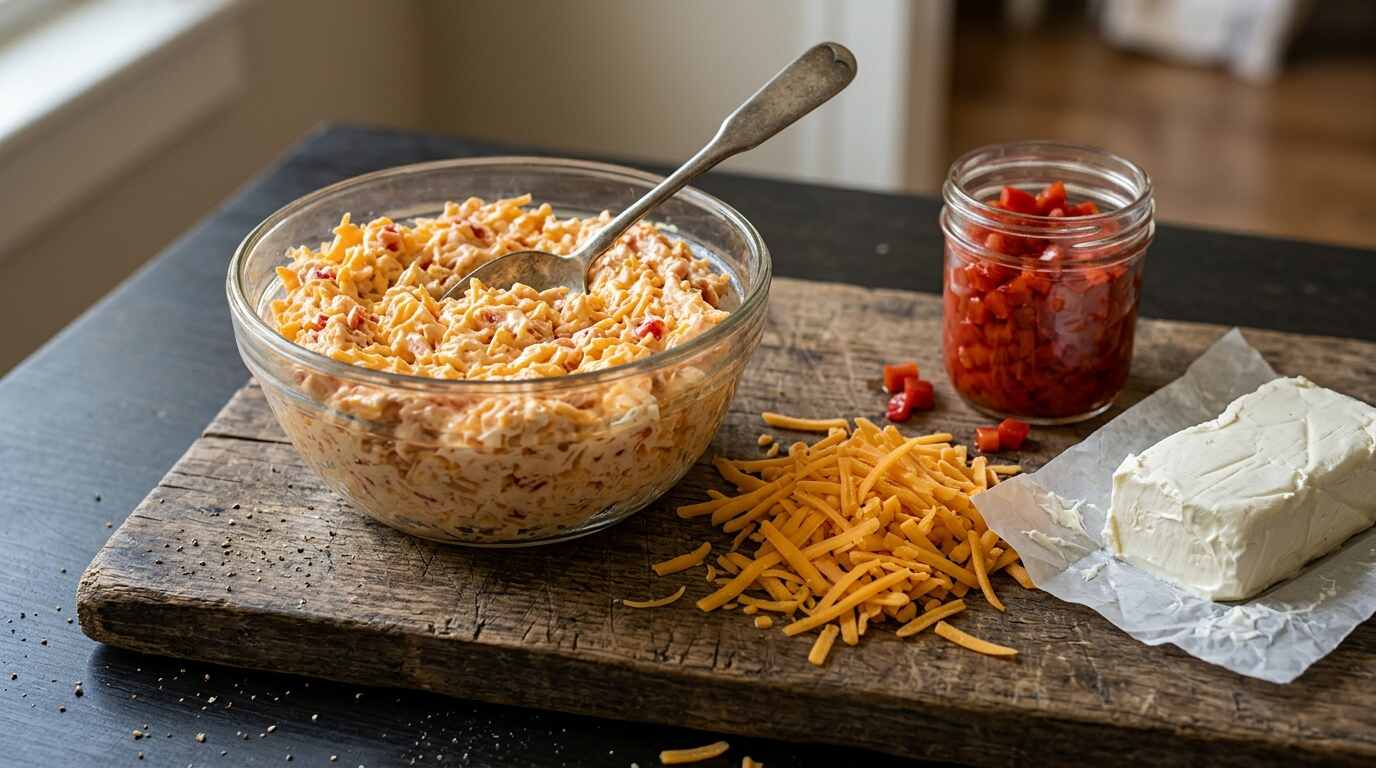
The ingredients of a typical modern batch are consistent across sources. The Cheese Professor lists shredded cheddar or processed cheese, mayonnaise and pimentos as the base, with cream cheese, hot sauce, cayenne, paprika, Worcestershire sauce, onion and garlic as common additions. A recipe on Southern Plate uses 8 ounces of cream cheese, 2 cups of sharp cheddar, 4 ounces of chopped pimentos and half a cup of mayonnaise, and the page remarks that many Southerners use Velveeta. Processed cheese of that kind has its own history in the post on American cheese.
The Masters sandwich
Augusta National Golf Club, in Georgia, made the sandwich famous well beyond the region. Golf.com reports that in 1947 tournament cofounder Clifford Roberts asked the Herndon family to make sandwiches for patrons at 25 cents each. Ola and Hodges Herndon ran a small restaurant and managed food service at the Augusta VA hospital, and their son Tom and his fraternity brothers delivered batches to the club. InsideHook and Chowhound give the same couple, with the date described only as the late 1940s, and Chowhound adds that the sandwiches were made at home and driven to the course.
Nick Rangos, a caterer from Aiken, South Carolina, later took over. Garden and Gun puts his tenure at 45 years, and Golf.com says he made the cheese until 1998. The Takeout puts the end of his contract in the early 2000s, which conflicts with the other two; the 1998 date matches Garden and Gun’s account of the contract moving that year. Rangos never revealed his recipe. Chowhound relays the later franchise owner Ted Godfrey’s recollection that the original was “more orange than most cheeses.”
Wife Saver, an Augusta restaurant chain, took over in 1998. Godfrey presented batches that did not match until a tournament employee produced a frozen original for comparison, per Garden and Gun, and the chain served the sandwich for 15 years. The tournament brought concessions in-house in 2013 according to Golf.com and InsideHook; Chowhound puts the Wife Saver departure in 2012, after chairman Billy Payne cited food safety concerns. Reports followed that the new sandwich tasted different, and Garden and Gun says ESPN investigated; InsideHook calls the episode “PimentoGate.”
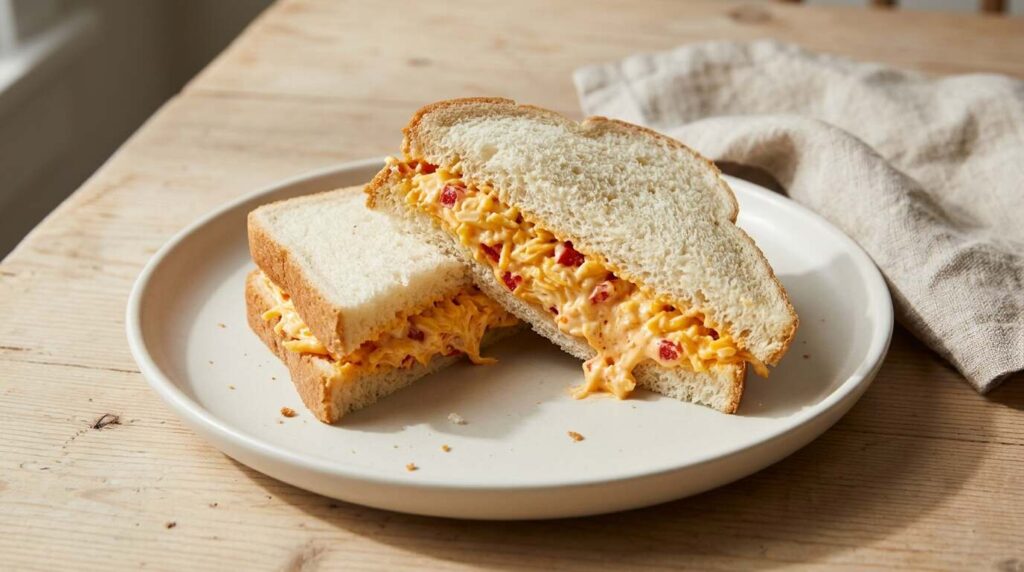
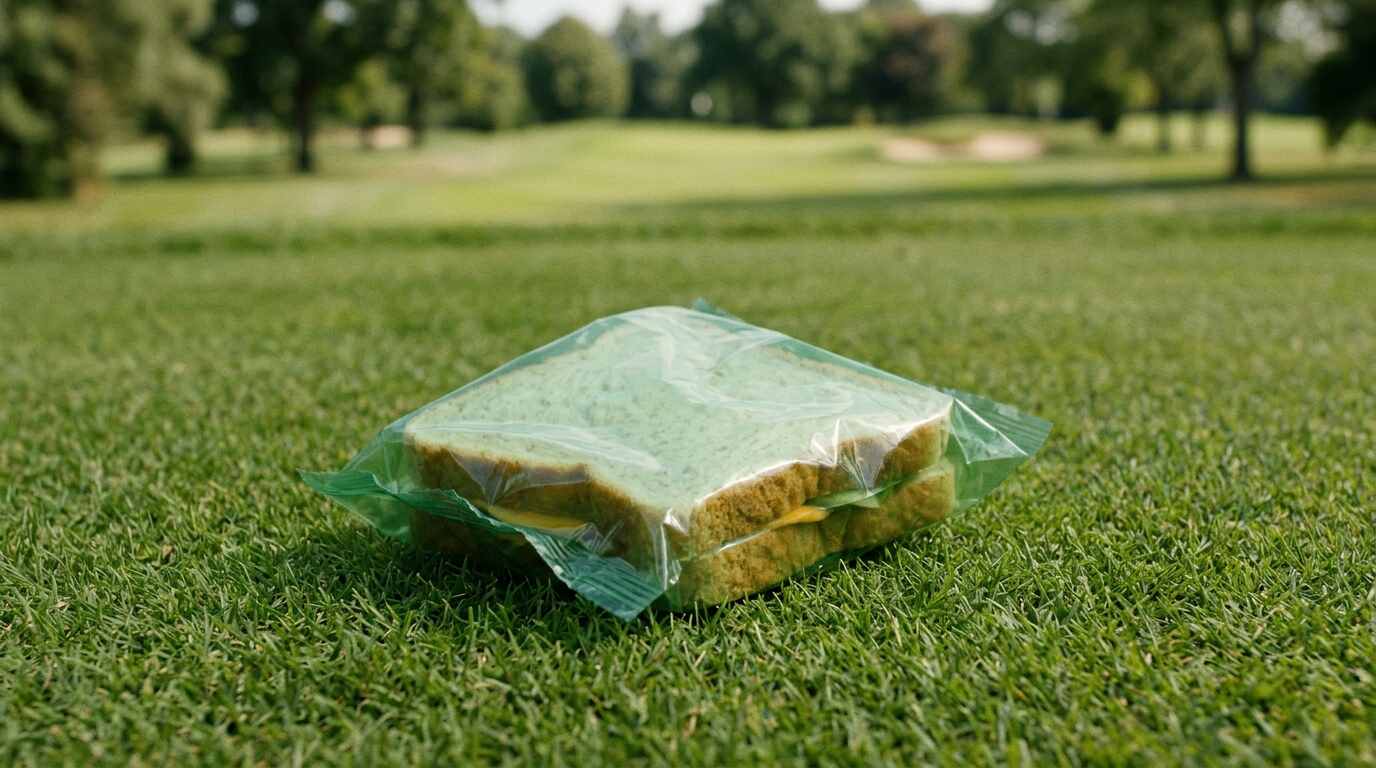
The product itself is plain. The sandwich costs $1.50, or $3 with chips and a sweet tea, per Garden and Gun, and arrives in a green plastic wrapper. The Takeout identifies the bread as Wonder Bread and says the wrapper is meant to blend into the grass if it blows away. A 1977 collection, Tea-Time at The Masters, includes a “Four-Cheese Pimiento Sandwiches” recipe that the same article suggests could be close to the real one, though the club may have changed its formula since. Neither source confirms it.
Grilled pimento cheese
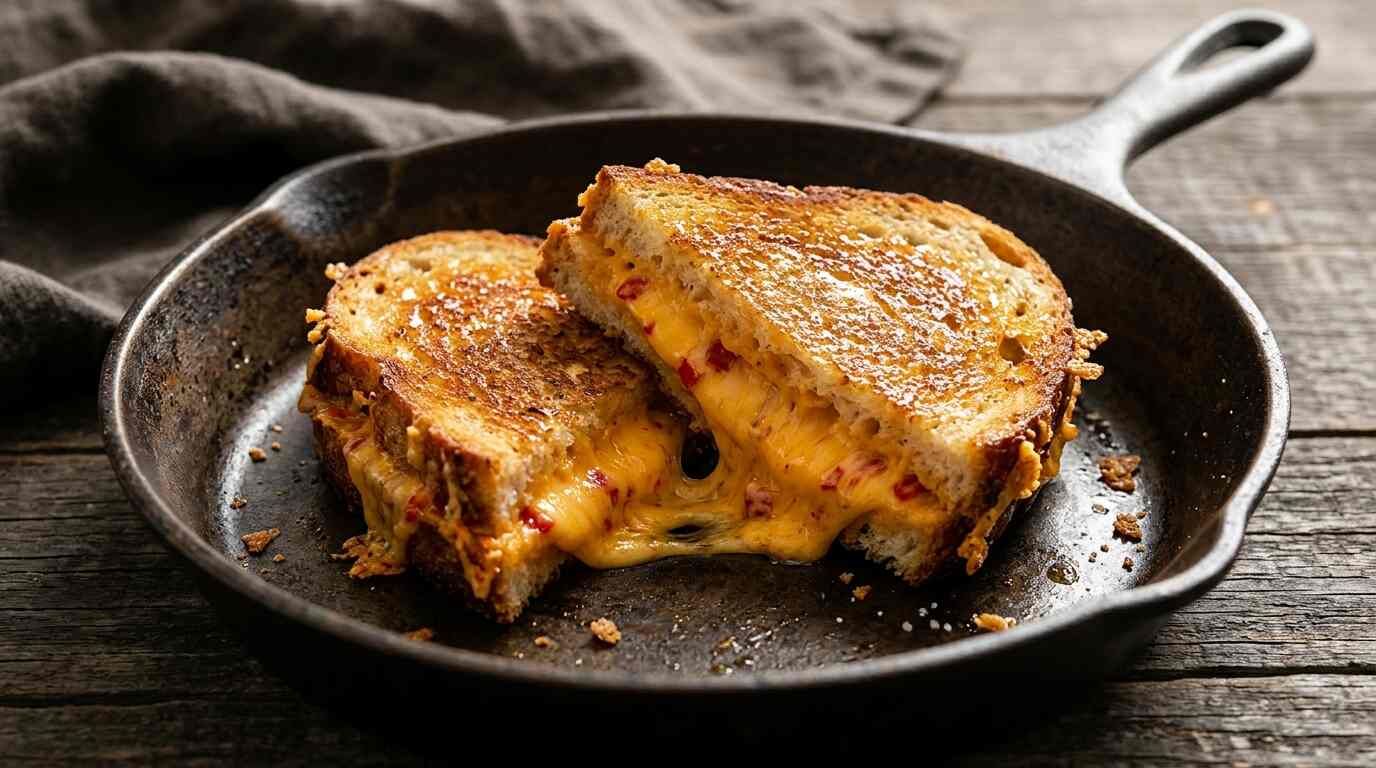
Grilling the spread turns a cold lunch into a hot sandwich, and the method tracks the technique for a standard grilled cheese sandwich. The Southern Plate recipe calls for butter for grilling. A version printed by Tasting Table, adapted from chef Sam Talbot, builds the filling from extra-sharp and white cheddar with mayonnaise, Dijon, hot sauce and Worcestershire, then presses the rolls in a cast-iron skillet over medium heat for 3 to 4 minutes a side and finishes them in a 400-degree oven for about 5 minutes. Tomato and pickled jalapeños go inside.
The mayonnaise in the spread alters how the sandwich behaves in the pan. Tasting Table’s recipe still uses butter on the outside of the bread, and none of the pages fetched for this post compares mayonnaise-bound spread with plain sliced cheese on the griddle, so the technical effect is not documented here.
Sources:
- Museum of the New South, “Pimento Cheese”: https://www.museumofthenewsouth.org/southern-tables/pimento-cheese
- The Takeout, “The South’s Most Iconic Cheese Actually Comes From Up North”: https://www.thetakeout.com/1757153/pimento-cheese-southern-origins/
- America’s Test Kitchen, “Pimento Cheese: The Caviar of the South”: https://www.americastestkitchen.com/articles/8472-pimento-cheese-the-caviar-of-the-south
- Good Grit, “Southern Origins of Pimento Cheese”: https://goodgritmag.com/southern-origins-pimento-cheese/
- The Cheese Professor, “All About Pimento Cheese”: https://www.cheeseprofessor.com/blog/pimento-cheese
- Tasting Table, “The Yankee Origins Of Southern Food Staple Pimento Cheese”: https://www.tastingtable.com/1131345/the-yankee-origins-of-southern-food-staple-pimento-cheese
- Visit Macon, “The South Owes the Glory of Pimento Cheese to Macon”: https://visitmacon.org/blog/the-south-owes-the-glory-of-pimento-cheese-to-macon/
- Atlanta Journal-Constitution, “The Secret History of Pimento Cheese”: https://www.ajc.com/food-and-dining/the-secret-history-of-pimento-cheese/PTN54EQRYBC57H2PX6BJBUKJ7Y
- Salon, “Pimento cheese is a classic for a reason”: https://salon.com/2023/04/27/pimento-cheese-is-a-classic-for-a-reason-sandwich-spread-party-dip-all-around-cheesy-delight
- Robert F. Moss, “Authentic Pimento Cheese”: https://robertfmoss.com/features/Authentic-Pimento-Cheese
- InsideHook, “The Rich, Creamy, Piquant History of the Masters’ Pimento Cheese Sandwich”: https://www.insidehook.com/article/food-and-drink/the-rich-creamy-and-slightly-spicy-history-of-the-masters-pimento-cheese-sandwich
- Garden and Gun, “Mystery of the Masters Pimento Cheese”: https://gardenandgun.com/articles/mystery-masters-pimento-cheese
- Golf.com, “The Story of the Masters’ Famous Pimento Cheese Sandwich”: https://golf.com/lifestyle/food/story-masters-famous-pimento-cheese-sandwich/
- Chowhound, “How Georgia’s Official State Sandwich Became A Staple Of Masters Golf Tournaments”: https://chowhound.com/1707633/georgia-official-state-sandwich
- The Takeout, “The Pimento Cheese Sandwich At Augusta National Is Golf’s Greatest Tradition”: https://thetakeout.com/1845655852
- Southern Plate, “Pimento Cheese Sandwich”: https://www.southernplate.com/pimento-cheese-sandwich/
- Tasting Table, “Pimento Grilled Cheese Recipe”: https://tastingtable.com/686386/pimento-grilled-cheese-recipe
- CHEF IN THE KITCHEN (YouTube), “The Curious Tale of Pimento Cheese”: https://www.youtube.com/watch?v=GuRXp-BdCvg