In this story
Two cities claim the Reuben, and neither claim has been settled. Omaha’s account puts a corned beef and sauerkraut sandwich on a hotel table during a late-night poker game; New York’s account puts a celebrity-named sandwich on the menu of a Madison Avenue delicatessen. Both rest heavily on family memory, and the paper trail for each is thinner than the confident versions suggest.
Video: Who Really Invented the Reuben Sandwich? A Delicious Mystery | Curious Nebraska Omaha, Nebraska Public Media
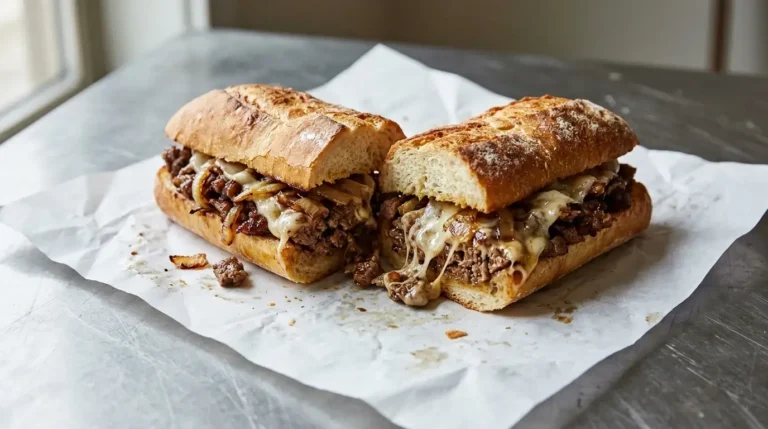
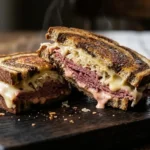
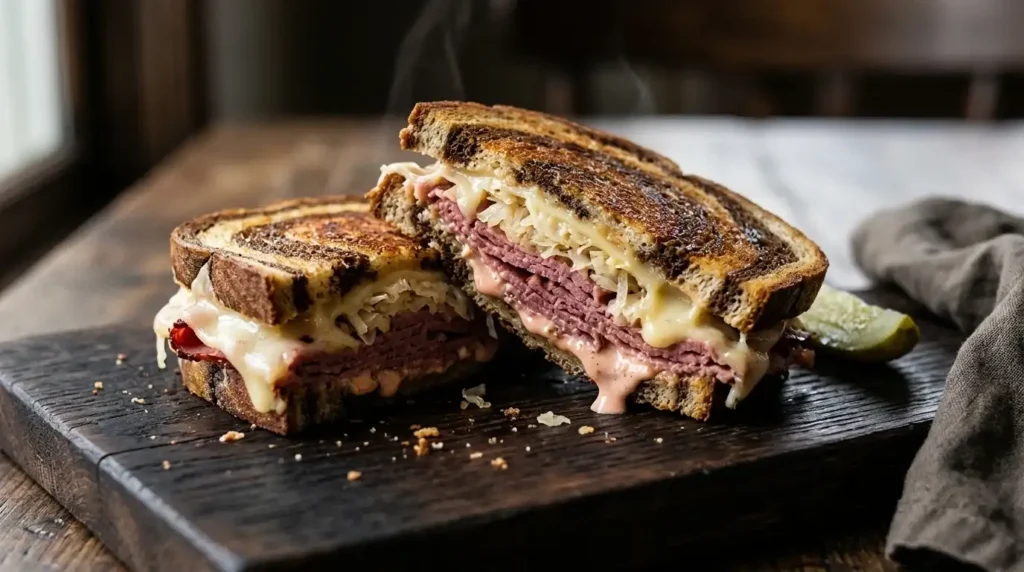
The sandwich itself is not in doubt. The Reuben is an American grilled sandwich of corned beef, Swiss cheese, sauerkraut and Russian or Thousand Island dressing pressed between slices of rye. What follows lays out each origin claim in turn, then the records that exist for it, then the places where the sources contradict one another.
The Omaha claim
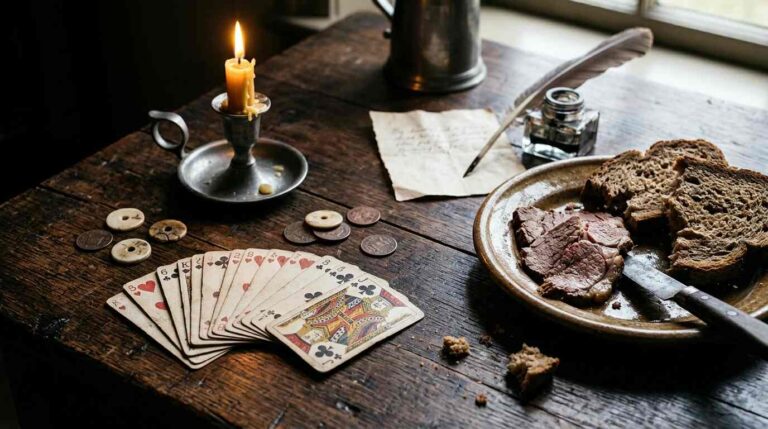
A poker game at the Blackstone Hotel
The Nebraska story centers on Reuben Kulakofsky, a grocer. History Nebraska, the state’s historical society, summarizes the lore this way: the sandwich was created in 1925 at the Blackstone Hotel in Omaha for late-night poker players, and Charles Schimmel, one of the players and the hotel’s owner, liked it enough to put it on the menu of the hotel restaurant, The Plush Horse.
Who actually built the first sandwich depends on the teller. Elizabeth Weil, writing in the New York Times Magazine, gave the credit to her grandfather Bernard Schimmel, who drained the sauerkraut, mixed it with Thousand Island dressing, layered it with corned beef and Swiss on dark rye, and grilled it, according to a summary of her account in Tablet. In that telling, Bernard’s father hosted a Sunday night game and the players paid a nickel or a dime for a midnight lunch from room service.
The 1956 contest
The sandwich’s national profile is tied to a competition. According to Tablet’s summary, a waitress named Fern Snider entered the Reuben in the National Sandwich Idea Contest, and it won. A Nebraska TV report gives the same event as the National Restaurant Association’s sandwich of the year in 1956, and adds that the recipe was later published. Omaha now observes March 14 as Reuben Sandwich Day, a detail noted by National Geographic.
The New York claim
Reuben’s Delicatessen and the Seelos sandwich
Arnold Reuben was a German-Jewish immigrant who founded Reuben’s Restaurant and Delicatessen in 1908, and the place later moved through several Manhattan addresses before closing in December 2001. The most widely repeated New York story says that in 1914 the silent-film actress Annette Seelos asked him for a sandwich, and he produced one of ham, turkey, Swiss cheese, coleslaw and dressing on rye.
That sandwich has no corned beef and no sauerkraut. Food historian Andrew Smith, the leading voice for New York in that exchange, conceded that it was not a Reuben, according to Saveur.
Other New York versions
Wikipedia’s account lists several competing New York stories. Arnold Reuben reportedly told Craig Claiborne that he created a “Reuben Special” around 1914. Bernard Sobel’s 1953 memoir instead says a sandwich was improvised for the actress Marjorie Rambeau when the cupboards were nearly bare. A third version credits a chef at Reuben’s, Alfred Scheuing, with making it for Arnold Reuben Jr. in the 1930s. Jim Rader, a Reuben researcher whose notes are archived by the American Dialect Society, describes that 1930s version as corned beef, Swiss and sauerkraut on pumpernickel.
What the Nebraska records show
Menus carry most of the weight for Omaha, and the sources do not agree on which menu is earliest.
History Nebraska reports that newspaper accounts treat a 1937 menu from the Cornhusker Hotel in Lincoln, also owned by the Schimmel family, as the first written evidence. The society also shows a mid-1940s Plush Horse menu listing the Reuben. Saveur, in a piece by a Schimmel descendant, reports something different: a 1937 Blackstone coffee shop menu with a Reuben at 35 cents (50 cents “with chicken”), and a 1934 main dining room menu from the Douglas County Historical Society listing one at 40 cents. Smith conceded these were the earliest references to a specific “Reuben sandwich,” though he called the chicken version worrisome.
Rader’s catalog, kept in the American Dialect Society archive, reads the evidence more cautiously. He lists a Cornhusker coffee shop menu dated October 9, 1937 as the earliest dated menu, an undated Depression-era Plush Horse menu with a “Rueben” at 50 cents, and a Plush Horse menu from roughly 1943 to 1946 priced at 60 cents. He also notes that Kulakofsky died on March 6, 1960, and that his obituary does not mention the sandwich.
The oral side of the record is older than the menus. Rader writes that Ed Schimmel told the story to Omaha columnist Robert McMorris in 1965, citing his father Charles, a participant in the game. A 2019 article from My Jewish Learning likewise rests mainly on family recollections, and that article cites no archival records.
What the New York records show
The case for New York is built on the pieces of the sandwich rather than the name. Saveur reports that Smith pointed to a 1941 cookbook, Menu Making for Professionals in Quantity Cookery, which lists a Reuben of rye, Swiss, sliced corned beef, sauerkraut and dressing, and whose author lived in New York. He later found a “Col. Jay Flippen” sandwich on Reuben’s own menu: corned beef, Swiss and mustard with coleslaw on toasted rye. His reasoning was that the restaurant used every Reuben component. His conclusion, in his words: “The Reuben sandwich is a New York invention; it’s time to put the Nebraska origin myth to bed.”
The weak points are on the record too. History Nebraska says there is evidence that a sandwich similar to the Reuben was served at Arnold Reuben’s restaurants, but that only family stories substantiate his claim to the sandwich by that name. The Wikipedia entry on the restaurant says Reuben was interviewed by the Federal Writers’ Project in 1938 and that a circa 1943 menu is linked from the page, but the page does not state that the sandwich appears on it. Rader found that Arnold Reuben’s death in 1970 came with an obituary that likewise omits the sandwich.
Where the accounts conflict
Laid side by side, the accounts differ on more than geography.
| Point | Omaha accounts | New York accounts |
|---|---|---|
| Creator | Kulakofsky named as the requester; the maker is Bernard Schimmel in some tellings, an unnamed hotel chef (said to be Schimmel’s brother) in another | Arnold Reuben, or Alfred Scheuing, or an improvisation for Marjorie Rambeau |
| Date | About 1925, or the 1920s | 1914, or the 1930s |
| First sandwich | Corned beef, sauerkraut, Swiss, dressing, rye | Ham, turkey, Swiss, coleslaw in the 1914 story |
| Earliest paper | Menus from 1934 or 1937, depending on the source | A 1941 cookbook entry; the Flippen sandwich, undated in the sources read |
Several smaller disputes sit inside the Omaha story. Chowhound reports that Kulakofsky’s family says Schimmel only delivered the ingredients and that Kulakofsky assembled the sandwich himself. A Nebraska TV report quotes the Kimpton Cottonwood Hotel’s general manager, whose version has the chef being Schimmel’s brother, and that report cites no documents. Louise Ware’s account, passed down through an uncle and summarized by Rader, dates the sandwich to 1922 and does not name Kulakofsky. A caller to a radio show, again per Rader, said Lincoln’s Cornhusker Hotel was the birthplace, with nothing offered to back it up.
Rader himself ended up leaning toward Nebraska on the strength of the menus, yet wrote that he had “serious misgivings” and considered the matter unresolved. The Chowhound piece reaches a similar place from another direction: it says few official records exist for this kind of food history, so both stories depend on anecdote, and it judges Omaha more plausible because the New York sandwich described was a different one.
The standard components
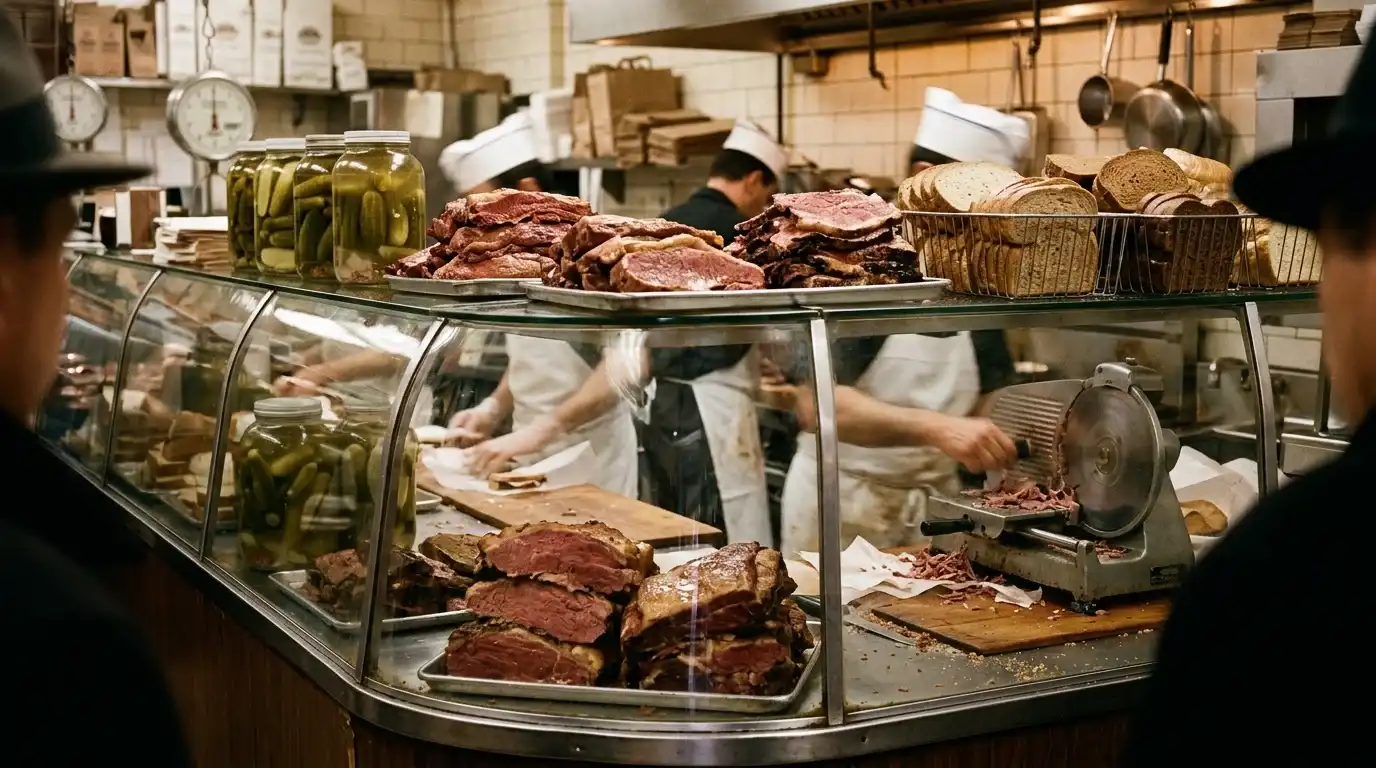
The core build is stable across sources. Corned beef is brisket cured in salty brine, and pastrami is sometimes used as a substitute. Swiss cheese and sauerkraut complete the filling, rye bread holds it, and the dressing is Russian or Thousand Island. National Geographic describes both dressings as mayonnaise-and-ketchup based, with Russian the spicier one, carrying paprika and Worcestershire.
Meat and cheese together rule out kosher status. Although the Reuben is common in kosher-style delicatessens, it is not kosher under traditional Jewish dietary law. National Geographic notes that Liebman’s Deli, a kosher deli, leaves the Swiss off.
Variants are plentiful. The Rachel swaps in pastrami or turkey and coleslaw; the Montreal Reuben uses smoked meat; the Dinty Moore, popular around Detroit, replaces sauerkraut with coleslaw. Wikipedia also lists fish versions and a deep-fried Reuben egg roll that a Milwaukee chef reportedly created around 1990.
Griddling a Reuben
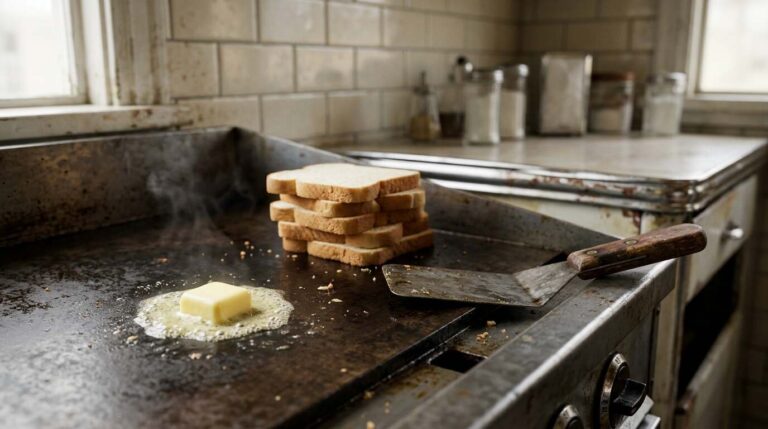
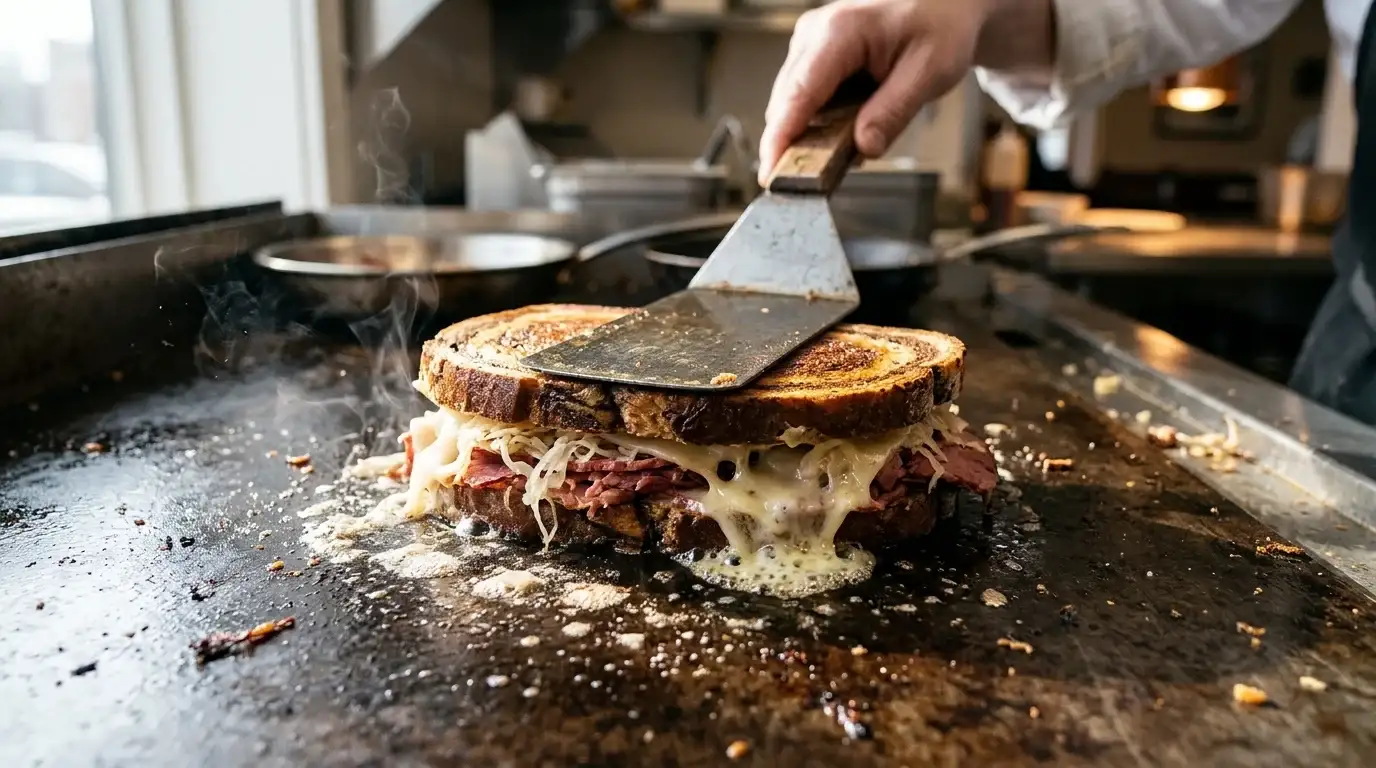
The Reuben is built like a grilled cheese and cooked like one. The Wikipedia entry says it is assembled and grilled or toasted until the bread is crisp and the cheese has melted, a technique it links to flattop cooking. The Saveur article adds that pressing the sandwich with a spatula in the pan gives a crisp exterior and well-melted cheese, and that the meat should be piled generously but no more than an inch or two thick so the center warms through.
One published home method, from Once Upon a Chef, shows the sequence. Butter goes on one side of each slice of rye; the other side gets Russian dressing, about 1½ tablespoons per slice. Two slices of Swiss, a quarter pound of corned beef or pastrami, sauerkraut and two more slices of cheese go between the bread. The sandwiches cook covered over medium heat for 3 to 4 minutes a side in a nonstick or cast iron pan. The recipe warns that the heat should come down if the bread browns before the cheese melts, and it calls for well-drained sauerkraut.
Set beside the history of the grilled cheese sandwich, the Reuben shares the basic steps: butter on the outside of the bread, cheese as the part that melts, a hot pan to finish. National Geographic describes the result as cheese melting into the dressing so that it binds the filling.
Whether that logic was worked out in a Madison Avenue kitchen or on the eighth floor of an Omaha hotel is still undecided, and no document read for this article settles it.
Sources:
- History Nebraska, “Was the Reuben Sandwich invented in Omaha?”: https://history.nebraska.gov/blog/was-reuben-sandwich-invented-omaha
- Saveur, “Who Really Invented the Reuben?”: https://saveur.com/reuben-sandwich-origin-history
- Tablet, “The Origin of the Reuben Sandwich”: https://www.tabletmag.com/sections/news/articles/the-origin-of-the-reuben-sandwich
- KOLN/WOWT, “The Reuben sandwich: A Nebraska original”: https://www.1011now.com/2023/02/10/reuben-sandwich-nebraska-original/
- My Jewish Learning, “The Reuben Sandwich Probably Wasn’t Invented Where You Thought It Was”: https://www.myjewishlearning.com/the-nosher/the-reuben-sandwich-probably-wasnt-invented-where-you-thought-it-was/
- National Geographic, “What is the Reuben sandwich? The story behind the iconic deli staple”: https://www.nationalgeographic.com/travel/article/what-is-reuben-sandwich-the-story-behind-the-iconic-deli-staple
- Chowhound, “The Murky Origins of the Iconic Reuben Sandwich”: https://www.chowhound.com/1779860/reuben-sandwich-origin-story/
- American Dialect Society archive (Jim Rader’s Reuben research): https://americandialect.org/americandialectarchives/5.98-100.html
- Wikipedia, “Reuben sandwich”: https://en.wikipedia.org/wiki/Reuben_sandwich
- Wikipedia, “Reuben’s Restaurant”: https://en.wikipedia.org/wiki/Reuben%27s_Restaurant
- Once Upon a Chef, “Reuben Sandwich”: https://www.onceuponachef.com/recipes/reuben-sandwich.html
- Nebraska Public Media, “Who Really Invented the Reuben Sandwich? A Delicious Mystery” (YouTube): https://www.youtube.com/watch?v=82nXZaDPeP8