In this story
Limburger is a soft washed-rind cheese known first for its smell. Brick is its milder Wisconsin relative, made with the same rind bacteria. In the 1930s American Limburger was an industry; today one cooperative in Green County, Wisconsin, makes all of it. Brick, meanwhile, has found a new life on Detroit-style pizza.
Video: BAUMGARTNERS LIMBURGER SANDWICH SHOP – Monroe, WI, from the WILD TRAVELS YouTube channel
A Belgian cheese in Green County
Limburger crossed the Atlantic with immigrants. Culture, the cheese magazine, in a 2019 article by Molly McDonough, describes it as a Belgian cheese that was copied and popularized in Germany, then reinvented in Green County after a wave of late-19th-century immigration. Workers ate it on toast or in rye-and-onion sandwiches because it was cheap and plentiful.
The Wisconsin start date is early. WBEZ, Chicago’s public radio station, in a 2012 piece by Louisa Chu, says Swiss immigrants first made Limburger in the United States in 1867 in Green County, and that by the 1920s the county made more Limburger than Swiss cheese, much of it eaten in taverns with local beer.
The numbers were large. Culture reports that in 1926, 98 percent of Wisconsin’s Limburger came from Green County, and that by 1935 the state made nearly 7 million pounds. Tasting Table, in an April 2026 article by Sean Bell, adds that more than 100 Limburger brands were sold in the 1930s and that a local train line was nicknamed the Limburger Express.
The smell made enemies
Towns tried to ban it. Tasting Table recounts that in 1935, Independence, Iowa, banned Limburger shipments after a postal worker was repulsed by a package, and that Monroe’s postmaster challenged his Iowa counterpart to a smell-off, remembered as the “Duel of Dubuque.” Culture also notes a 1902 ban in Louisville, Kentucky.
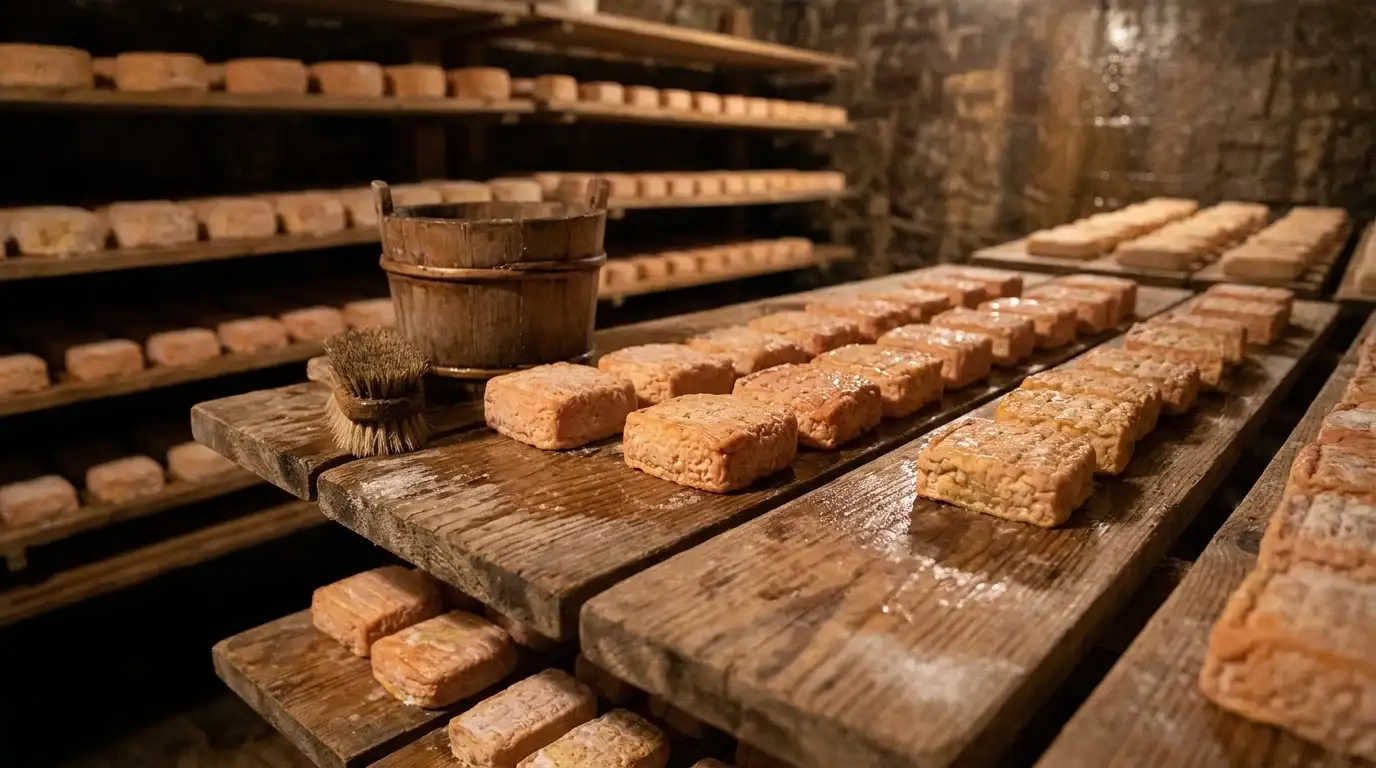
The smell comes from the rind. Culture describes how the young blocks are washed with brine and ripening bacteria twice in their first week, which builds the rosy rind, and how scrapings from the wooden aging boards are added to fresh brine to keep the house cultures going.
Not Prohibition
A popular story blames Prohibition for Limburger’s fall. WBEZ points out that Prohibition ran from 1920 to 1933, so the timing does not fit, and suggests changing tastes, pressure on immigrants to assimilate and the two world wars did more damage. It also cites J.L. Kraft’s 1916 patent for pasteurizing cheese, which made long-distance shipping and processed cheese possible and cut into Limburger’s market.
The decline in Culture’s account starts in the mid-1940s. The number of Limburger plants fell by two-thirds between 1950 and 1960, and by the early 1980s Chalet Cheese Cooperative, near Monroe, was the only one left. The American market, Culture reports, has shrunk to under 500,000 pounds a year.
The last Limburger plant
Chalet’s own history has two dates. Culture says it was founded in 1885 by five Green County dairy farmers as the Swiss Cheese Factory and is Wisconsin’s oldest cooperative dairy. WBEZ reports that Kraft built the current plant in 1947, hoping to make the world’s best Limburger; the new curing boards produced failed green cheese, so the old pine boards went back in and are still used.
Kraft’s role ended later. Culture says Kraft partnered with Chalet from the 1920s, that Chalet peaked at about two million pounds a year in the mid-1970s, and that Kraft’s last Limburger order came about 14 years before the 2019 article.
The cheesemaker became a symbol. Myron Olson, who began at Chalet in high school, was the only Wisconsin Master Cheesemaker certified in Limburger. Culture reported his retirement and named Jamie Fahrney, his colleague of about 40 years, as his successor. “We like to say we’re the granddad of stinky cheese,” Olson told the magazine.

Brick: a milder cousin
Brick cheese came out of the same world. Wisconsin Cheese says Wisconsin cheesemaker John Jossi first made it in 1877 and named it for the bricks used to press the curds. It is brined, moved to a warm room and washed during ripening, with its rind smeared with Brevibacterium linens, the same bacteria used for Limburger. Young brick is mild and slightly nutty; aged brick turns pungent and tangy.
The 1877 date is widely repeated, though a 2021 Milwaukee Journal Sentinel article puts the invention more loosely in the 1870s.
Detroit pizza revived it. The Journal Sentinel reports that the style’s popularity brought new national demand for brick, with Pizza Hut adding a Detroit-style pie that January. Joey Widmer, the fourth generation at Widmer’s Cheese Cellars in Theresa, Dodge County, said: “We get people calling every week about it.” The young, mild brick goes on pizza, the article notes, while the aged version is for cheese boards.

The Monroe sandwich
The Limburger sandwich survives in its hometown. Tasting Table says Baumgartner’s Cheese Store and Tavern in Monroe has served it since 1931: three slices of Limburger on rye with raw red onion and mustard, often with Braunschweiger, a German liver sausage, and topped with a mint. A sign in the shop advises customers not to eat it with their nose. Culture’s reporter found that at least half of first-timers were pleasantly surprised.
WBEZ’s reporter tried it another way at Chalet: on brown bread for breakfast, with mustard and strawberry jam, and recommends a bock beer.
Buying Limburger
- Country Castle, Limburger Country, 6 Ounce: Chalet Cheese Cooperative’s Limburger, sold under the Country Castle label. See it on Amazon (affiliate link)
As an Amazon Associate I earn from qualifying purchases. A commission may be earned if you buy through this link, at no extra cost to you.
Questions people ask
Where is Limburger made in the United States? Only at Chalet Cheese Cooperative near Monroe, Wisconsin.
Why does Limburger smell? Its rind is washed with brine and ripening bacteria, the same Brevibacterium linens used on brick cheese.
Did Prohibition kill Limburger? The dates do not fit; WBEZ points to changing tastes, assimilation, the world wars and processed cheese.
Who invented brick cheese? John Jossi in Wisconsin, usually dated to 1877.
What is a Limburger sandwich? Limburger on rye with raw onion and mustard, served at Baumgartner’s in Monroe since 1931.
Sources
- culture, Molly McDonough, “The Last Limburger” (January 18, 2019): https://culturecheesemag.com/stories/the-last-limburger/
- WBEZ, Louisa Chu, “Limburger: This cheese stands alone, but perhaps not for long” (November 12, 2012): https://www.wbez.org/stories/limburger-this-cheese-stands-alone-but-perhaps-not-for-long/73faa454-ac23-4fa8-a0ce-3310b257b3cd
- Tasting Table, Sean Bell (April 18, 2026): https://www.tastingtable.com/2148297/wisconsin-oldest-cheese-shop-limburger-sandwich/
- Wisconsin Cheese, “Brick Cheese” (May 7, 2024): https://www.wisconsincheese.com/about-cheese/brick-cheese
- Milwaukee Journal Sentinel via PressReader (2021): https://www.pressreader.com/usa/milwaukee-journal-sentinel/20210407/282153589088345