In this story
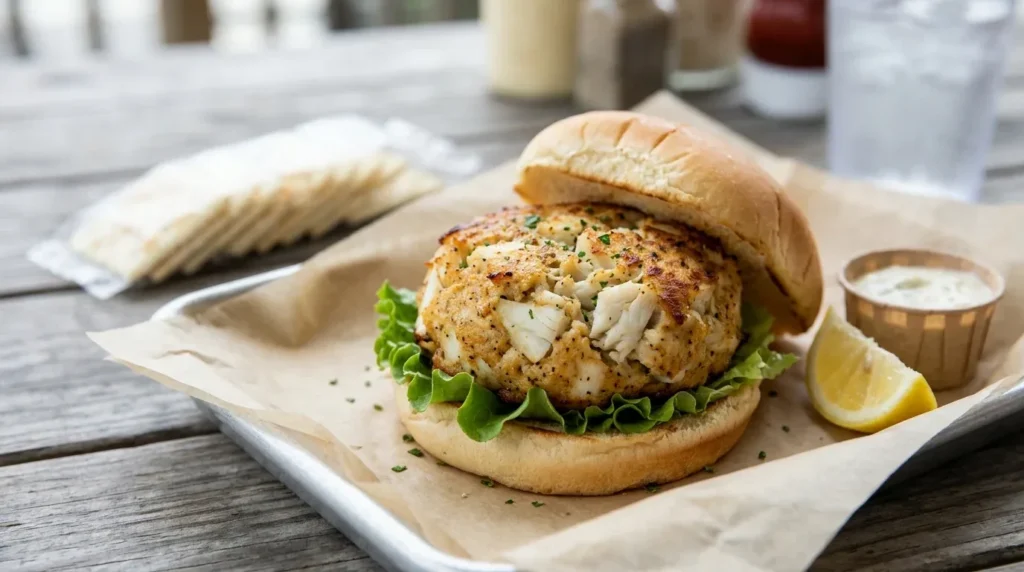
A Maryland crab cake sandwich is mostly crab. Lump meat from the Chesapeake blue crab is bound with as little filler as the cook can get away with, seasoned, broiled or fried, and served on a soft roll or on saltine crackers. The argument over how little filler is enough has outlasted every other argument about the dish, including the one over who printed the first recipe.
Video: Watch Owners Of Faidley Seafood Cook Up Their Jumbo Lump Crab Cakes, from the Goldbelly YouTube channel
The crab inside it
The grade of meat decides the cake. Tasting Table, in a 2022 article by Erica Martinez, ranks four grades from top to bottom. Jumbo lump comes from the two large swimming muscles at the back of the crab, and each crab has only two of them. Lump is broken jumbo lump plus chunks from the body. Backfin is smaller pieces of lump mixed with flaked body meat, and claw is darker, stronger and cheapest.
Cooks disagree on which grade belongs in a cake. Tasting Table recommends backfin because the small pieces hold together. The Maryland purist standard runs the other way: Food Republic, in a 2025 piece by Chala June, says a true Maryland cake uses lump meat from local blue crabs and nothing pungent, with no onion or pepper in the mix.
Price follows the same order. Tasting Table puts crab meat overall at roughly $25 to $50 a pound, citing The Spruce Eats, with jumbo lump at the top and claw at the bottom.
Saltines, breadcrumbs and the filler fight
The binder is where families split. Baltimore magazine, in its 2017 crab cake guide, quotes chef John Shields on the general rule: just enough filler to hold the cake together. The same article notes that the choice between breadcrumbs and saltines has caused long-running family disputes.
Food Republic draws the regional line. Maryland cakes use small amounts of breadcrumbs, crushed crackers or mayonnaise and are seasoned almost entirely with Old Bay. Carolina cakes add onion, bell pepper or celery, hot sauce or mustard, and heavier amounts of crumbs or crushed saltines, and they often mix lump with backfin or other crab.
Mayonnaise carries a lot of the load in the Maryland version, which is why the jar matters. Grill Cheesy covers the Southern brand most often named in that debate in its history of Duke’s mayonnaise.

Broiled or fried
Food Republic says Maryland cakes are traditionally broiled, though some are pan-fried, while Carolina cakes are usually pan-fried because they hold together better that way and come out crisper. Baltimore magazine treats it as a menu choice rather than a rule: many restaurants in its guide offer both methods, and the same counters sell the cake as a sandwich, as a platter or with saltines.
The two methods track the two recipes. If a heavier Carolina cake holds up better in a pan, as Food Republic says, the leaner Maryland cake is the one that goes under the broiler.
Who printed it first
The usual story credits a 1930s cookbook. Baltimore magazine quotes Alexandra Deutsch, then chief curator at the Maryland Historical Society, saying Crosby Gaige included a “Maryland Crab Cake” of crabmeat, crackers, mayonnaise and spices in his New York World’s Fair Cookbook. Accounts disagree on the year and the name. Kara Mae Harris of Old Line Plate, a Maryland food history site, notes that some sources date Gaige to 1930 and call it a “Baltimore crab cake.” Cameron’s Seafood transcribes the recipe as “Baltimore Crab Cakes” from the 1939 Doubleday edition, pages 42 to 43, made with crab meat, mustard, Worcestershire, egg yolk and mayonnaise or cream sauce, coated in crumbs and fried.
The first-print claim does not hold up. Harris calls it a demonstrable falsehood and lists earlier sources: an 1873 bill of fare at the Harris House, printed in the Harrisburg Telegraph, that lists crab cakes; Thomas J. Murrey’s 1891 Cookery with a Chafing Dish, which has a recipe titled “Crab Cakes”; and Mrs. Charles Gibson’s Maryland and Virginia Cook Book of 1894, with “Crab Cakes for Breakfast.” Cameron’s adds a 1932 Maryland anthology, Eat, Drink & Be Merry in Maryland, with a Baltimore Crab Cakes recipe credited to W.L. Jackson of the Lord Baltimore Hotel, seven years before the 1939 Gaige edition.
Harris also notes that Murrey popularized the name in print but that nothing she found shows he invented the dish.

The bear fat story
An older origin story is still in circulation. Mashed, citing The Baltimore Sun in a 2022 article, says crab cakes are believed to trace to Native Americans of the Chesapeake region, “who first created cakes of crab using crab meat, cornmeal, vegetables, and bear fat.”
Harris disputes it. Old Line Plate traces the bear fat version to James Michener’s novel Chesapeake and reports finding no supporting evidence in the sources it checked, adding that frying was not part of the Indigenous cooking known to her expert contact. Her reading places the crab cake in the wider family of fritters and cutlets, with many cooks contributing and none of them named.
The same history has a labor side. Harris writes that much of the crab picking in Maryland was done by Black workers, and that Black “crab men” sold crab cakes on Baltimore’s streets.
Faidley’s and the Baltimore counter
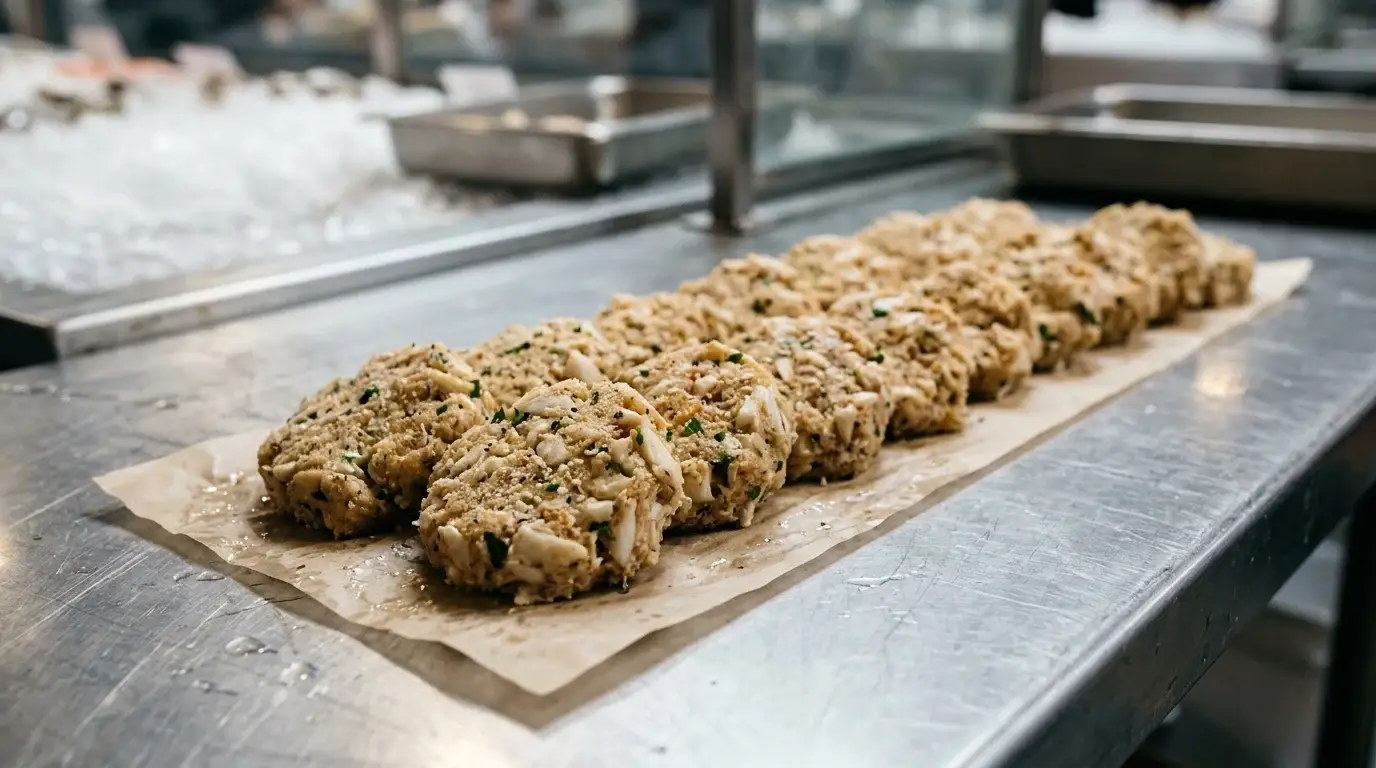
The best-known address is a market stall. Baltimore magazine’s 2017 guide says Faidley Seafood, a stand in Lexington Market, had operated for more than 130 years, and reports that third-generation co-owner Nancy Faidley-Devine still shaped every cake by hand. The stand shipped more than 6,300 crab cakes across the continental United States in 2016, according to the same article.
The sandwich form is a matter of menu, not doctrine; Baltimore magazine lists places selling the cake on bread and places pairing it with saltines. The fried-seafood counterpart farther south is the Louisiana po’ boy, built on French bread instead.
Books and seasoning
- Old Line Plate: Stories & Recipes from Maryland: Kara Mae Harris’s book on Maryland food history and recipes, from the site that took apart the first-print crab cake story. See it on Amazon (affiliate link)
- OLD BAY Seasoning, 24 oz – One 24 Ounce Container of OLD BAY All-Purpose Seasoning with Unique Blend of 18 Spices and Herbs for Crabs, Shrimp, Poultry, Fries, and More: the seasoning Food Republic names as the near-exclusive spice in a Maryland cake. See it on Amazon (affiliate link)
As an Amazon Associate I earn from qualifying purchases. A commission may be earned if you buy through this link, at no extra cost to you.
Questions people ask
What crab is used in a Maryland crab cake? Blue crab, ideally lump meat; some cooks use backfin for a cake that holds together better.
Saltines or breadcrumbs in crab cakes? Both are used in Maryland. The rule most cooks state is just enough to hold the cake together.
Are Maryland crab cakes broiled or fried? Traditionally broiled, according to Food Republic, though many Baltimore restaurants offer both.
When was the first crab cake recipe published? Murrey’s 1891 Cookery with a Chafing Dish is the earliest recipe Old Line Plate identifies; an 1873 Harrisburg menu lists crab cakes earlier.
Where did Gaige’s “Baltimore crab cake” appear? In his New York World’s Fair Cook Book, dated 1939 in Cameron’s transcription and 1930 in some other accounts.
Sources
- Tasting Table, Erica Martinez, “Here’s How The Grades Of Crab Meat Are Determined” (September 17, 2022): https://tastingtable.com/1006248/heres-how-the-grades-of-crab-meat-are-determined
- Food Republic, Chala June, “Maryland Vs Carolina Crab Cakes” (April 22, 2025): https://www.foodrepublic.com/1836015/difference-maryland-carolina-crab-cakes
- Baltimore magazine, “Best Crab Cakes in the Baltimore Area” (July 10, 2017): https://www.baltimoremagazine.com/2017/7/10/best-crab-cakes-in-baltimore-area
- Old Line Plate, Kara Mae Harris, “Crab Cakes. (True History of)” (2017, updated April 5, 2026): https://oldlineplate.com/crabcakes-true-history-of/
- Cameron’s Seafood, “History of the Blue Crab” (May 5, 2019): https://www.cameronsseafood.com/blogs/recipes/history-of-the-blue-crab
- Mashed, Jennifer Goldsmith, “The Untold Truth Of Crab Cakes” (August 8, 2022): https://www.mashed.com/955712/the-untold-truth-of-crab-cakes