In this story
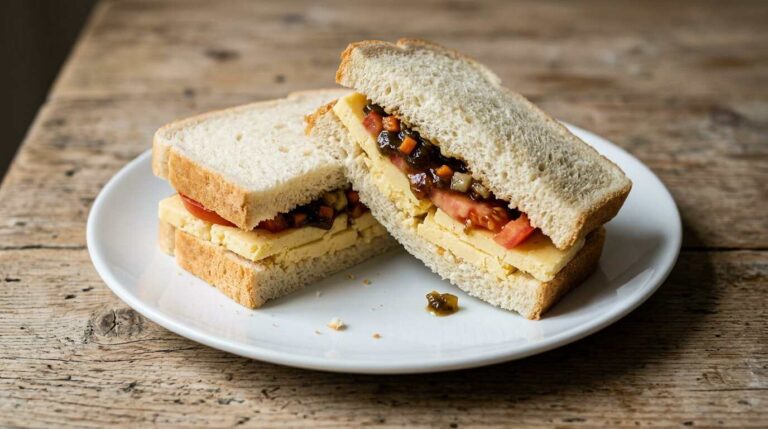
Benedictine is a pale green spread of cream cheese, cucumber and onion, made in Louisville, Kentucky, and spread on white bread for finger sandwiches, especially around the Kentucky Derby. It is named for Jennie Carter Benedict, the city’s best-known caterer at the turn of the 20th century. Whether she actually invented it is less certain than the name suggests.
Video: The Benedictine Sandwich on Sandwiches of History (our history), from the Sandwiches of History YouTube channel
Cream cheese, cucumber juice, onion juice
The best-known recipe is short. NPR, reporting from Louisville, printed it as Jennie Benedict’s: 8 ounces of softened cream cheese, 3 tablespoons of cucumber juice, 1 tablespoon of onion juice, a teaspoon of salt, a few grains of cayenne and 2 drops of green food coloring. The juices are made by grating the cucumber and onion, wrapping each in a towel and squeezing, then discarding the pulp.
Modern cooks change it. Louisville Public Media, in a 2022 story by Stephanie Wolf, profiled Ouita Michel of the Holly Hill Inn in Midway, Kentucky, who has made Benedictine since the restaurant opened in 2001. She uses a pound and a half of cream cheese and several English cucumbers, squeezes the chopped cucumber through cheesecloth, then returns the pulp to the food processor with the cream cheese, a few drops of hot sauce and a teaspoon of onion juice. She leaves a little cucumber skin on for a faint green instead of dye.
The green dye argument
Color is the running dispute. NPR says Louisville chefs disagree over whether to include the two drops of green food coloring in Benedict’s recipe. Kathy Cary, owner of Lilly’s, told NPR she avoids dyes and uses natural ingredients to celebrate local cucumbers.
The Smithsonian Center for Folklife and Cultural Heritage, in a piece by Emma Cieslik, recommends leaving some cucumber skin in for a striking green and lists food coloring as optional, noting that coloring looks more artificial.

Louisville’s caterer
Benedict’s biography is well documented. The Smithsonian piece says she was born in Louisville in 1860 and that her grandmother encouraged her cooking. She began with a small kitchen in her father’s backyard, selling school lunches from a red pull-cart on Third Street. The Louisville Courier Journal, in a 2022 article by Dahlia Ghabour, says she trained at the Boston Cooking School and offered the city’s first school lunches, chicken salad sandwiches sold from a pushcart.
The business grew. According to the Smithsonian, by 1900 she had opened Jennie C. Benedict and Company, with a lunchroom, candy department and soda fountain, and in 1908 she bought a five-story building for a restaurant and tearoom. NPR dates her South Fourth Street tearoom to 1911.
Did she invent it?
The doubt comes from her own cookbook. Benedict’s Blue Ribbon Cook Book does not contain a recipe called Benedictine. The Smithsonian says the original edition, which it dates to 1902, did not include the spread, though later editions did.
The Courier-Journal raised the question directly in 2004. A food column in the paper, preserved on Newspapers.com, asked whether Benedict invented the spread that bears her name and answered that “we may never know.” It noted that many sources, including the Courier-Journal itself in 1983, credit her with it. The column found that the Blue Ribbon Cook Book, which it dates to 1904, has no Benedictine but does have a cucumber sauce it called “very similar”: minced cucumber, cayenne, onion juice, parsley, tarragon vinegar and whipped heavy cream, served with cold fish or as a dip. The column describes the classic recipe as one that was probably named after, not by, Jennie Benedict.
So the attribution rests on tradition. NPR says Benedict reportedly invented it around the turn of the 20th century. Louisville Public Media credits her too but notes there is little documentation of how or why she created it, and that it was added only to later editions of her cookbook.

The cookbook’s date and reprints
The book’s dates vary too. The Smithsonian gives 1902; the 2004 Courier-Journal column gives 1904. NPR reports a 2008 re-release with an introduction by Susan Reigler, a former Courier-Journal restaurant critic, and the 2022 Courier Journal article reports that the University Press of Kentucky published a paperback fifth-edition reprint in March 2022, with Reigler’s foreword. The Courier Journal says the book holds more than 400 recipes.
NPR notes that not everything in it aged well. Calf brains and peptonized oysters for the sick have fallen from favor. Benedictine has not.

On the Derby table
The spread belongs to spring in Louisville. The Smithsonian piece describes it as a fixture of Derby parties alongside pecan pie and mint juleps, rarely known or made outside the city, and says chef Kenneth Hardiman added it to the official Kentucky Derby menu in 2022.
It also goes on heartier sandwiches. NPR says Cary makes one with homemade mayonnaise, bacon, Bibb lettuce and sprouts, while Gwynne Potts, a Louisville native, prefers it plain on white bread. Louisville Public Media notes it is used with fresh cucumber or bacon and also as a dip. Grill Cheesy covers other Southern spreads and dressings in comeback sauce and aioli versus mayonnaise.
The cookbook
- The Blue Ribbon Cook Book: Jennie C. Benedict’s cookbook, in the paperback edition with an introduction by Susan Reigler. See it on Amazon (affiliate link)
As an Amazon Associate I earn from qualifying purchases. A commission may be earned if you buy through this link, at no extra cost to you.
Questions people ask
What is Benedictine spread? Cream cheese blended with cucumber juice and onion juice, seasoned with salt and cayenne, sometimes tinted green.
Who invented Benedictine? Louisville caterer Jennie C. Benedict is credited, but her original cookbook has no such recipe, and a 2004 Courier-Journal column said it was probably named after her, not by her.
Is Benedictine supposed to be green? Benedict’s recipe as printed by NPR includes two drops of green coloring; many cooks use cucumber skin instead.
When is Benedictine served? Especially at Kentucky Derby parties, as finger sandwiches or a dip.
Sources
- NPR, “A Summery Spread That’s As Cool As A Cucumber” (July 13, 2013): https://www.npr.org/2013/07/13/201545790/a-summery-spread-thats-as-cool-as-a-cucumber
- Louisville Public Media, Stephanie Wolf, “The backstory on Benedictine, a Derby-adjacent sandwich spread” (May 3, 2022): https://www.lpm.org/the-backstory-on-benedictine-a-derby-adjacent-sandwich-spread
- Smithsonian Center for Folklife and Cultural Heritage, Emma Cieslik, “Benedictine Spread”: https://folklife.si.edu/magazine/benedictine-spread-kentucky-derby
- Louisville Courier Journal via Yahoo, Dahlia Ghabour (May 2, 2022): https://www.yahoo.com/lifestyle/woman-invented-benedictine-spread-changed-091622417.html
- The Courier-Journal, food column (April 2004), via Newspapers.com: https://www.newspapers.com/newspage/180520451/