In this story
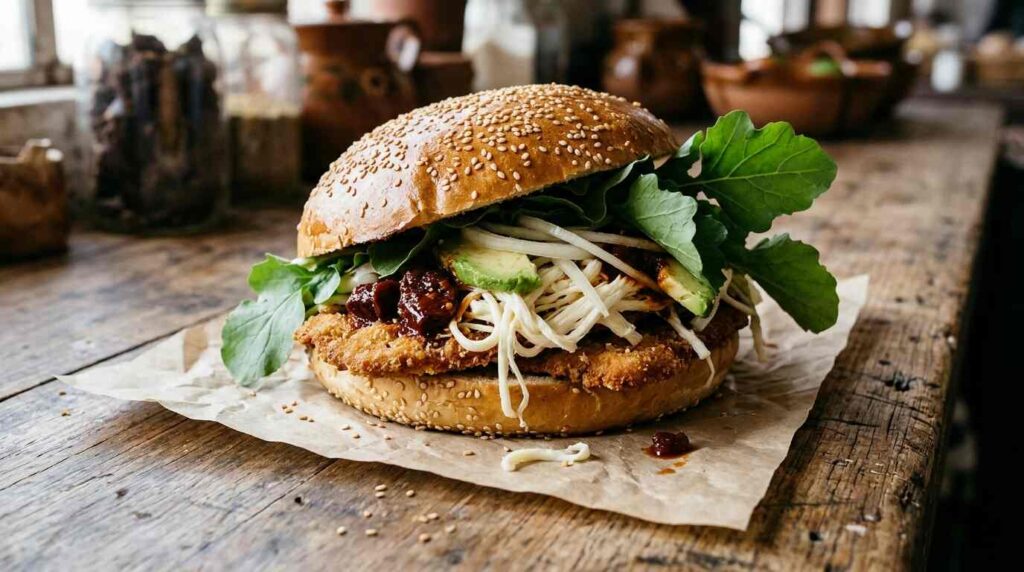
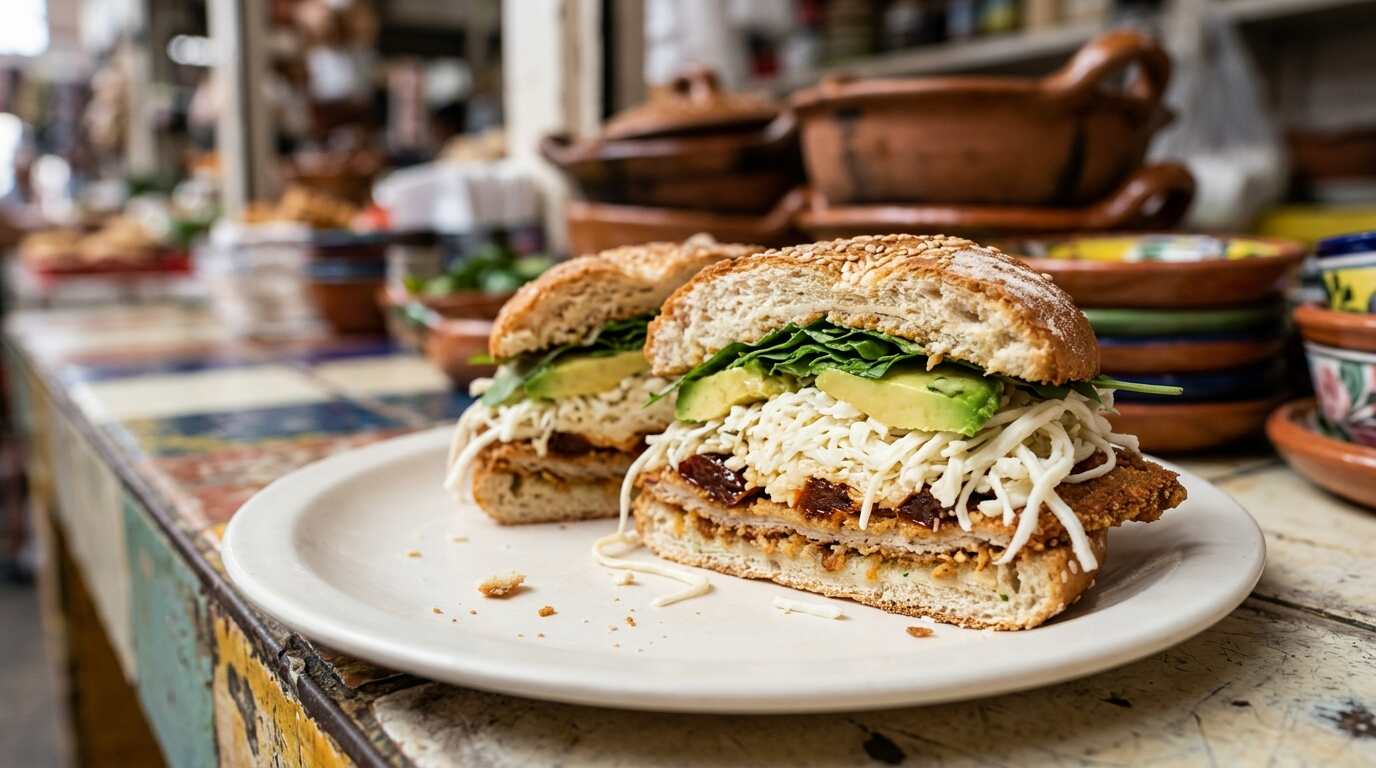
In Puebla, Mexico, the word cemita names two things at once: a sesame-covered roll and the sandwich built inside it, according to Cooksense. The sandwich is also called a cemita poblana, and it is the city’s best-known street and market food, usually stacked with a breaded cutlet, stringy Oaxacan-style cheese, avocado, onion, smoky chipotle chiles and a handful of a pungent herb called papalo. Writing in Saveur in 2011, Mauricio Velázquez de Leon called it “the queen of tortas”, a description that places it inside a Mexican sandwich family while claiming the top seat.
Video: Mexican STREET FOOD MARKET & GIANT Pulled Pork Sandwich (Cemita) in Puebla Mexico — from the Strictly Dumpling YouTube channel
The Roll Comes First
A sesame crust, a soft crumb, and an argument over eggs
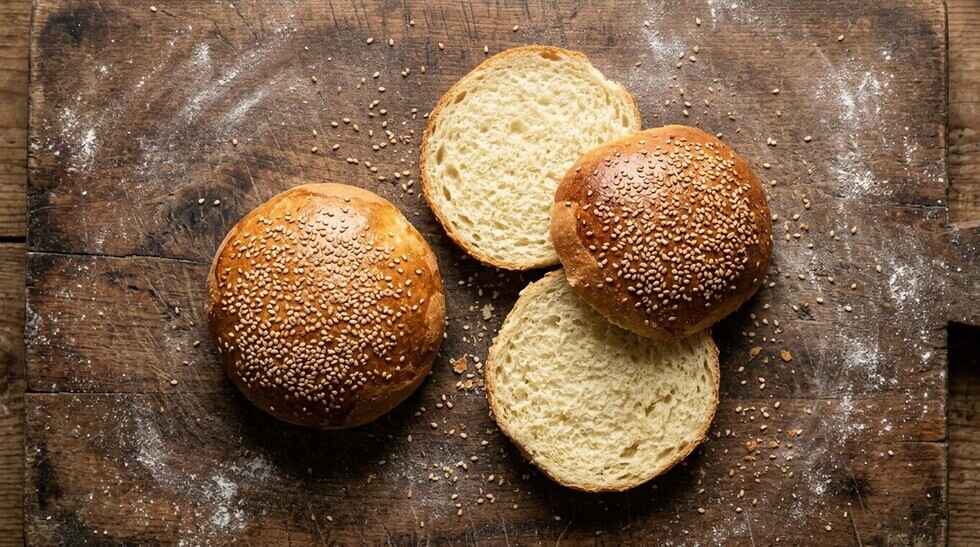
Most descriptions of the cemita begin with the bread rather than the filling. Saveur’s account calls the roll a “fluffy egg roll topped with sesame seeds”, and Table Journey describes it as egg-enriched and sesame-crusted, similar to brioche. Cooksense, by contrast, states that the roll is made without egg. The sources disagree, and no fetched baker’s account settles it.
What the sources do agree on is the crust and the size. A Chicago cemita shop owner interviewed by Sandwich Tribunal in 2015 described the roll as larger and stiffer than a hamburger bun, with a crusty exterior and slight sweetness. Rick Bayless, in his published recipe, writes that the bread is “perfectly crunchy and crusted with sesame” and offers a toasted telera roll as a substitute for cooks who cannot find the real thing.
The seeds sometimes do decorative work. The Mexican food site Mexicanist reports that bakers have shaped sesame seeds on the top of the roll into flowers, stars, animals, phrases, names and landscapes, and repeats an anecdote about General Maximino Ávila Camacho being served cemitas in Teziutlán with the town’s coat of arms drawn on them. The anecdote comes with no further documentation on the page.
In Puebla, the roll can carry the whole reputation of a shop. The 2026 Michelin Guide gave a Bib Gourmand to Semitas Beto in the Barrio de la Luz, and Table Journey notes that the award recognized the flaky crumb of its bread as much as anything inside it.
Where the Name Comes From
Bran, Semites, and a word that moved from the roll to the sandwich
The origin of the word cemita has no settled answer, and the fetched sources offer several.
The English-language Wikipedia entry reports that the Real Academia Española traces the word to acemite, an archaic Spanish word for bran, which in turn comes from Aramaic and is related to the Greek word for semolina. Wikipedia is used here only as a pointer to that dictionary entry; the Academy’s own page could not be fetched. Courthouse News, reporting from Puebla, supports the bran thread from a baker’s side: the bread was once called acemita, a mix of wheat bran and flour, and Puebla baker Muñoz described it as originally a poor person’s bread made from leftover wheat scraps.
A competing explanation ties the name to the word “Semite.” Researcher Barry Popik’s etymology file collects that claim along with others: a Wikipedia passage attributing the roll to Lebanese immigrants, and a 1992 text saying the bread is believed to be traditional for Semites. Popik does not reach a verdict, and he writes that the earliest sandwich-sense citation he found is from a 1997 cookbook by Nancy Zaslavsky, with the earliest newspaper link between the term and the sandwich coming in 2004.
Dated citations on the same page show the older spelling “semita” attached to sweet anise or cinnamon pastries in Texas and New Mexico newspapers from 1944 onward. That is a different product from the Pueblan roll, and the page treats the connection as unproven.
The spelling still varies in Puebla today. The Michelin-recognized shop, Semitas Beto, spells the word with an S, while other shops on the same Mexico Desconocido guide, such as Cemitas Lupita, use a C.
The Spanish Bread Story and Its Doubters
One account traces the roll to the colony; a baker finds no European ancestor
Mexicanist places the cemita’s roots in the colonial period. It says the bread was introduced by the conquistadors and later enriched by French influence, and it quotes Esperanza Toral calling the cemita “eminently Iberian”, the result of two bread varieties that Puebla paid as tribute to the Spanish crown. Table Journey tells a similar story, saying the roll is one that Spanish bakers brought to Puebla.
Courthouse News records a skeptical view. Muñoz told the reporter that some online rumors link the roll to the 1860s French intervention, but that he found no European predecessor for it. He added that the bread, once humble, is now also a bread for rich people.
The fillings changed more visibly than the bread. Mexicanist notes that in the nineteenth century, cemitas were filled with potatoes, beans and nopal, while the modern sandwich leans on meat and cheese.
Papalo, Quesillo and Chipotle
Three ingredients that separate a cemita from any other filled roll
Several of the fetched sources treat three ingredients as fixed. Mexicanist states that every cemita should include chipotle chile, quesillo and papalo leaves.
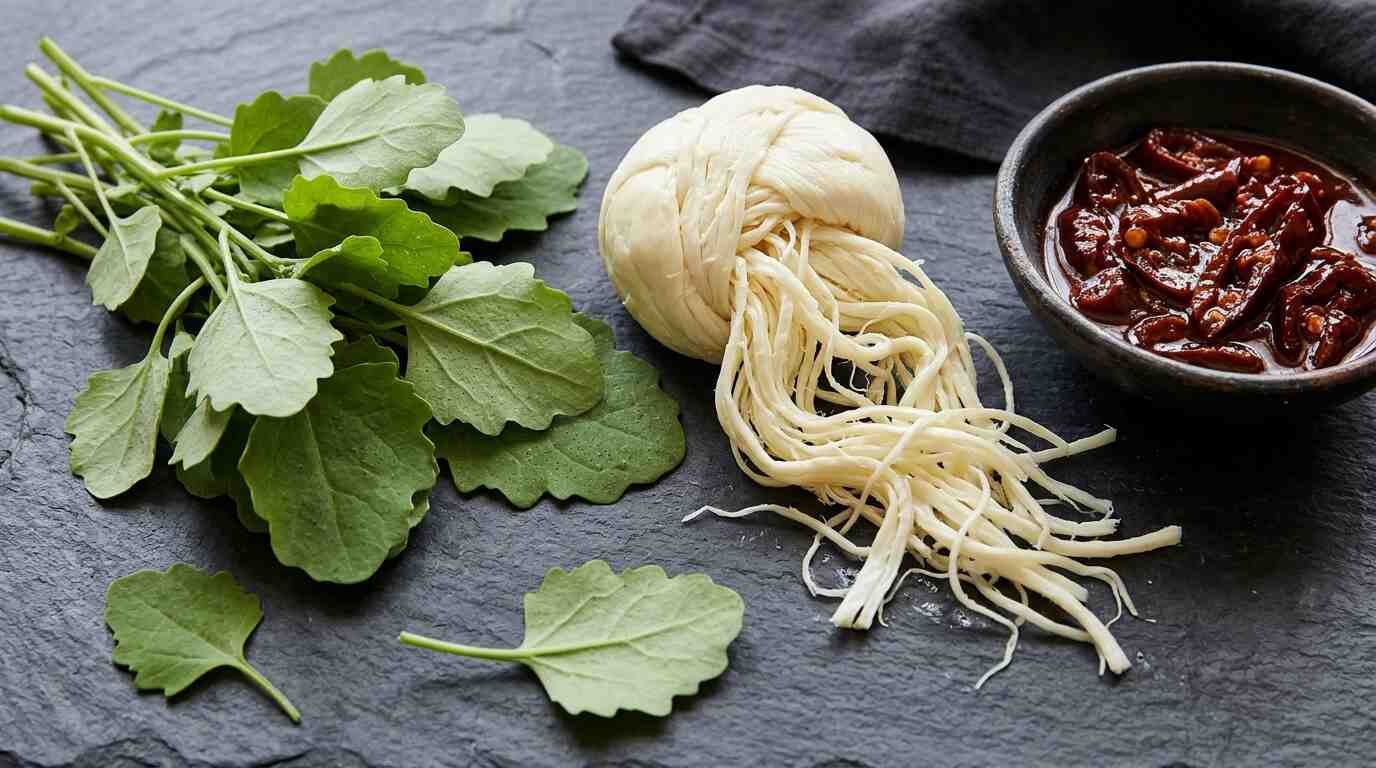
Papalo is the least familiar of the three outside Mexico. Table Journey describes it as a pungent herb that is never cooked and does not keep when dried, which is why it appears fresh and raw on the sandwich. Bayless relays that some say it tastes like a “muscley cilantro”, and Courthouse News cites chef Aliza Green’s comparison to a mix of arugula, cilantro and rue, and calls papalo the most divisive ingredient: Muñoz leaves it out, finding it “too intense,” while vendors say it aids digestion. Supply can be seasonal outside Mexico; the Chicago shop owner told Sandwich Tribunal in 2015 that papalo there ran roughly mid-June to mid-October.
Quesillo is Oaxacan-style cheese pulled into thin strings. Bayless describes it as fresh and rich. Courthouse News adds a wrinkle, reporting that Puebla and the neighboring state of Oaxaca both claim the origin of quesillo. Soft panela is the other white cheese the Chicago owner named as common.
Chipotle in a cemita is usually the pickled, sweet-sour kind sold in adobo. Bayless writes that the sweet-sour smoke and spice of the chipotles are unique to Puebla, and allows pickled jalapeños as a stand-in. Sandwich Tribunal reports that the Chicago owner’s father once carried chipotles back from Puebla when they were hard to find locally.
What Goes Between the Halves
Milanesa leads, and cow’s foot, ham and barbacoa follow
The breaded cutlet is the common anchor. Bayless states that in Puebla, cemitas are most often constructed with crispy-breaded milanesa, a cutlet coated in flour, egg and crumbs and fried. The Japanese katsu sando is another breaded-cutlet sandwich, with a history of its own.
Other fillings in the fetched sources run long. Courthouse News lists ham, pata (cow’s-foot cartilage in vinaigrette), chicken, barbacoa and pork in red chile paste, with cheese alone available for vegetarians. Saveur adds pierna en adobo and head cheese to the list. At Semitas Beto, according to the news site El Congresista, cemitas come with milanesa de cerdo, quesillo, avocado, pápalo and chile, with pata, chicken and ham among the alternatives.
Size matters to the reputation. Courthouse News reports that cemitas average just under two pounds. In 2022, Puebla’s Festival de la Cemita returned after a two-year pandemic pause with more than 50 stalls and a planned attempt at a record-size pork milanesa cemita weighing 15 kilograms, according to UnoTV.
Cemita Versus Torta
Same family, different bread and a different capital
Mexico’s torta is the broader category: a sandwich on a roll, built differently from region to region and most strongly identified in the Saveur piece with Mexico City. Velázquez de Leon writes that his Mexico City family regarded Puebla’s cemita as a rival regional favorite, comparing the situation to a New Yorker driving to Boston for a bagel.
Muñoz told Courthouse News that the cemita differs from the torta mainly in the bread: its shape and its recipe. Size is the second difference, since cemitas run large. The filling list is the third. Papalo is rare in a torta, while Bayless notes that a smear of beans, common on tortas, shows up in some cemitas but is not part of his recipe.
The overlap is real, and Cooksense itself classes the cemita as a kind of torta, calling it a torta originally from Puebla.
Markets, Michelin and Chicago
Where the sandwich is eaten and how it left Puebla
Saveur describes the Mercado del Carmen in Puebla as the place locals consider best for cemitas. A guide from Mexico Desconocido lists several named shops, including Cemitas Las Poblanitas in the El Carmen market, Cemitas El As de Oros in the Mercado de Sabores (more than 50 years of service, with milanesa and pata the standouts), and Semitas Beto in the La Acocota market.
That last name drew national attention. El Congresista reported on May 24, 2026 that Semitas Beto received a Bib Gourmand in the Michelin Guide Mexico 2026, an award for quality food at affordable prices, and that the shop works from family recipes passed down through generations.
Beyond Puebla, the sandwich has mostly spread through migration. The Sandwich Tribunal profile describes how Tony Anteliz’s parents, who came from Puebla, started Taqueria Puebla in Humboldt Park in Chicago after their travel agency closed, then renamed the business to feature the cemita. The article explains why Pueblan food was scarce there: Chicago’s Mexican community was mostly from Michoacán, Guanajuato and Jalisco. His father put it plainly: “Because there’s not too many Poblanos around here.”
Sources
- Cooksense, “Cemita” — https://cooksense.org/cemita
- Table Journey, “Cemita poblana” — https://tablejourney.com/dish/cemita-poblana/
- Table Journey, “What to order at Semitas Beto” — https://tablejourney.com/mexico/puebla/casual-dining/semitas-beto/
- Saveur, Mauricio Velázquez de Leon, “South of the Border,” March 18, 2011 — https://www.saveur.com/article/travels/South-Border-Latin-American-Sandwiches
- Courthouse News Service, “The cemita: A volcano-shaped — and -sized — must-eat when visiting Puebla” — https://www.courthousenews.com/the-cemita-a-volcano-shaped-and-sized-must-eat-when-visiting-puebla/
- Barry Popik, “Semita (Cemita)” — https://barrypopik.com/blog/semita_cemita
- Wikipedia, “Cemita” (used as a pointer to the Real Academia Española entry) — https://en.wikipedia.org/wiki/Cemita
- Mexicanist, “Cemita poblana: a delicacy filled with endless flavors” — https://www.mexicanist.com/l/cemita-poblana/
- Rick Bayless, “Pueblan Cemitas” — https://www.rickbayless.com/recipe/pueblan-cemitas/
- Sandwich Tribunal, “Cemitas: Pueblan Specialty, Chicago Favorite” (2015) — https://sandwichtribunal.com/2015/03/cemitas-pueblan-specialty-chicago-favorite
- El Congresista, “Semitas Beto distinción Bib Gourmand” — https://elcongresista.mx/semitas-beto-distincion-bib-gourmand
- Mexico Desconocido, “Dónde comer cemitas poblanas” — https://escapadas.mexicodesconocido.com.mx/donde-comer-cemitas-poblanas/
- UnoTV, “Festival de la cemita regresa a Puebla” (2022) — https://www.unotv.com/turismo/festival-de-la-cemita-regresa-a-puebla-luego-de-2-anos-de-pandemia/
Keep reading
- Bocadillo: Spain’s Crusty-Loaf Sandwich, Its Name and Its Regional Forms
- Choripán: The Argentine and Uruguayan Chorizo Sandwich, Its Name and Disputed Origins
- Francesinha: Porto’s Sandwich, Its Origin Story and the Sauce
More in this section: Sandwiches Around the World guide.