In this story
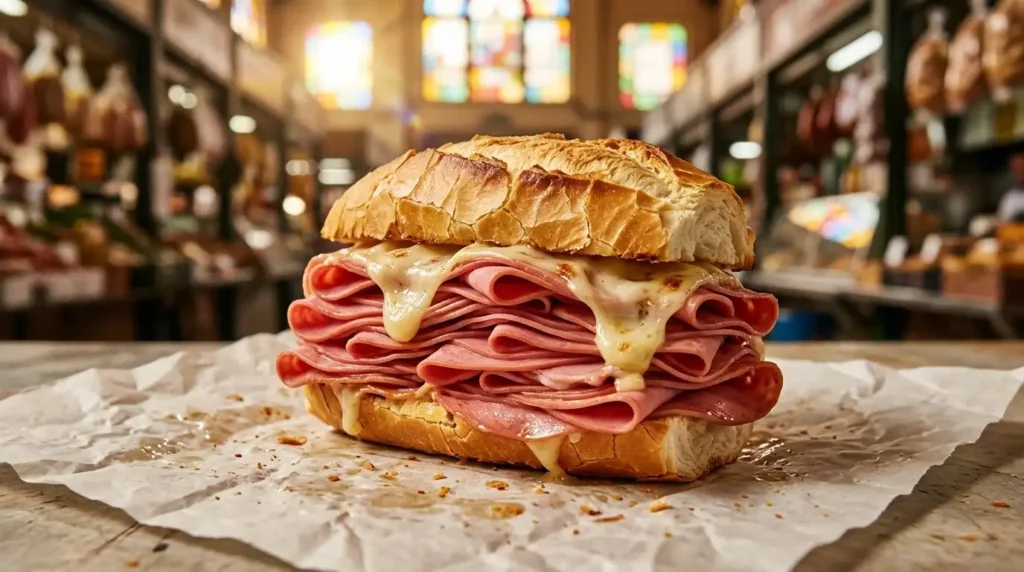
The sanduíche de mortadela is a roll stuffed with a heap of hot, thin-sliced mortadella, often with melted cheese, sold at the Mercado Municipal in central São Paulo. It is famous less for what is in it than for how much. Sources put the filling at around 300 to 350 grams.
Video: Brazilian STREET FOOD at Central Market!! MONSTER Mortadella Sandwich, from the Davidsbeenhere YouTube channel
The Mercadão
The Mercado Municipal de São Paulo, called the Mercadão, opened on January 25, 1933, according to Michelly Lelis of BaresSP, writing in April 2021. Two bars inside it are tied to the sandwich, and both date to the building’s opening.
Giulia Trecco, editor of São Paulo Secreto, wrote in March 2021 that the market then worked more as a wholesale hub than a tourist site, and that its snack bars served the people who worked there.
Bar do Mané
The bar at box 14 did not start under its current name. Trecco explains that bars were then called by their owners’ names, so it was first the Bar do Jeremias. Jeremias’s son, Mané, began working there at nine and stayed until he was 79. The bar took his name. His son, Marco Antonio, runs it now, the third generation.
Lelis lists its hours as starting at 4:30 a.m. Monday through Saturday, and 6 a.m. on Sunday.
Two origin stories
How the sandwich became so large has at least two versions, and neither is documented beyond the telling.
Trecco’s account, the most specific, involves price controls. A federal food-supply agency, the Superintendência Nacional de Abastecimento, set sandwich prices, she writes, so vendors gave very little filling. When the controls ended, Mané began adding more mortadella to make his bar stand out, and people started coming to the market for the sandwich alone. Marco Antonio kept the name and kept increasing the filling.
Culture Trip tells a different story, set in the 1930s. Market stalls, it says, sold stingy sandwiches at prices locals thought unreasonable. One customer complained so much that a cook filled a roll with an absurd amount of mortadella to quiet him; onlookers asked for the same, and the oversized sandwich became the market’s specialty. The page presents this as a story that is told, not as a documented event.
Both stories point toward Bar do Mané, or at least toward the market. The other bar has its own claim to the sandwich.

Hocca Bar
Hocca Bar, on mezzanine 5, was also opened when the building was new, by the Portuguese founders Horácio Gabriel and Maria de Deus Ferreira, according to Lelis. It later reformulated the mortadella sandwich, giving it a more polished form. Lelis reports that Horácio Gabriel received the José de Anchieta medal for making the pastel de bacalhau, a salt-cod pastry, and the mortadella sandwich into symbols of São Paulo.
That leaves a split credit. São Paulo Secreto places the sandwich’s origin at Bar do Mané; the city honored Hocca’s founder for making it a symbol. Both bars serve it today.
How much meat
The weight varies by source and probably by year. Lelis gives about 300 grams of filling on fresh French bread at Bar do Mané. Trecco, writing the same spring, puts it at about 350 grams. Culture Trip says roughly 10 ounces, which is just under 300 grams.
Trecco records that the mortadella is Ceratti, and that the owner credits the sandwich’s success to freshness: the bar goes through so much that the meat reaches the plate fresh. Culture Trip adds that Ceratti is made only in São Paulo.
The bread is pão francês, which Culture Trip describes as a Portuguese-style roll common in Brazil; Lelis calls it fresh French bread. Trecco notes that some customers add queijo prato, a mild Brazilian cheese, and that tomato and lettuce are available.

Mortadella in Brazil
Mortadella is Italian in origin, a large cooked pork sausage associated with Bologna and covered in Grill Cheesy’s mortadella post. In São Paulo it became the center of a sandwich that is almost entirely meat.
For another sandwich known mainly for the height of its meat, see Katz’s Delicatessen in New York.
Lelis also lists turkey breast, salami and ham sandwiches at Bar do Mané, all heavily filled, and a mortadella croquette, the bolinho de mortadela.

Questions people ask
Where is the famous mortadella sandwich in São Paulo? At the Mercado Municipal, mainly at Bar do Mané (box 14) and Hocca Bar (mezzanine 5).
How much mortadella is in it? About 300 grams, per BaresSP; about 350 grams, per São Paulo Secreto.
Who invented it? Most sources credit Bar do Mané. Hocca Bar’s founder received a city medal for making it a São Paulo symbol.
What mortadella is used? Ceratti, according to São Paulo Secreto and Culture Trip.
What bread is it served on? Pão francês, a Portuguese-style roll common in Brazil.
Sources
- Michelly Lelis, BaresSP, Principais restaurantes do Mercado Municipal de São Paulo (Apr. 8, 2021): https://www.baressp.com.br/noticias/principais-restaurantes-do-mercado-municipal-de-sao-paulo
- Giulia Trecco, São Paulo Secreto, Bar do Mané e a história do sanduíche de mortadela mais famoso de SP (Mar. 24, 2021): https://saopaulosecreto.com/bar-do-mane-sanduiche-de-mortadela/
- Culture Trip, São Paulo’s Iconic Sandwiches Will Make Your Mouth Water (undated): https://theculturetrip.com/south-america/brazil/articles/sao-paulos-iconic-sandwiches-will-make-your-mouth-water