In this story
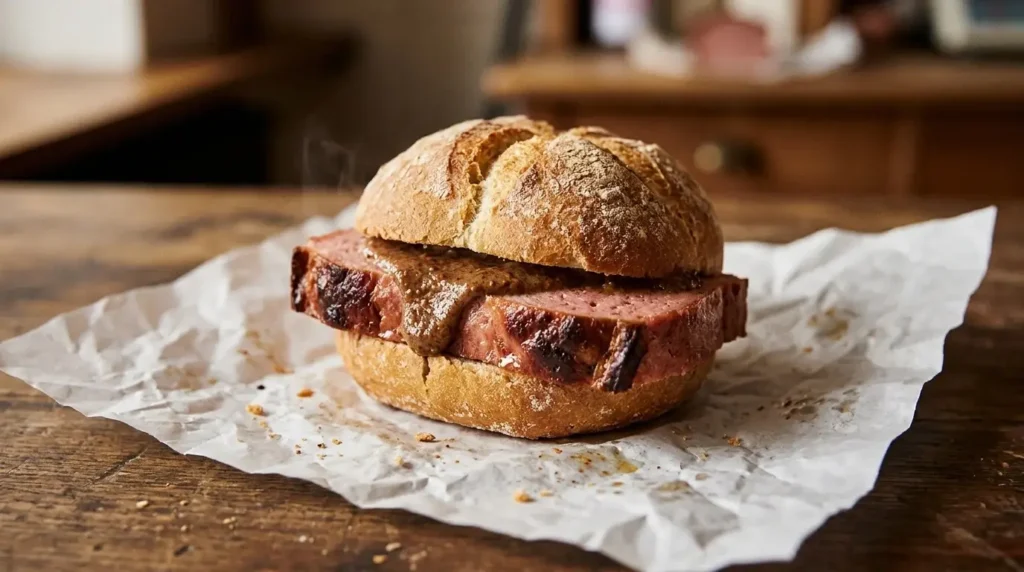
A Leberkäse Semmel, or Leberkässemmel, is a thick, hot slice of baked meat loaf tucked into a crusty white roll, usually with mustard. It is eaten hot across Bavaria and Austria, and it is a fixture of Vienna’s sausage stands. The name means “liver cheese.” In Bavaria, the meat usually contains neither.
Video: Münchner Weißwurst-Gschichten: Leberkassemmel, from the münchen.tv YouTube channel
A loaf of fine sausage
Leberkäse is a sausage that never goes into a casing. Austria’s agriculture ministry, in its register of traditional foods, classifies it as a Brühwurst, an emulsified cooked sausage, made from finely minced beef and/or pork, bacon, water, potato starch and spices such as garlic, pepper, mace, allspice, onion and sweet paprika.
The method is specific. According to the ministry, the meat is chopped very fine with ice or water, curing salt, phosphate and spices, and diced bacon goes in last. The mixture is kept airy, “flaumig,” or fluffy, unlike a dense sausage. It is packed into greased rectangular pans and baked at 150 to 180°C, often with the top scored to form a crust.
The ministry adds a practical point about its history. The modern product depends on the meat cutter and on refrigeration, since ice is needed to bind the mass.
The liver question
German food guidelines treat Bavaria as the exception. The Leitsätze für Fleisch und Fleischerzeugnisse, the meat guidelines of the German Food Book, published in their 2022 revision in the Bundesanzeiger, list liver among the ingredients of Leberkäse but note that Leberkäse in Bavaria usually contains no liver, and that liver-free Leberkäse made the same way outside Bavaria may be sold as “Bayerischer Leberkäs(e).”
Two named variants have a set minimum. The same guidelines give Stuttgarter Leberkäse and coarse Leberkäse at least 5 percent liver.
A widely repeated figure says ordinary Leberkäse elsewhere in Germany must contain at least 4 percent liver. That number does not appear in the guideline text fetched for this post, which names liver as an ingredient for Leberkäse without a percentage. Grill Cheesy reports the 5 percent rule for the two named variants and leaves the 4 percent claim unconfirmed.
Austria went the other way over time. The Austrian ministry says its 1913 food codex listed 10 percent liver, and that cookbook recipes from 1930 used 20 to 50 percent, but that liver is no longer expected today.

Loaf cheese, or rennet, or a mass
The name has several explanations. The Austrian ministry tells the legend that a butcher thought the loaf looked like a cheese and called it “Lääb Kees,” loaf cheese, which became “Leberkäse.” It adds that linguists disagree, with proposed roots in the Middle High German words for rennet (lab) and loaf (laib), and käs meaning a compact mass.
The Sword and the Sandwich, a sandwich newsletter, reported in August 2024 that the Bavarian dialect scholar Ludwig Zehetner traces “Leber” to “Laib” and “Käs” to an edible mass, making the name roughly “a loaf of edible mass.” The newsletter treats the dialect-pun version, in which a Palatinate butcher’s “Laib Kas” was misheard, as too convenient.
The court butcher who may not have existed
The popular origin story involves an elector and his butcher. In the Austrian ministry’s telling, Karl Theodor, Elector of the Palatinate, inherited Bavaria in early 1778 after the death of Maximilian III and moved his court from Mannheim to Munich. A butcher he brought from Mannheim first baked minced pork and beef in a loaf, according to the legend.
Many retellings date this to 1776, a date The Sword and the Sandwich notes is wrong: Karl Theodor took power in Bavaria in 1778, which matches the Austrian ministry’s chronology.
The Sword and the Sandwich tried to find the butcher. Its author contacted German institutions and found nobody who could name him. Anja Lochbrunner of the Bavarian Academy of Sciences found records of two Munich court butchers, Sebastian Hofmann and Johann Seyfried, hired before Karl Theodor took over, and no official court butcher in Mannheim. Historian Susan Richter told the newsletter that court salary lists do not record specific products. The author concluded the “ghost butcher” is most likely a fiction.

Ordering one
The roll is the common form. The Austrian ministry calls the Leberkäsesemmel the most popular way to eat it in Austria and a standard item at the Viennese Würstelstand. Leberkäse is also served in slices with mustard, fried with an egg, or in a salad.
Some customers ask for a specific piece. The ministry notes that regulars may request the Scherzl, the drier end of the loaf, with more crust.
Austria also allows other meats if declared. The ministry says that when meat from other animals is used, as with horse Leberkäse, it must be stated on the label. The Sword and the Sandwich adds that the horse version is more popular in Austria than in Germany.

A cousin on the deli counter
Another finely ground cooked meat on Grill Cheesy is Italian mortadella. For the bread side of the story, the history of the Kaiser roll covers another Austrian roll.
Sweet mustard
- Händlmaier’s Sweet Bavarian Mustard, 13.4 oz.: a jar of Bavarian sweet mustard for Leberkäse and other sausages. See it on Amazon (affiliate link)
As an Amazon Associate I earn from qualifying purchases. A commission may be earned if you buy through this link, at no extra cost to you.
Questions people ask
Does Leberkäse contain liver? In Bavaria, usually not. German guidelines allow liver-free “Bayerischer Leberkäse”; Stuttgarter Leberkäse needs at least 5 percent liver.
Does Leberkäse contain cheese? No. “Käse” in the name refers to the loaf’s shape or mass, not to cheese.
What is a Leberkässemmel? A thick slice of hot Leberkäse in a crusty roll, usually with mustard.
Who invented Leberkäse? Legend credits Karl Theodor’s court butcher, around 1776 or 1778, but no record of that butcher has been found.
What is the difference between Leberkäse and Fleischkäse? Fleischkäse is a common name for the same kind of loaf, especially outside Bavaria; German guidelines list no liver for Fleischkäse.
Sources
- Austrian Federal Ministry of Agriculture, traditional foods register, “Leberkäse”: https://www.bmluk.gv.at/themen/lebensmittel/trad-lebensmittel/Fleisch/Fleischprodukte/leberkaese.html
- German Food Book Commission, Leitsätze für Fleisch und Fleischerzeugnisse, revision of April 14, 2022, Bundesanzeiger (BAnz AT 28.07.2022 B1): https://www.bundesanzeiger.de/pub/publication/KCO26oi03c5v82DIgCB/content/KCO26oi03c5v82DIgCB/BAnz%20AT%2028.07.2022%20B1.pdf?inline
- The Sword and the Sandwich, “Notable Sandwiches #106: Leberkäse” (August 16, 2024): https://buttondown.com/theswordandthesandwich/archive/notable-sandwiches-106-leberkase