In this story
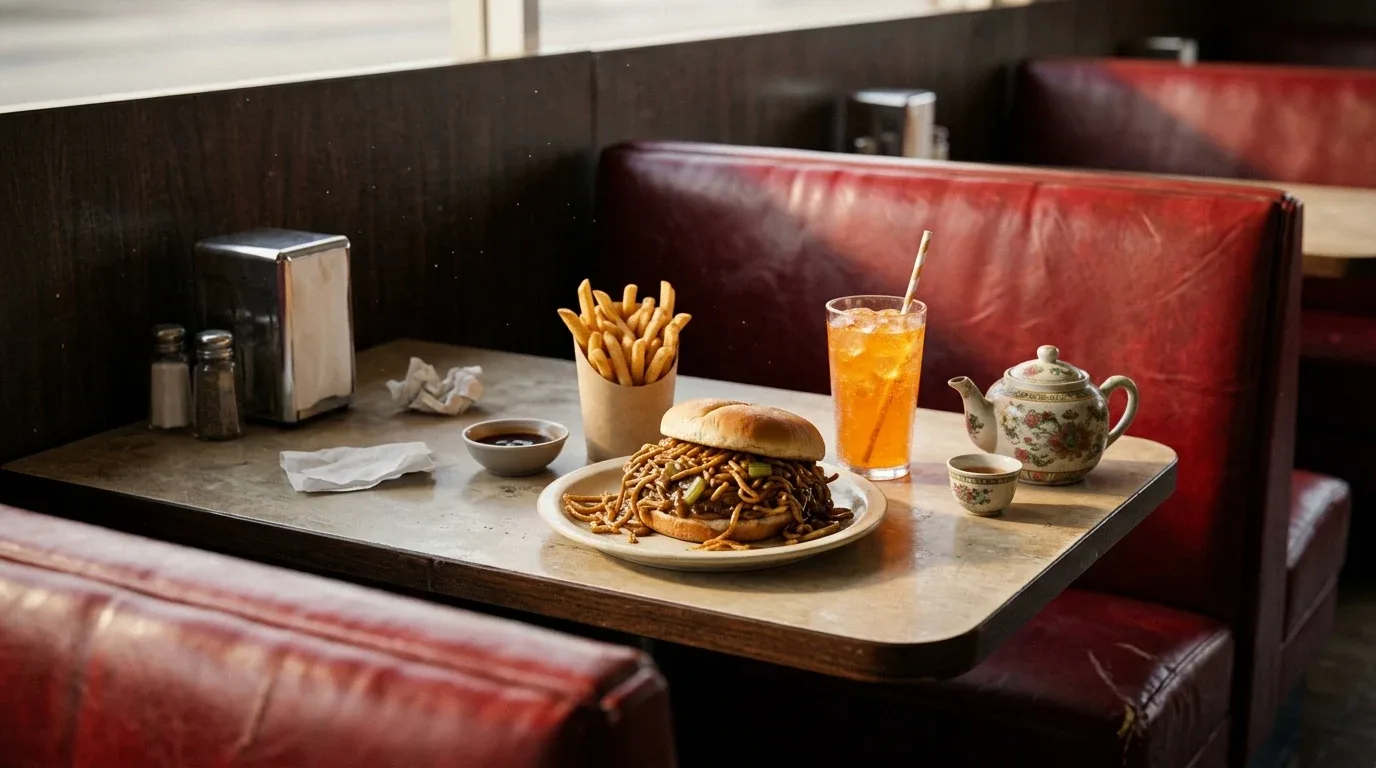
The chow mein sandwich is a pile of crispy fried noodles under brown gravy, often with meat, celery, onion and bean sprouts, served between the halves of a plain hamburger bun. It belongs to Fall River, Massachusetts, a former textile-mill city, and to the Chinese restaurants that fed its mill workers. It is often eaten with a fork.
Video: Feast on the Fall River Chow Mein and the Salem Chop Suey… sandwich, from the Chronicle 5 WCVB YouTube channel
What goes in it
The sandwich is Chinese-American chow mein with a bun added. Katherine Keenan of Yankee Magazine, in a piece first published in 2019 and updated in 2022, describes the typical components: brown sauce, chunks of meat, diced celery, onions and bean sprouts poured over crunchy deep-fried noodles. Customers can also order it “strained,” without the vegetables or the meat.
The noodles are the point. Sarah Mizes-Tan of WCAI, in a June 2019 report published by GBH, quoted Fall River native Dave Lussier saying the noodles set it apart. He recommended topping it with vinegar.
Eating it by hand is mostly theoretical. Keenan calls it immensely difficult to eat with the hands and used a fork; Lussier joked to WCAI that you can’t pick it up.
Mill workers and a nickel
The sandwich grew out of Fall River’s industrial workforce. Mizes-Tan reports that it rose to popularity in the early 1900s, driven by textile workers who had immigrated from Poland, Ireland and French Canada. Chinese immigrants had arrived in Fall River from the late 1800s, she writes, many moving east after the Chinese Exclusion Act of 1882; many opened laundries, some of which added tea rooms that grew into restaurants.
Putting the food on a bun was a bridge. According to Mizes-Tan, restaurant owners served it as a sandwich because European immigrant workers knew sandwiches better than Chinese food. The anthropologist Imogene Lim, who studied the sandwich for her Brown University dissertation, summed it up for WCAI: “The identity is American, but uniquely Fall River.”
At its peak the sandwich sold for a nickel. Leslie Landrigan of the New England Historical Society, writing in 2014, adds that it fed students as well as mill workers, and that a meatless version was sold to Catholics on Fridays.

Who started it, and when
The sources do not agree. WCAI places its rise in the early 1900s. Landrigan describes it as a 1930s American Chinese food and does not credit any one person with inventing it. Atlas Obscura, in an undated entry with no author, credits Frederick Wong with creating it in the 1920s while working in his family’s Fall River restaurant, around New Englanders’ fondness for gravy.
The bun has its own small story. Regina Mark, co-owner of the Fall River restaurant Mee Sum, told Keenan that the restaurant once served chow mein with bread to soak up the gravy, and when it ran out of bread it used hamburger buns instead. The practice stuck. That is one restaurant’s account of its own menu, not a claim about the sandwich’s first appearance.
What the sources share is the place, the mill-worker customers and a date range somewhere between the early 1900s and the 1930s.
The Wong family and Hoo-Mee
The noodle company is better documented than the sandwich. Landrigan writes that Frederick Wong left Canton in 1926 intending to study at Salem State, stopped in Fall River to visit an uncle who owned the Hong Kong Restaurant, and spent about ten years cooking noodles there while saving money. In 1938 he opened the Oriental Chow Mein Company in a brick building on Eighth Street, at first selling chow mein mix, crispy noodles and bean sprouts to local restaurants.
Just before the Second World War, Landrigan writes, the company began packing noodles and gravy mix in yellow boxes under the Hoo-Mee name. His son Albert married Barbara Wong in 1953, and after Albert’s death in the 1990s she joined the business and became its public face.
The company has had setbacks. Landrigan reports that a 2009 fire destroyed the Eighth Street factory and that the business was back within about six months. Atlas Obscura lists it at 42 8th Street. In May 2025, CBS Boston reported the noodles temporarily out of stock after a mechanical failure.
Video: Fall River's famous Hoo-Mee Chow Mein noodles temporarily out of stock, from the CBS Boston YouTube channel

Beyond Fall River
The sandwich traveled, a little. Landrigan writes that it was sold along the East Coast as far as Coney Island, where Nathan’s Famous carried it; Atlas Obscura says the same. In Massachusetts it has a cousin: Keenan describes the chop suey sandwich of Salem, meat and vegetables with extra bean sprouts on a hamburger bun, as a separate specialty.
Mee Sum, which had served the sandwich for more than 50 years and drew national attention in 2019, closed permanently in January 2025, according to an editor’s note on Keenan’s article. Keenan points home cooks to Hoo-Mee noodles, sold online and in many southeastern New England supermarkets.
The noodles and gravy
- Fried Chow Mein Noodles 1 pound bag: crispy fried noodles from the Oriental Chow Mein Company of Fall River. See it on Amazon (affiliate link)
- Hoo-Mee Gravy Mix: the same company’s brown gravy mix. See it on Amazon (affiliate link)
As an Amazon Associate I earn from qualifying purchases. A commission may be earned if you buy through this link, at no extra cost to you.
Questions people ask
What is a chow mein sandwich? Crispy fried noodles with brown gravy, often with meat and vegetables, on a hamburger bun.
Where is the chow mein sandwich from? Fall River, Massachusetts.
Who invented the chow mein sandwich? Undocumented. Atlas Obscura credits Frederick Wong in the 1920s; the New England Historical Society names no inventor and dates it to the 1930s.
Why is it on a bun? To appeal to European immigrant mill workers who knew sandwiches, per WCAI; Mee Sum’s owner says the restaurant switched to buns when it ran out of bread.
What are Hoo-Mee noodles? The fried chow mein noodles and gravy mix made by Fall River’s Oriental Chow Mein Company since 1938.
Sources
- Sarah Mizes-Tan, WCAI / GBH, How The Chow Mein Sandwich Claimed A Small Slice Of New England History (June 24, 2019): https://www.wgbh.org/news/local/2019-06-24/how-the-chow-mein-sandwich-claimed-a-small-slice-of-new-england-history
- Leslie Landrigan, New England Historical Society, Fall River’s Famous Chow Mein Sandwich (Jan. 18, 2014): https://newenglandhistoricalsociety.com/fall-river-famous-chow-mein-sandwich/
- Katherine Keenan, Yankee Magazine, The Chow Mein Sandwich of Fall River, Massachusetts (2019, updated July 29, 2022): https://newengland.com/today/travel/massachusetts/fall-river-chow-mein-sandwich/
- Atlas Obscura, Chow Mein Sandwich (undated): https://assets.atlasobscura.com/foods/chow-mein-sandwich