In this story
Schwartz’s Montreal Hebrew Delicatessen sits at 3895 Saint-Laurent Boulevard, on the street Montrealers call “the Main,” and its own website gives the year it started making smoked meat as 1928. Tastet, a Montreal restaurant guide, credits the founding to Reuben Schwartz, a Romanian immigrant, and describes a 62-seat room whose decor has barely changed in about 90 years. The deli is formally the Montreal Hebrew Delicatessen. Customers have long called it simply Schwartz’s, and in the French of the neighbourhood, Chez Schwartz.
Video: Sandwiches of Canada – Montreal Smoked Meat (Schwartz’s – Montreal QC) – Sandwich Dad — from the Sandwich Dad YouTube channel
A Romanian Immigrant and a Kosher Tradition
Reuben Schwartz opened the doors in 1928, and the meat he sold had a longer history on the same boulevard
Tablet magazine states that Schwartz’s “was started by a Romanian immigrant named Reuben Schwartz in 1928.” CBC’s report on the 2012 sale gives the same account: a Jewish immigrant from Romania, 1928. Wikipedia, which is used here only as a pointer because the page cites a long list of newspapers and books, narrows the founding to 31 December 1928.
Who first made smoked meat in Montreal is a separate and disputed question. Tourisme Montréal’s guide to smoked meat calls the history “shrouded in mystery” while noting that every account leads back to Jewish immigrants from Romania or Eastern Europe. One account credits Benjamin Kravitz, who left Lithuania in 1899 and sold smoked meat sandwiches from a fruit and candy store on Saint-Laurent, with his own brisket-curing technique; his business later became Ben’s De Luxe. Another gives the credit to Schwartz. The historian Eiran Harris, according to the same guide, disputes both and points to Aaron Sanft, a butcher from Romania, who opened Montreal’s first kosher butcher shop in 1884 and advertised smoked meat. Tastet repeats the Sanft story with a hedge: it “goes that it dates to 1884.”
None of the sources settles the matter, and none of them needs to for Schwartz’s purposes. The deli’s claim is to 1928 and to continuous operation on one block of the Main, a standing that Tourisme Montréal summarizes by calling the deli “touted to be the oldest deli in Canada.”
How the Smoked Meat Is Made
Brisket, a spice cure measured in days, hours in the smoke, and a long steam
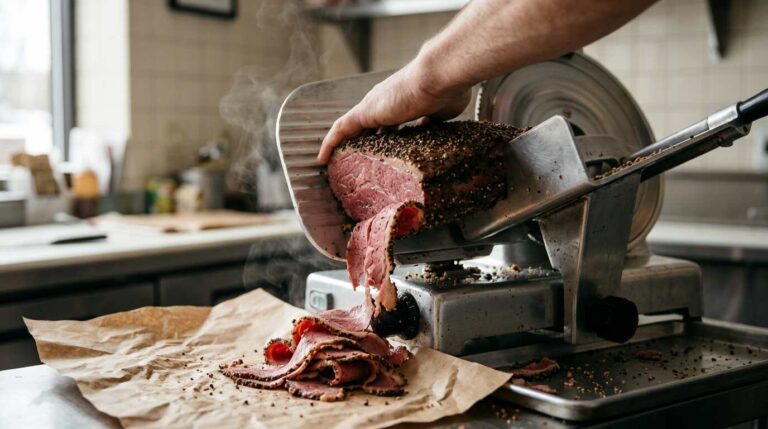
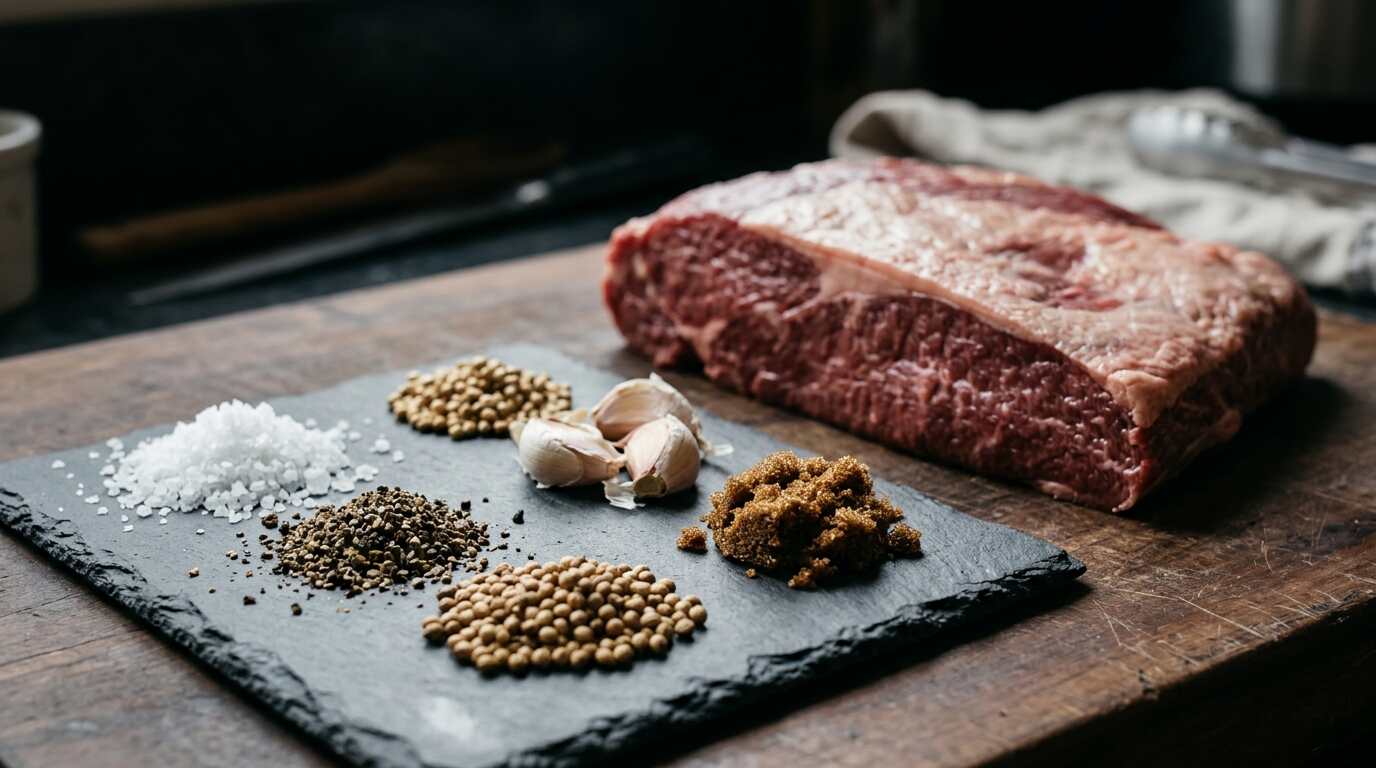
The raw material is brisket. Tastet describes brisket or lower breast meat cured for 10 to 12 days in a house spice mixture of salt, coriander, black pepper, garlic and sugar, with no preservatives. After curing, the meat is smoked for 8 to 9 hours in the deli’s own brick smokehouse and then steamed for three hours. It is cut by hand with a knife. A 2007 review of the documentary Chez Schwartz in the Forward gives a nearly identical sequence: ten days marinating in dry spices and the meat’s own juices, eight hours of smoking, and three hours of steaming.
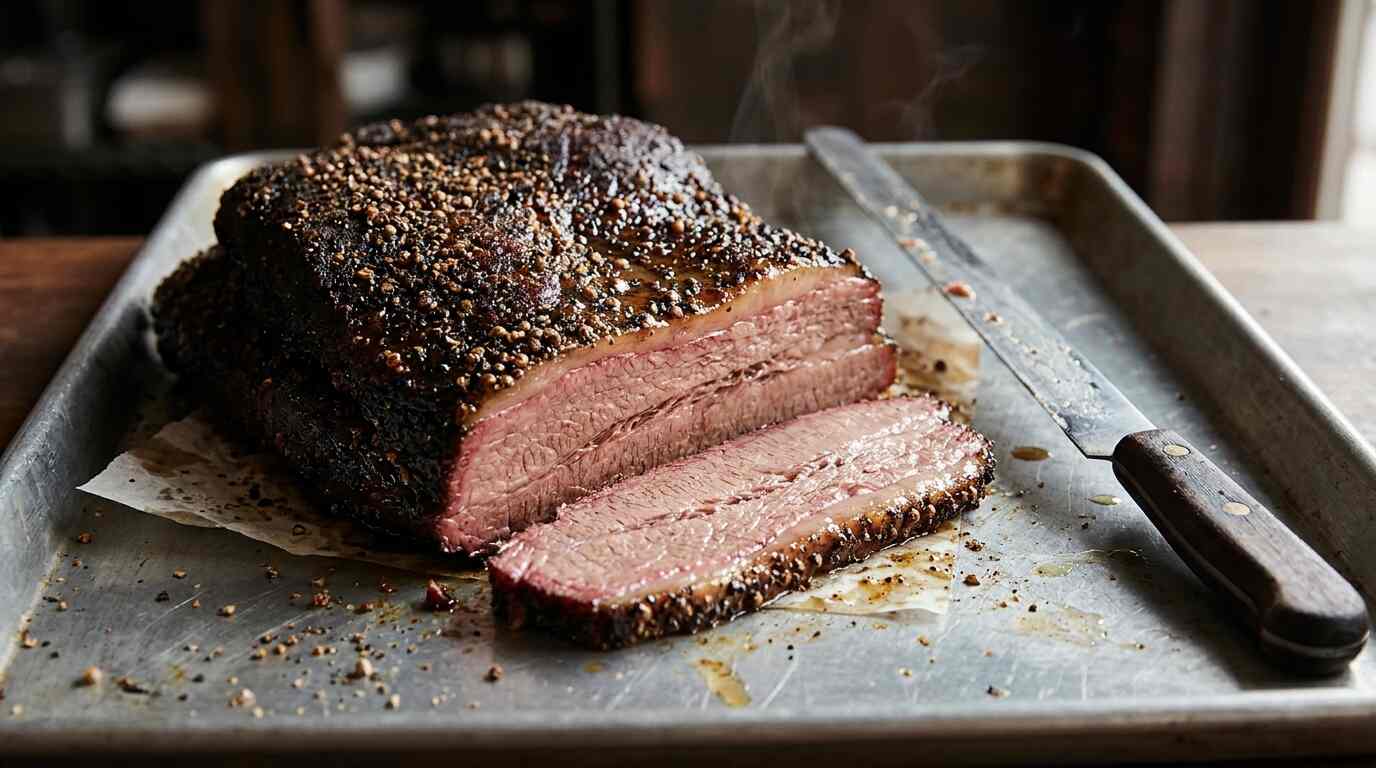
Manager Frank Silva, quoted by Tastet, attributes the lack of chemicals to economics rather than principle: “It was cheaper at the time to use natural products than chemicals.” The Forward’s film review sets that approach against New York pastrami, which it describes as injected with nitrates and brined.
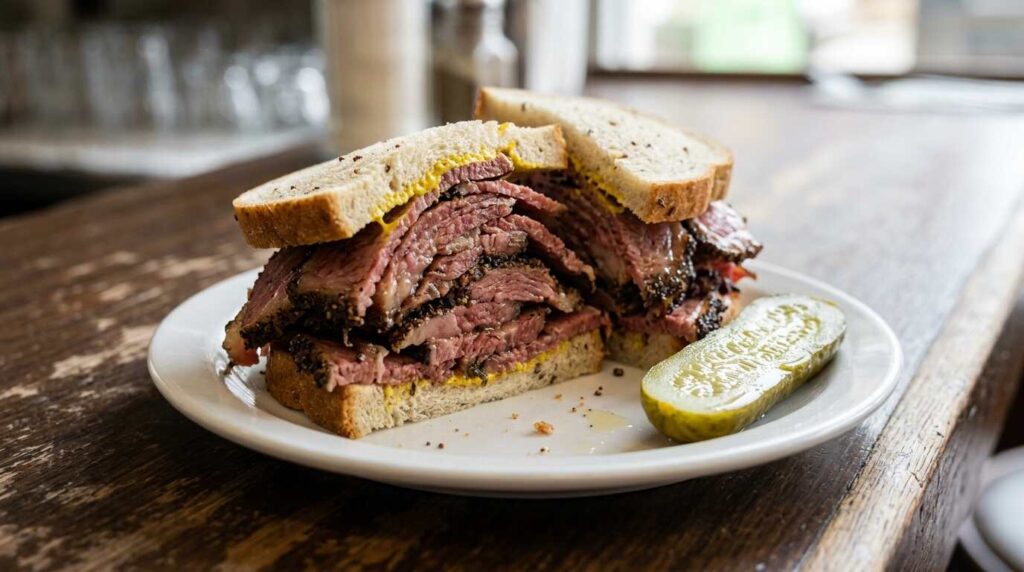
The Michelin Guide’s entry summarizes the result in one line: brisket marinated in a house spice blend, smoked, steamed, thinly sliced and served on rye with mustard. The Tourisme Montréal guide adds some context for the cure. In the traditional method, it says, dry-cured brisket was packed in barrels to marinate in its own juices for up to a month and smoked for up to ten hours; modern producers often shorten the marinating to a few days. The cure of 10 to 12 days at Schwartz’s sits between those two poles.
One detail is reported differently depending on the source. Tastet refers to a brick smokehouse. Wikipedia says that because wood smoking was banned in city restaurants, the deli has used an electric smoker for more than 50 years. A legend recorded in Tablet holds that the meat tastes the way it does partly because it has been smoked “in the same place since the very beginning,” leaving residue in the smokehouse. The legend is a legend, as Tablet labels it, and the two physical descriptions are not necessarily in conflict.
Ordering by Fat Content
Lean, medium, medium-fat and fat describe where on the brisket the slices come from
Montreal smoked meat is sold by fat. The Tourisme Montréal guide defines lean as the drier, less flavourful cut from the flat of the brisket, medium as the most popular cut from the middle with a mix of lean and fatty meat, and “old-fashioned” as slices between medium and fatty, often cut thicker. Wikipedia lists the Schwartz’s grades as lean, medium, medium-fat and fat, with medium and medium-fat the most popular.
The guide also notes a structural difference from pastrami: pastrami uses the leaner navel cut, while Montreal smoked meat uses the whole brisket, fattier sections included. The classic sandwich, in the guide’s description, is piled high on rye with yellow mustard, and the guide cautions against asking for mayonnaise. Michelin’s inspectors point to a cherry soda as the traditional drink alongside it. The guide to smoked meat suggests a half-sour pickle and fries.
The Michelin entry mentions that lines can be avoided by arriving off-peak, sitting at the counter or sharing a table, and it labels the restaurant “Worth Queueing For.” The Forward’s film review records that lines formed even in harsh Montreal weather.
Owners From Reuben Schwartz to the Present
A founder who struggled with money, a violinist, a Parisian-born caretaker, an accountant, and, since 2012, two families
Ownership of Schwartz’s has changed hands only a handful of times, and each owner has a recorded personality. The Montreal Review of Books, in its review of Bill Brownstein’s Schwartz’s Hebrew Delicatessen: The Story, calls Reuben Schwartz a “difficult and demanding” boss and says the deli would have gone bankrupt without the financial help of the musician Maurice Zbriger. Brownstein’s book, published by Véhicule Press in 2006, is described by a Canadian digital library listing as beginning with Reuben Schwartz in 1928 and moving through “a series of eccentric successors.”
Zbriger was a violinist and composer. The National Film Board of Canada’s page for The Concert Man, a short documentary about him, states that he owned Schwartz’s and that income from it financed the free concerts he organized. The Montreal Review of Books adds a scene: Zbriger would arrive with his classical group in evening wear, take a table and sing arias, while regulars paid no attention. Wikipedia places his ownership at 1971 to 1981.
After Zbriger, the deli passed to Armande Toupin Chartrand, whom the Montreal Review of Books calls his right-hand woman. She was Parisian-born, hosted friends for late-afternoon high tea at the deli, and insisted on a checked tablecloth for her table. She later sold to Hy Diamond, and the review notes that Diamond declined offers to franchise, saying the deli “wouldn’t be the same.” Wikipedia dates the Chartrand years to 1981 to 1999 and Diamond’s to 1999 through 2012.
On 5 March 2012, according to the announcement distributed through Newswire, the Nakis family and the Angélil-Dion family bought Schwartz’s. Anastasia Nakis, granddaughter of the restaurateur Paul Nakis, spoke for one side and René Angélil for the other; Angélil’s nephews Martin and Eric Sara were also involved. The release says the owners intended to keep the restaurant’s consistency and high standards and would not franchise. CBC reported the price as an undisclosed sum and quoted the owners on character: “It’s truly one-of-a-kind, and we intend to keep it this way.” The Forward later quoted Angélil: “It’s the most unique restaurant in the world and we’re thrilled to be a part of it.”
The Forward adds that Jewish customers were initially skeptical of non-Jewish ownership, and that Silva said the customers stayed satisfied because the deli’s traditions did not change. His account of how it runs: “We run the show, and as long as the line is around the block, [the owners] let us do our jobs.”
A Jewish Deli That Became a Montreal Institution
The clientele changed long before the menu did
Tablet records that Schwartz’s earliest patrons were exclusively Jewish, a contrast with the present, when only a small share of customers are. The Forward’s film review puts that share at about 5 to 10 percent and describes patrons switching easily between English and French. It also says the restaurant is now considered part of Quebec’s heritage, though no formal heritage designation appears in the sources consulted here.
The deli’s standing with critics and guides has followed. Michelin’s inspectors call it “quintessentially Montreal,” and note a wall of photographs and articles documenting its history, with a centenary due in 2028. The Suburban reported that the deli was placed on the guide’s list of selected restaurants in the Québec edition, in the company of Au Pied du Cochon, Joe Beef and Toqué!, and gave the corporation’s legal name as Charcuterie Hebraique de Montréal Inc. General manager Frank Silva, in that report, called the listing “a nice little souvenir” and said “this, I think, takes the cake.”
Tastet notes multi-generational loyalty, with adults who came as children now bringing their grandchildren, and lists the deli among Montreal’s best delis and its oldest restaurants. The Forward’s film review records the human side of the Main: veteran staff with around 40 years of service, and a handful of panhandlers who held spots outside for up to 15 years.
Where Montreal Smoked Meat Sits Among Deli Sandwiches
A close relative of pastrami and corned beef, with its own cut, cure and cut of the knife
Montreal smoked meat shares a lineage with the Jewish deli meats of New York and Los Angeles. The American pastrami sandwich has its own history, covered in the pastrami on rye post, and two of its best-known homes are profiled in the posts on Katz’s Delicatessen and Langer’s Deli.
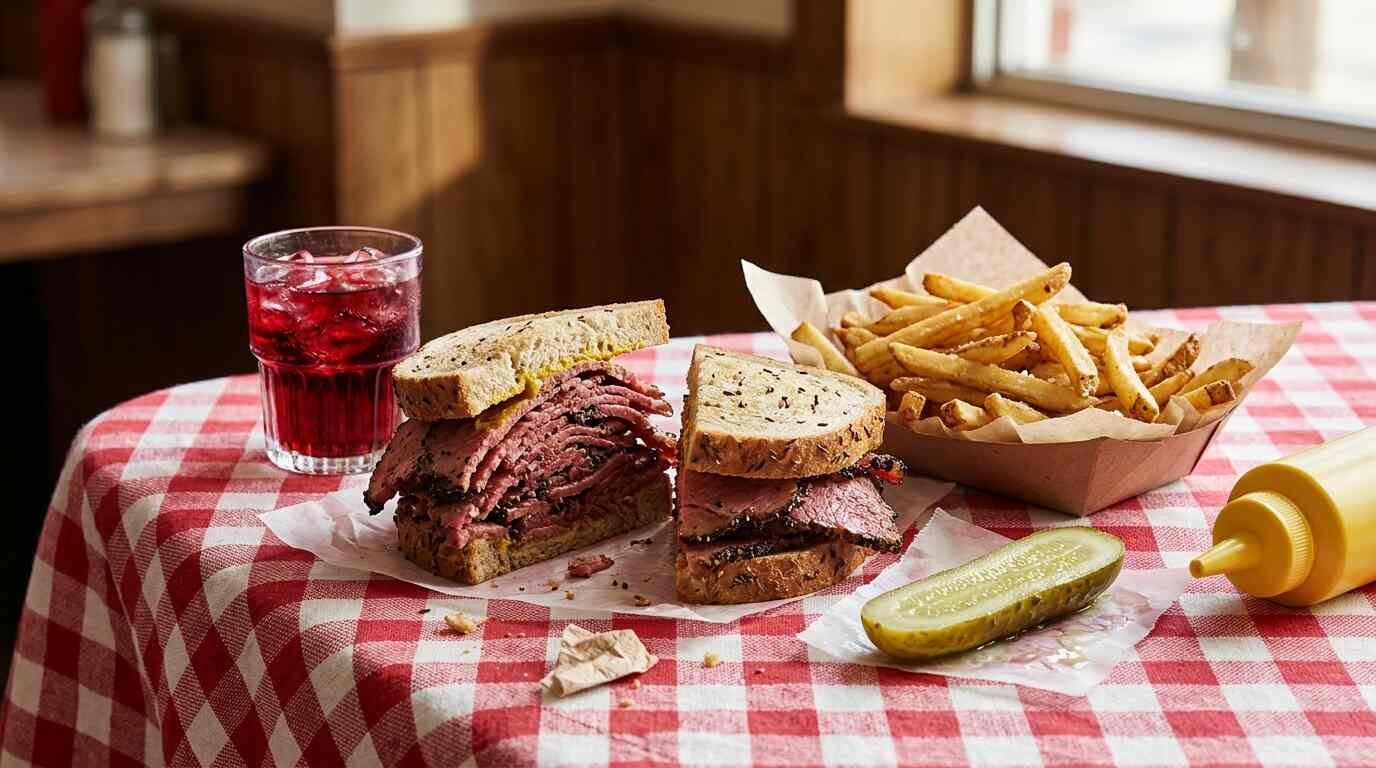
The difference between the Montreal and New York versions, according to the Forward’s film review, lies in the cure: dry spices and the meat’s own juices against injected, brined pastrami. The Tourisme Montréal guide adds the cut: whole brisket against navel. Michelin ends its description on the sandwich in its plainest form: thinly sliced meat on rye with mustard.
Sources
- Schwartz’s Deli official site: https://schwartzsdeli.com
- Tastet, “Schwartz’s: Montreal’s most famous deli”: https://tastet.ca/en/reviews/schwartzs
- Tablet, “The Origin Story of Smoked Meat on Rye”: https://www.tabletmag.com/scroll/154704/the-origin-story-of-smoked-meat-on-rye
- Tourisme Montréal, “Everything you should know about smoked meat”: https://mtl.org/en/experience/guide-to-montreal-smoked-meat
- Forward, “A Tasteful Film: The World of Schwartz’s”: https://forward.com/news/9985/a-tasteful-film-the-world-of-schwartz-s/?amp=1
- Forward, “How Celine Dion Helped Save Montreal’s Most Iconic Jewish Deli”: https://forward.com/news/breaking-news/358851/how-celine-dion-helped-save-montreal-s-most-iconic-jewish-deli/
- CBC, “Schwartz’s deli sold but stays on the Main”: https://amp.cbc.ca/news/canada/montreal/schwartz-s-deli-sold-but-stays-on-the-main-1.1272572
- Newswire, “It’s official: Schwartz’s Deli sold to Montreal business families”: https://newswire.ca/news-releases/its-official-schwartzs-deli-sold-to-montreal-business-families-509751091.html
- Michelin Guide, Schwartz’s Deli: https://guide.michelin.com/en/quebec/montreal_2433514/restaurant/schwartz-s-deli
- The Suburban, “Schwartz’s Deli joins other Montreal eateries in the Michelin Guide”: https://www.thesuburban.com/news/city_news/schwartzs-deli-enters-the-michelin-guide/article_80a9fad4-6673-464d-8e8a-7ab16774ad6d.html
- Montreal Review of Books, “Schwartz’s Hebrew Delicatessen: The Story”: https://mtlreviewofbooks.ca/reviews/schwartzs-hebrew-delicatessen-the-story/
- Canadian Digital Library Collection, “Schwartz’s Hebrew Delicatessen: The Story” (book description): https://canadiandigitallibrarycollection.ca/Books/S/Schwartz-s-Hebrew-Delicatessen2
- National Film Board of Canada, “The Concert Man”: https://nfb.ca/film/concert_man
- Wikipedia, “Schwartz’s” (used as a pointer for ownership dates and smoker type; it cites Brownstein’s book, David Sax’s Save the Deli and newspaper reports): https://en.wikipedia.org/wiki/Schwartz%27s
Keep reading
- Zingerman’s Delicatessen: The Ann Arbor Deli Behind the Numbered Sandwiches and the Reuben
- Pat’s King of Steaks and Geno’s Steaks: The South Philadelphia Cheesesteak Corner
- Primanti Bros.: The Strip District Sandwich With the Fries Inside
More in this section: Famous Sandwich Shops guide.