In this story
Challah is the braided, egg-glazed loaf of the Jewish Sabbath table, and in America it is also an everyday bakery bread. The word is far older than the bread. For most of its history it meant a small piece of dough, not a loaf at all, and the braid, the eggs and the sweetness each arrived separately.
Video: Six Strand Challah Bread, from the painlesscooking YouTube channel
A portion of dough
The word comes from the Torah. Libi Astaire, writing for Kosher.com in September 2017, points to Exodus (Shemos) 29:2, which mentions unleavened cakes of fine flour, and Numbers (Bamidbar) 15:20, which commands setting aside a challah from the first of the dough as an offering. She notes that the Torah never instructs anyone to eat challah on the Sabbath.
George E. Johnson of Moment Magazine, writing in March 2020, explains that in Numbers the word refers to a piece of dough about the size of a large olive, set aside during baking and given to the priests. Liz Susman Karp of The Nosher, writing in December 2020, adds that the weekly ritual, usually carried out by the women who baked, involved throwing a piece of dough into the fire.
Two loaves, not yet challah
The Sabbath bread itself has a separate origin. Astaire writes that the Talmud requires the blessing over bread to be said over two loaves on the Sabbath, recalling the double portion of manna, and that the text calls them kikarim, not challot.
What those loaves looked like varied. According to Astaire, Sephardic and Ashkenazic Jews alike used flatbreads for the Sabbath until the 1400s, and communities began using white flour to set the Sabbath loaf apart, though Persian Jews preferred whole wheat.
The braid, and where it came from
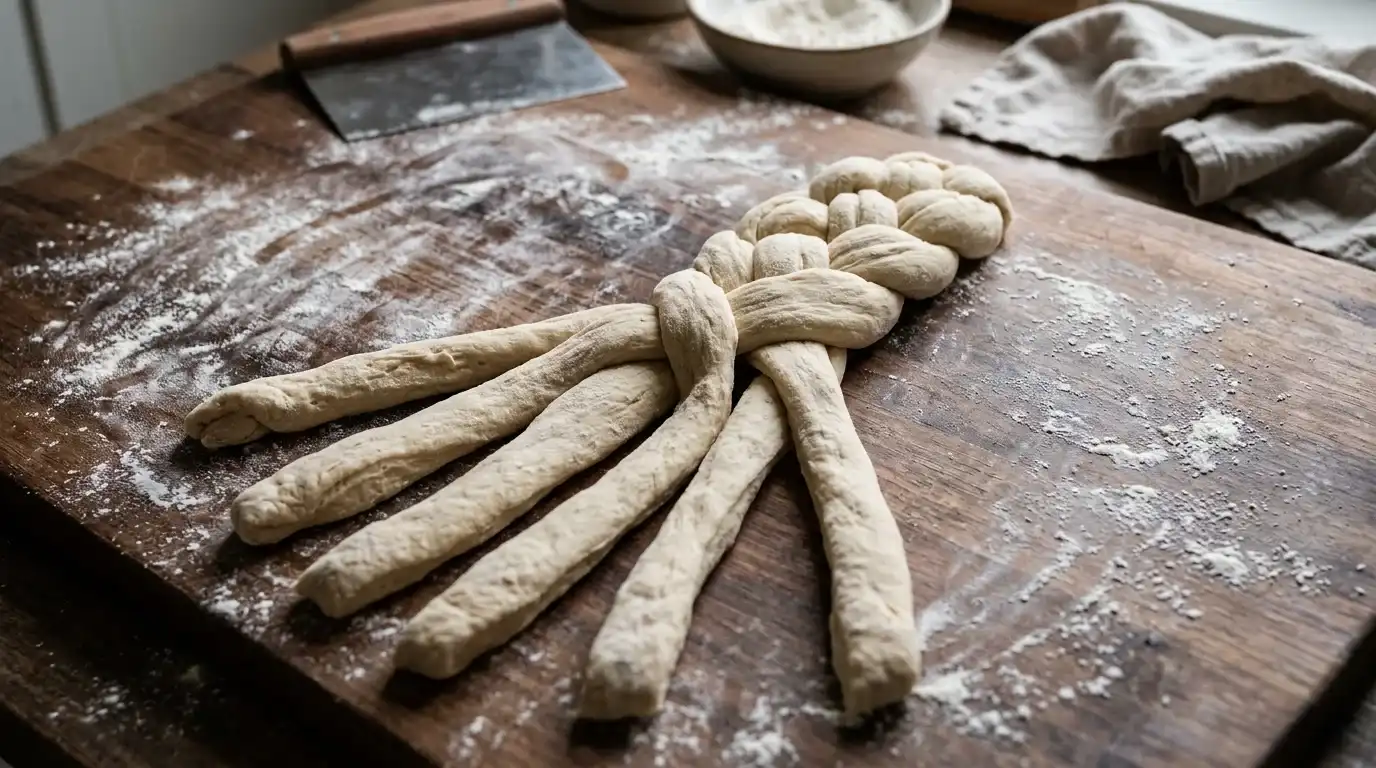
The braided loaf is German and Austrian, and late. Karp writes that braiding began in 15th-century Austria and southern Germany, following the practice of non-Jewish bakers. Johnson notes that while the word is more than 2,500 years old, its link to the braided Sabbath loaf is first documented in the 15th century, when Rabbi Joseph bar Moshe recorded that his teacher, Rabbi Israel Isserlein, welcomed the Sabbath with three challot made with eggs, oil and a little water.
Why braid it is a question with several answers. Johnson cites the late Gil Marks’s Encyclopedia of Jewish Food, which says German and Austrian Jews modeled their loaves on a local braided bread called berchisbrod or Holle, braided to resemble the matted hair of a Teutonic figure named Holle and thrown into a fire in a pre-Christian rite. Astaire offers a practical reason, that braiding may help bread stay fresh longer, and frames it as a possibility rather than a fact.
The name followed the same path, by some accounts. Astaire notes that the German word for braid, bercht, resembles the Hebrew brochos, blessings. Marks, as Johnson summarizes him, suggests the Holle bread’s name sounded like the biblical challah. Neither etymology is proved; both explain why a German bread name and a Hebrew word ended up attached to the same loaf.
Shapes and symbols
Once the braid arrived, it carried meaning. Astaire and Johnson both describe two six-strand loaves as recalling the twelve showbreads of the Temple. Johnson adds that eggs or saffron evoked the manna, that poppy or sesame seeds alluded to it too, and that Ashkenazi families developed distinctive shapes partly to tell their loaves apart in communal ovens.
Not every challah was rich. Astaire describes a German vasser challah, water challah, made without eggs or oil, with a strip of dough along its length. She also records that Sephardic authorities considered egg- and sugar-enriched dough too close to cake for the blessing over bread, so Sephardim kept their Sabbath loaves simpler. Johnson writes that Sephardi bakers typically left out eggs and sugar in favor of spices, honey, seeds and oil.
The regional names varied as much as the recipes. Astaire lists barches in Germany, barhesz in Hungary, kitke in Lithuania and Latvia, and khale in Eastern Europe.
How it got sweet
The sweet, yellow American challah is the newest part of the story, and the sources disagree on exactly why sugar went in.
Karp writes that the Eastern European berches that became American challah was not sweet, with eggs used only as a wash. In Poland, where sugar beets were grown, she says, sugar was added; in America, immigrants found cheap sugar, eggs and poppy seeds. She quotes the cookbook author Joan Nathan: “Everything got bigger and sweeter.” Astaire gives a religious reason instead: sugar was added in Eastern Europe once it became affordable, because manna pounded into cakes was said to taste like honey. Both may be true at once; neither source rules out the other.
Karp also credits commercial yeast for a sweeter, saltier loaf, and reports that after the Second World War most families bought challah from bakeries rather than baking it. Astaire notes that Israeli challah is generally less sweet than American.
Raisins have no settled story. Karp writes that there is no definitive answer, and that the food writer Leah Koenig suggests raisin challah may have grown out of cooks using leftover dough for babka.

Challah and other breads
Another enriched loaf, the French brioche, is covered separately on Grill Cheesy. The sources fetched here describe challah as a Sabbath and holiday bread rather than document its use in any particular sandwich. How quickly any loaf dries out is covered in why bread goes stale.
Questions people ask
What does challah mean? In the Torah, a portion of dough set aside as an offering. Later, the braided Sabbath loaf.
When did challah become braided? In 15th-century Austria and southern Germany, according to The Nosher and Moment Magazine.
Why is challah braided? Explanations include imitation of a German braided bread called Holle or berchisbrod (Gil Marks), keeping the bread fresh longer (Kosher.com), and symbolism of the Temple showbreads.
Why is American challah sweet? Cheap sugar and eggs in America, and earlier sugar in Poland, per The Nosher; Kosher.com links the sugar to manna said to taste like honey.
Is all challah made with eggs? No. German water challah had no eggs or oil, and Sephardic loaves were often simpler.
Sources
- Libi Astaire, Kosher.com, The Evolution of Challah (Sept. 18, 2017): https://www.kosher.com/article/the-evolution-of-challah-200/
- George E. Johnson, Moment Magazine, Jewish Word: Challah (Mar. 9, 2020): https://momentmag.com/jewish-word-challah/
- Liz Susman Karp, The Nosher, A Short History of Challah Bread, and How It Got So Sweet in America (Dec. 16, 2020): https://www.myjewishlearning.com/the-nosher/a-short-history-of-challah-bread-and-how-it-got-so-sweet-in-america/