In this story
A griddle changes three things about a grilled cheese sandwich: how many sandwiches fit, how evenly the surface holds its temperature, and how much the cook has to manage heat by hand. Published recipes disagree sharply on the numbers. Settings run from a low flame under a skillet to a 400°F electric dial, and cooking times per side run from one minute to ten. The basic grilled cheese sandwich is the same in every case, so the differences come down to the cooking surface, the fat, the weight and the heat.
Video: How to Make the Perfect Grilled Cheese on a Griddle | TINY CABIN CHRONICLES
What separates a griddle from a skillet
Lodge, the cast iron maker, defines the difference in its griddle guide as height of the sides. Griddles have low edges, skillets have higher sidewalls, and griddles generally offer a much larger cooking surface. The same page lists “toast paninis and grilled cheese sandwiches” among the things a griddle suits and credits cast iron with excellent heat retention.
Surface area is the practical gain. From Michigan to the Table, a recipe site, says a large griddle lets several sandwiches cook at once. The patty-based cousin of the dish, the patty melt, is also a plate-and-fat sandwich and has its own post.
A skillet is what the test kitchens use. America’s Test Kitchen builds its classic grilled cheese recipe around a heavy 12-inch skillet, and its cheddar-crusted version around a 12-inch nonstick one. Neither recipe uses a griddle, so test-kitchen timings from those pages describe a skillet and cannot be carried over to a flat-top without adjustment.
Surface temperature: what the sources specify
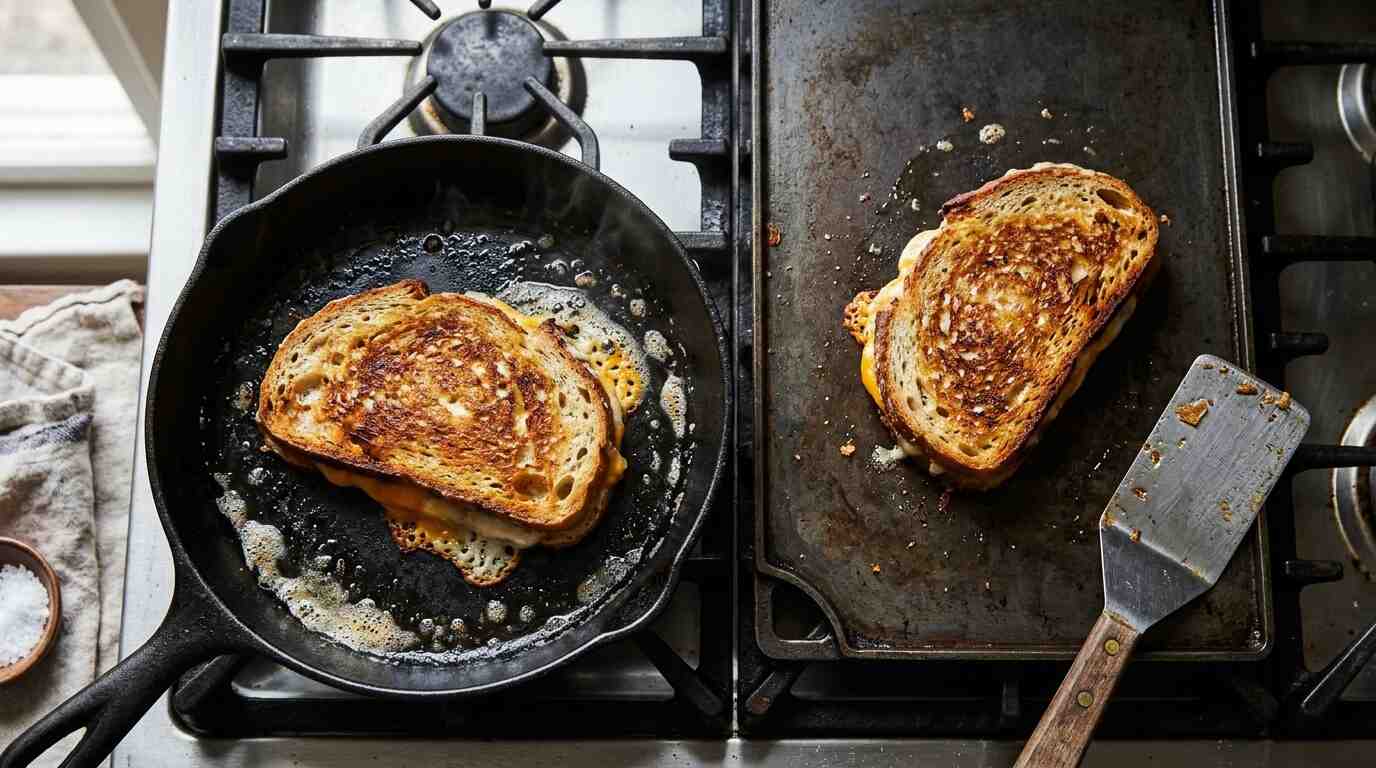
Very few pages give a surface temperature in degrees, and the ones that do are not describing the same equipment. Tasting Table’s piece on cooking temperature mistakes recommends medium heat on a stovetop skillet, dropping to medium-low after the flip, and 275°F on an electric griddle. A recipe for a Blackstone flat-top says to set an electric model’s dial to 400°F and cook one to three minutes a side. The same article says medium for a gas flat-top, with no degree figure.
A third figure comes from Baking Steel, which sells a steel griddle plate. Its recipe from The Chef Show preheats the steel over medium-high heat for 10 to 15 minutes to reach a surface temperature of 300 to 325°F. A pat of butter on the surface is the test: it “should begin to bubble assertively, but should not turn brown or black.” The first side then takes about two minutes. The company has a product to sell, which is worth remembering when reading its numbers, but the butter test is a usable check that does not require a thermometer.
Seen together, the figures span 275 to 400°F, and the gap shows mostly in time. America’s Test Kitchen’s low-to-medium-low skillet runs 5 to 10 minutes per side, while the 400°F electric griddle runs 1 to 3. Lower heat, according to America’s Test Kitchen, gives a more developed, crispy exterior.
Browning chemistry explains the lower bound. Science of Cooking states that Maillard reactions “generally only begin to occur above 285°F” and that a high-moisture environment inhibits them, since the reaction itself releases water. The 285°F line is a general threshold for the chemistry, not a sandwich-specific target, and none of the recipe pages above cites it.
Measuring beats guessing. ThermoWorks, in a foodservice article written about meat, recommends reading a griddle with a flat-probe surface thermometer to find hot and cold zones. The article does not mention sandwiches, and its 350 to 375°F range is for meat, but the method of mapping a plate before loading it applies to anything.
Butter, mayonnaise and the fat on the surface
Fat is where a griddle and a skillet part ways most visibly. America’s Test Kitchen puts butter on the bread rather than in the pan: “Evenly coating the bread (not the pan) with butter ensured an evenly golden product.” The point is control, because loose butter on a wide plate pools, scorches and leaves bare patches.
Burning is a function of milk solids. The Food Network’s guide to preventing burnt butter puts butter’s smoke point at about 350°F, names the milk solids as the part most prone to burning, and notes that butter spread thin across a pan exposes them to direct heat. It recommends an electric skillet or griddle for steadier temperatures and says clarified butter, which has no milk solids, can reach about 450°F. Blackstone’s 400°F electric dial setting sits above that 350°F figure, although a dial setting and the temperature of the cooking surface are not necessarily the same measurement.
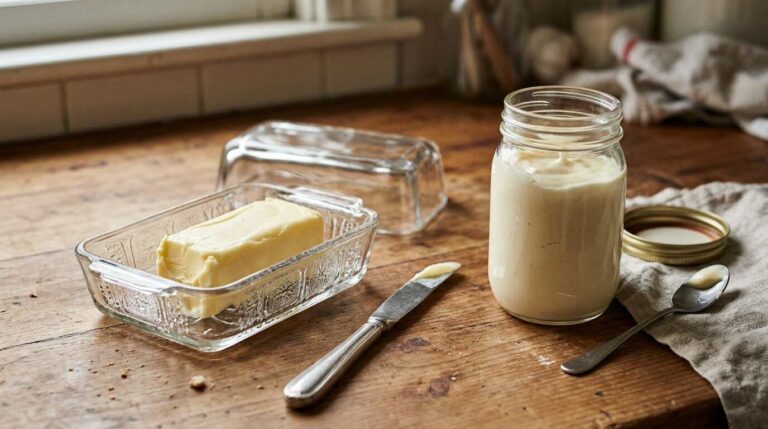
Tasting Table ran a side-by-side of butter and mayonnaise on shokupan milk bread with American cheese. The test used a nonstick skillet over medium-low heat, not a griddle. The butter sandwich browned unevenly on the first side, needed a second flip and some pressing, and smoked at about the two-minute mark. The mayonnaise sandwich browned its edges faster than its middle until a light press evened it, and the pan never smoked. Mayo won on even browning, while tasters preferred the nutty, caramelized flavor of the butter. The article puts butter’s smoke point at 302 to 350°F and mayonnaise’s near 450°F, citing a third-party site for the second figure.
America’s Test Kitchen’s cheddar-crust recipe uses a small amount of mayonnaise, 2 teaspoons spread on one side of each slice, plus butter in the pan. Chargriller’s three-sandwich griddle recipe uses mayonnaise alone. The Tasting Table test is the only source consulted that compares the two fats side by side.
Pressing and weight
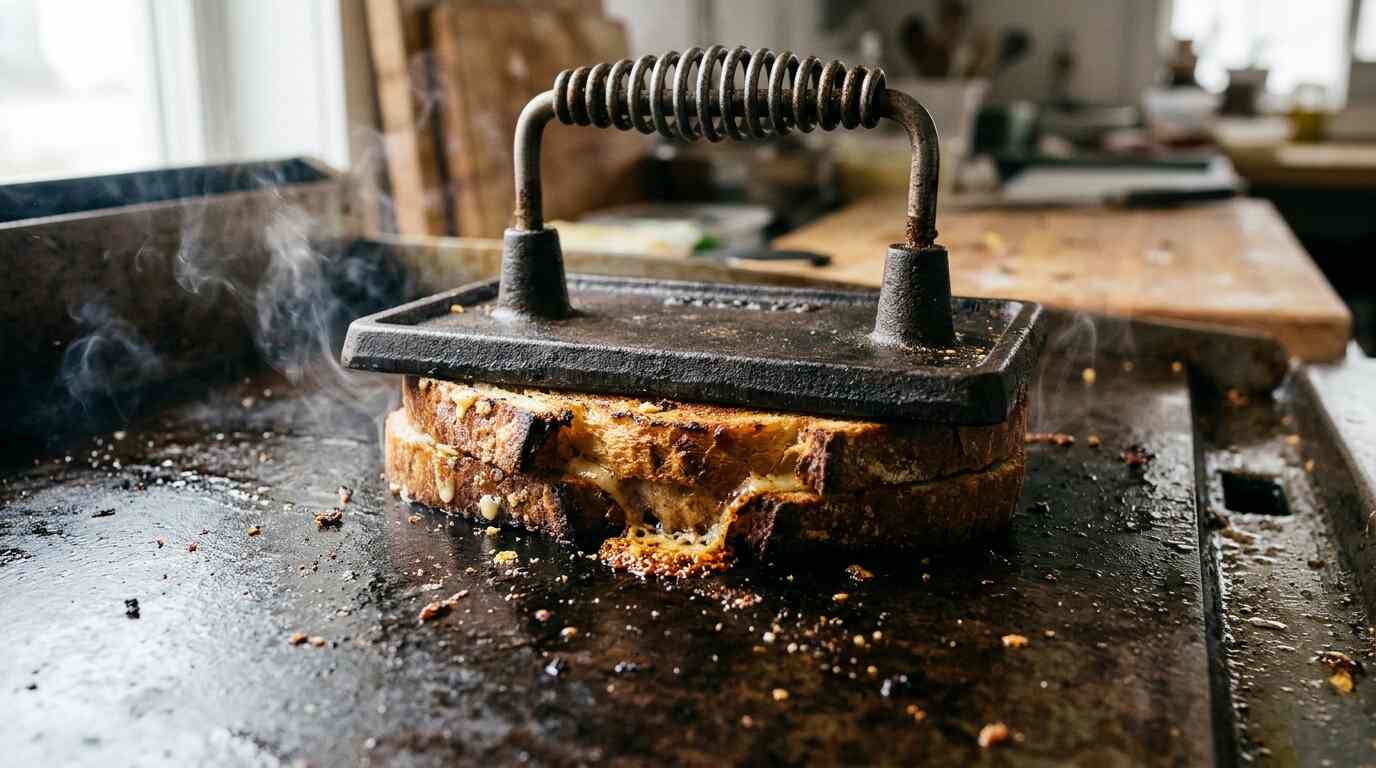
Pressure is the most argued variable. Chowhound’s piece on adding a little pressure says pressing with a metal spatula or burger press removes air from the bread and pushes it against the pan so it crisps evenly, and that the pressing should be repeated on the second side. It cautions against pressing too hard, since the sandwich can be squashed. A hand-held tool, the article says, lets the cook adjust, which it presents as a reason to avoid something as heavy as a cast iron pan.
Nancy Silverton’s method, as reported by Tasting Table, goes the other direction. She cooks on a preheated cast-iron griddle or pan, brushes the bread with ghee, and presses the closed sandwich with “a spatula or grill weight” for two to three minutes. She flips, then finishes the second side without the weight. Her stated reason is even toasting.
The two positions are not as far apart as they look. Both apply pressure while the first side browns and both keep the load removable. Other recipes skip weight entirely. The Baking Steel recipe does not mention pressing, and America’s Test Kitchen’s classic recipe asks only that the assembled sandwich be pressed down gently to set before it goes in the pan.
Heat zones, lids and cold starts
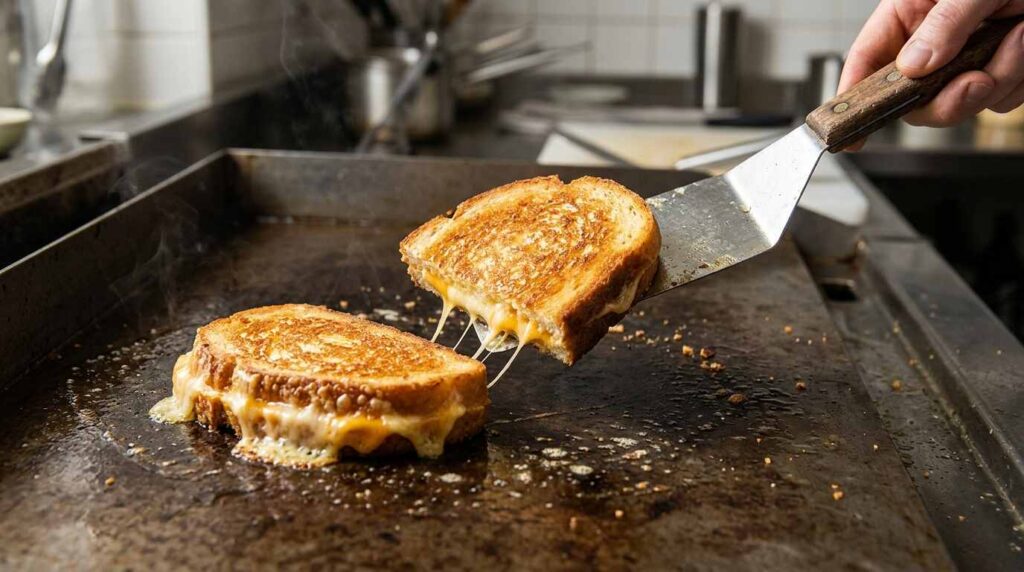
A flat-top allows something a skillet cannot: a gradient. Blackstone’s explanation of temperature zones describes hot and cool areas on one plate, with bacon started on the hot side and buns toasted on the low side. It does not mention grilled cheese, but the technique is the one Chargriller applies to it. Its recipe leaves the left burner off, sets the middle to half, and keeps the right side on high. Sandwiches go down on the hot side, are flipped constantly for even toasting, and move to the middle zone when browning needs to slow.
Lids split the sources. Tasting Table’s pan-type article says a cover keeps heat in place and melts the cheese faster, and the Blackstone recipe above recommends a dome lid. The same site’s heat-mistake article says to skip the lid because trapped moisture makes the sandwich soggy. Silverton’s approach threads the gap by steaming the open-faced halves under a metal bowl first, then pressing the closed sandwich uncovered.
At the other extreme is the cold start. The Takeout reports a method credited to Simply Recipes: butter-side-down bread goes into a cold pan, the heat is turned to medium, and the first side cooks 5 to 7 minutes. The author notes the drawback, which is that the pan is already hot for the second side, so the cheese can overmelt.
How a commercial flat-top is built
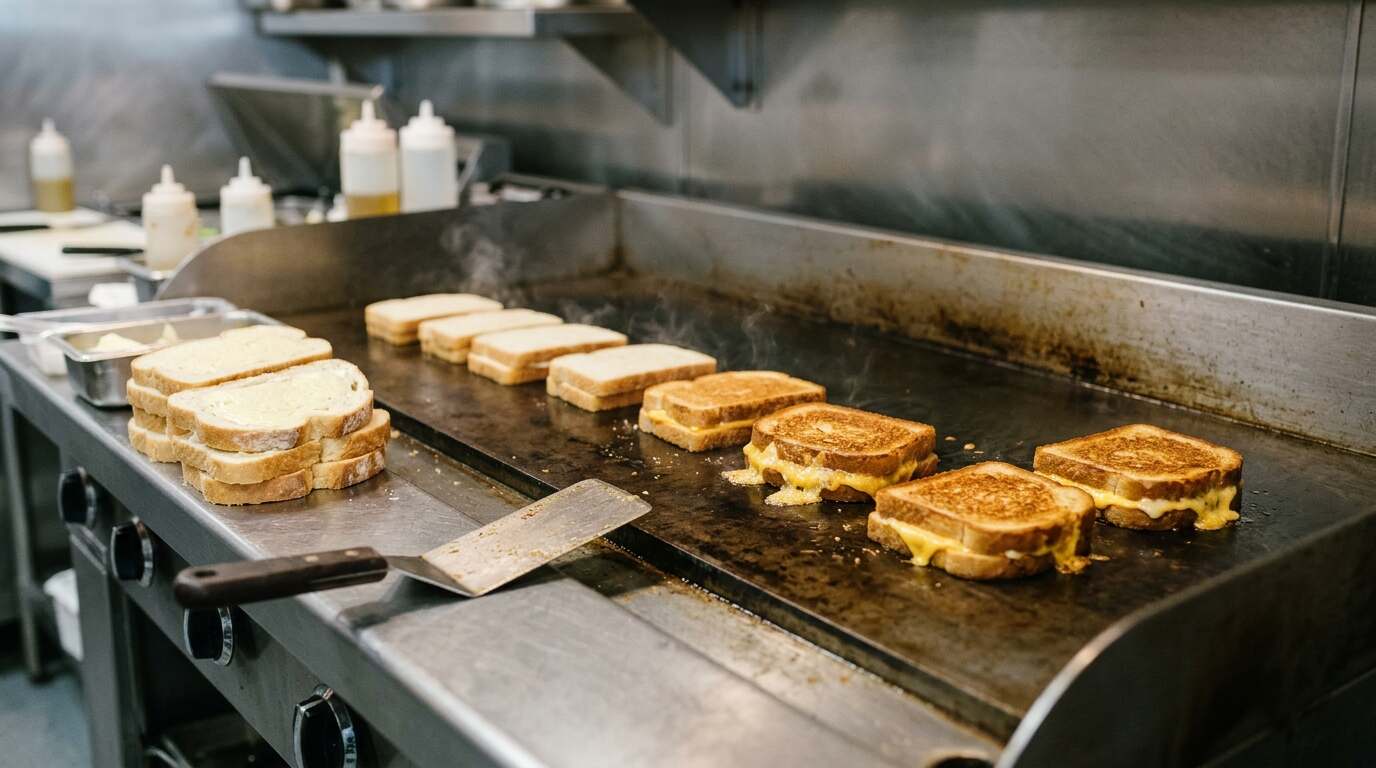
A restaurant plate differs from a home griddle in thickness, power and control. The Restaurant Warehouse’s flat-top guide lists polished steel plates of three-quarters of an inch on its manual models and one inch on its thermostatic ones. A thicker plate, it says, “stores more heat and can reduce the initial temperature drop when cold food is loaded.” Models come with two to five independent heat zones depending on width, and the guide cautions that a dial setting does not guarantee the same temperature at every point on the plate. It describes a lunch station that favors burgers, cheesesteaks and toasted sandwiches.
KaTom’s griddle buying guide adds controls. Thermostatic models let the operator set a temperature, usually between 150 and 450°F, and the guide grades accuracy by duty: within 30 to 40°F for economy modulating thermostats, 15°F for snap-action, and 5°F for solid-state. Thicker plates, it says, heat more evenly and stay hotter after cold food is added. Grilled cheese appears in its list of customer favorites that griddles prepare well, with no sandwich-specific numbers.
Baking Steel describes the diner result it is trying to reproduce at home: heat that, in its words, “permeates the sandwich inside and out”, browning the bread while keeping the cheese gooey. The phrase comes from a retailer’s marketing copy and describes the outcome, not a measured process. No fetched source gives a standard commercial surface temperature for grilled cheese, so any single number quoted for diner practice should be treated as unsupported.
Sources:
- Lodge Cast Iron, “Griddles 101”: https://lodgecastiron.com/griddles-101
- America’s Test Kitchen, “Classic Grilled Cheese Sandwiches for Two”: https://www.americastestkitchen.com/recipes/3782-classic-grilled-cheese-sandwiches-for-two
- America’s Test Kitchen, “Cheddar-Crusted Grilled Cheese”: https://www.americastestkitchen.com/recipes/14149-cheddar-crusted-grilled-cheese
- From Michigan to the Table, “Blackstone Grilled Cheese”: https://frommichigantothetable.com/blackstone-grilled-cheese/
- Tasting Table, “The Heat Mistake You Might Be Making When Cooking A Grilled Cheese”: https://tastingtable.com/1439075/heat-mistake-cooking-grilled-cheese
- Baking Steel, “The Grilled Cheese From The Chef Show”: https://bakingsteel.com/blogs/recipes/the-grilled-cheese-from-the-chef-show
- Science of Cooking, “What is the Maillard Reaction?”: https://scienceofcooking.com/maillard_reaction.htm
- ThermoWorks, “Find Your Perfect Griddle Temperature”: https://www.thermoworks.com/foodservice101-griddle-temperature-pro-surface-thermapen/
- Food Network, “How to Prevent Butter from Burning”: https://www.foodnetwork.com/how-to/packages/food-network-essentials/how-to-prevent-butter-from-burning
- Tasting Table, “Butter Vs. Mayo”: https://tastingtable.com/1161681/butter-vs-mayo-we-resolve-the-debate-over-which-makes-a-better-grilled-cheese
- Chargriller, “Grilled Cheese Recipe on the 3-Burner Flat Iron Gas Griddle”: https://www.chargriller.com/blogs/recipes/grilled-cheese-trio
- Chowhound, “How A Little Pressure Creates The Ultimate Crispy Grilled Cheese”: https://www.chowhound.com/1916256/for-crispy-grilled-cheese-add-a-little-pressure
- Tasting Table, “The Nancy Silverton Rule”: https://www.tastingtable.com/2251907/grilled-cheese-rule-nancy-silverton/
- Blackstone Products, “How to Cook with Different Temperature Zones”: https://blackstoneproducts.com/blogs/griddling-101/how-to-cook-with-different-temperature-zones-on-a-blackstone-griddle
- Tasting Table, “This Type Of Pan Will Help You Make The Best Grilled Cheese”: https://tastingtable.com/982028/this-type-of-pan-will-help-you-make-the-best-grilled-cheese
- The Takeout, “The Temperature Of Your Pan Is The Key To Gooey Grilled Cheese”: https://www.thetakeout.com/1604698/melty-grilled-cheese-cold-pan/
- The Restaurant Warehouse, “Flat Top Restaurant Grill Guide”: https://therestaurantwarehouse.com/blogs/restaurant-equipment/flat-top-restaurant-grill-guide
- KaTom, “Choosing the Right Commercial Griddle”: https://www.katom.com/cat/commercial-grill-griddle/griddles-buyers-guide.html
- TINY CABIN CHRONICLES (YouTube), “How to Make the Perfect Grilled Cheese on a Griddle”: https://www.youtube.com/watch?v=uEuKU2V9ma0